
A Conversation With Kelley Armstrong
by Claire E. White
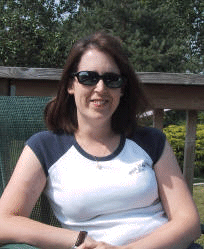
Kelley Armstrong is a rising star in the publishing world. The Canadian author of the
|
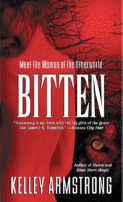
Bitten was inspired by an X-Files episode. A member of a writing group, Kelley needed an idea for a story she was supposed to bring to the group's next meeting. Dissatisfied with the ideas she was coming up with, she took a break to watch an episode of X-Files. It happened to be an episode about werewolves. Although she's a big X-Files fan, she didn't like the idea that werewolves were just bloodthirsty, ravening beasts. With that spark of inspiration, she sat down and wrote a short story about a human woman who becomes a werewolf. That story featured Elena Michaels; it eventually was sold in novel form as Bitten. The book was an immediate hit with reviewers and fans, and the Women of the Otherworld series was born.
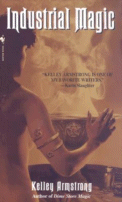
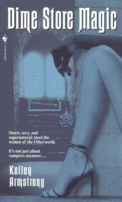
Wary of being typecast as a werewolf author, Kelley introduced many other supernatural species in the next book, Stolen. The next two books in the series, Dime Store Magic and Industrial Magic, focus on fledgling witch Paige Winterbourne and her half-demon attorney boyfriend, Lucas Cortez, who is the reluctant heir to the Cortez Cabal, one of the most powerful demon business organizations. Industrial Magic has Paige and Lucas working as private detectives to track down a serial killer who is preying on children.
Kelley's work has been compared to that of Laurell K. Hamilton, although her work is closer to Joss Whedon's in tone and in her sense of humor. She uses the fantastic and her innate sense of the absurd to shine a light on some very human institutions. The demon Cabals, for example, work much like the Mafia -- but they also offer Canadian-style health coverage for their employees and families. American readers, at least, will see the humor in the fact that the demons offer better health care coverage than what is offered by most American corporations. Of course, being "terminated" from an American corporation usually means the loss of a job -- not of one's life, as is the case in the Cabals (perhaps there is a high cost to the Cabal's fabulous health care plan, after all?)
Kelley grew up in Canada. She describes her background as "very middle-class, very WASP." As a child, she adored reading both fantasy and horror stories, which encouraged her imagination and love for the fantastic. When she got to high school, she developed another love: computers. She graduated from university with a degree in psychology. She then decided to study computer programming, and took a job in that field so she could continue to write fiction in the evenings and on weekends.
The growing popularity of her books has led to "contract season" for Kelley. She is under contract from her American, Canadian and British publishers for up to nine books in the Women of the Otherworld series, which is good news for her growing fan base. Kelley spends quite a bit of time creating content for her fans on her excellent author website. The website offers free e-novellas set in the Otherworld, an online discussion forum, soundtracks for each book, an online book club and downloadable bookmarks and screensavers.
Married with three children, Kelley lives in rural Ontario, Canada. Currently, she's a full-time writer and parent. Kelley spoke with us about her move from computer programmer to bestselling author and how she created the Women of the Otherworld series. She also shares her secrets for juggling her parenting duties with the demands of her burgeoning writing career.
What did you like to read when you were growing up? Who were your favorite authors?
|
What was the first fiction you ever wrote? What reaction did you receive?
I honestly don't remember the first fiction I ever wrote. I've been writing it since I was old enough to write. I do know that in public school I was often praised for my writing, which encouraged me to continue.
How did you get interested in computers? I understand you switched majors in college?
When I was in high school, computers were my favorite subject. I had a guidance counselor, though, who's suggested that my problem solving skills might be more suited for something like counseling -- probably because that seemed like a more "feminine" career choice. So I went to university for psychology. I did enjoy it, and planned to go through grad school, but as I was applying, I realized I was heading into the sort of career that wouldn't leave much time for writing. There was a tough decision to make, but I decided to go back to community college for computer programming, so I could get a regular 9-5 job that would leave time for writing.
Please tell us about your road to publication. What led up to the publication of your first book, Bitten? What was it that made you decide to finally sit down and write the novel?
| "When my 'writing days' come, I can't decide that the Muse isn't with me, and go do something else. Jack London is quoted as saying 'You can't wait for inspiration. You have to go after it with a club.' And that's what I have to do." |
In Dime Store Magic, we move away from the world of Elena Michaels and the werewolves to Boston, Massachusetts and Paige Winterbourne, an apprentice witch who is having quite a bit of trouble with her coven. Paige is a very interesting young woman. She has hidden talents, lots of challenges -- and had a complex relationship with her mother. What was the greatest challenge in creating Paige? Were there any characteristics that you particularly wanted to avoid with her?
The greatest challenge in creating Paige was to make her very different from my first protagonist, Elena Michaels. I was adamant about wanting to switch narrators after the second book, but that didn't keep me from worrying that I was making a mistake. The last thing I wanted was to create someone who was just a witch version of my first narrator. So I took some of Elena's most notable characteristics, and gave Paige pretty much the opposite, making her, among other things, a more confident, but far less physically powerful character.
Paige has an intriguing love interest, Lucas Cortez, the rebel son of the head of the largest Cabal. Lucas has shunned the Cabals and his father's power, working for good in the world. But sometimes the things he does and says are a bit ambiguous. How did you create Lucas? What is the greatest challenge in writing this character -- and his relationship with Paige?
With Lucas, I also wanted to avoid repeating my first male love interest. Like Paige, I wanted to make him strong, but in a way that was different than the werewolves. I'm fascinated by the "Michael Corleone" syndrome -- the idea of growing up in the Mafia style family, but rejecting their values. With Lucas, I wanted to take this one step farther, that he not only rejects their values, but actively works against them. Then I complicated it by giving him a more complex, and more affectionate relationship with his father than one would expect in this situation. That gives me lots of opportunities for conflict, for now and for future books.
I'd like to talk about your latest book, Industrial Magic. In Industrial Magic, we learn quite a bit more about the Cabals. What was your inspiration for the Cabals? (They kind of remind me of the Mafia, but with demons. But there's also a feudalistic air to them -- they provide a full social safety net, with great health benefits.)
|
I'd like to talk about the creative process for you. Would you take us through a typical writing day for you?
I'm afraid my writing process isn't very creative! It's far more rigid than I would like right now. I have three children (ages 4, 5, and 12) and having the two little ones means I need to set aside specific time for writing, and to write when I have that time. When my "writing days" come, I can't decide that the Muse isn't with me, and go do something else. Jack London is quoted as saying "You can't wait for inspiration. You have to go after it with a club." And that's what I have to do. I do most of my writing in my office, which is in the farthest corner of my basement. I don't work well with distractions of any kind, including music, so my room is very quiet and pretty stark.
Would you say that you are more of a visual or an auditory writer? Do you see scenes and characters in your head when you write, or do you tend more to "hear" the characters' voices when you write them?
I would consider myself more of a visual writer. I tend to see the scenes unfolding before me, like a movie. I do hear the characters speak, but usually as part of a visual scene.
Dime Store Magic and Industrial Magic are written in first person, from Paige's point of view. Paige has a very distinctive -- and funny -- voice, which is very different from Eve's voice, for example. What are your thoughts on narrative voice?
|
When you begin a new book, do you outline the plot first? Or is it a more organic process of creation?
Writing used to be very organic for me. Then I started getting deadlines! When I have deadlines to meet, I really can't just let the story wander where it will, and rein it in when necessary. I need to have a better idea of where I'm going and how I plan to get there. What works best for me is a very basic outline of plot points (this happens, and then this happens, and so on). I don't "marry" my outline, though. If a better idea comes along as I'm writing, or if I realize that the story is going in a different direction, then if I decide that I prefer the new direction, I go with it. My final product always resembles my outline, but never follows it exactly.
How do you approach editing and re-writes? Do you let anyone else read your work in progress before it goes to your editor?
I used to do a lot of editing as I wrote. Now, though, I try to get the first draft completely done before I edit anything. Otherwise, I find I can get caught in a vicious cycle of writing and editing. As I'm working, if I decide to change something I've already written, or change directions slightly, I just make a note of what needs to be fixed earlier in the manuscript and keep going. As for who sees my work before my editor, I have writing friends and writing group members who will see parts of it, and my agent reads the whole thing before I send it out.
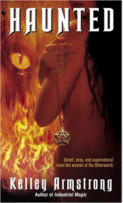
Can you give us a sneak peek into the next book, Haunted? I understand we'll get to hear Eve Levine's story? Eve is such a multi-faceted character.
| "The best advice I can give is to write what you love. Write the story that you want to tell, no matter what others say about its 'marketability.' That's the story that will showcase your passion for writing, not the one that everyone says is a sure-fire seller, but you have to force yourself to write it." |
I understand you have another book in the works: a mainstream thriller? How did that come about?
After Bitten was published, I'd finished Stolen and moved on to Dime Store Magic. Then the release date for Stolen was pushed back, and pushed back, and pushed back, and not only did I start getting very nervous, but I'd finished Dime Store Magic. I began to fear that the Otherworld was going to tank, so I started a mainstream thriller. Got halfway through it, and the Otherworld kicked into gear, so I put the thriller aside to start Industrial Magic. Then last fall my agent asked if she could send out that half-finished book, she did, and it sold.
So, it's not old work. It was backup "In-case-this-supernatural-stuff-doesn't-fly" work. And I'm thrilled to have the chance to return to it, and back a character I had a lot of fun working with, and had feared I'd have to abandon forever...well, unless I turned her into a vampire or something.
How will this series affect the Otherworld series?
It won't. Plain and simple. When a writer in a sub-genre launches a more mainstream series, it's often considered a step "up," as if the sub-genre series was just a stepping stone to the bigger market of mainstream thrillers, and will be abandoned if/when she sees success in the mainstream world. That's not the case here. The Otherworld is my first love and it comes first. Consider this second series a "bonus," not a replacement. Honestly, I'm more interested in snagging new readers from the mainstream series to the Otherworld than vice-versa.
When will this new series launch?
The first, Exit Strategy, is done (first draft, at least). The original thought was to bring it out in late 2005, before book 6, but one thing I'm very clear on is that this new series won't interfere with the Otherworld series publication schedule. I know people are waiting for the next Elena Michaels book, so we've bumped Exit Strategy to come out between book 6 and 7. In 2004, I had two Otherworld books published, but that was a fluke -- the result of a backup after Stolen's release was delayed. I write on a 9 month schedule with the Otherworld, and (barring changes at the publisher's end) I will continue to do do at least until book 9.
What is this new series about?
This is the question I least feel comfortable answering. The first book is a year from publication, and I might change my mind (and the plot) a hundred times between now and then. According to my publishers, the series is about "an ex-cop turned ethical hitwoman." I'm not sure you can be an "ethical" hired killer, but sure, let's go with that...for now.
On your website, you have some great free content: e-novellas set in the same world as Bitten. What prompted you to make this material available for free to your fans?
I started the novellas as a way to offer free back-story to readers who'd expressed an interest in it. When I started, I had free time, and that seemed like a good way to spend it and to hone my writing more, and readers seemed to appreciate it.
What is your opinion of writer's groups? Do you find them helpful? And how did you find yours?
I've been in many writing groups. I think the right one can be invaluable. Not only can you get good critiquing of your work, but it offers a level of support you really can't get with non-writer friends. If a writer is really interested in refining his/her craft though, he/she has to find one working on roughly the same level, and one that is serious about writing...I've been in many that were more social outings than "working" groups.
How has motherhood affected you as a writer? How do you juggle the demands of writing and taking care of three children?
|
What are some of your pet peeves in life?
One particular "quirk" peeve of mine is misspelled store signs. I feel so bad for anyone who pays to get a sign done, and it's misspelled -- any signmaker who doesn't know that "books" isn't spelled "book's" needs a new line of work!
What is your advice to aspiring writers? What tips or techniques do you use to keep yourself motivated when life throws you a curveball or two?
The best advice I can give is to write what you love. Write the story that you want to tell, no matter what others say about its "marketability." That's the story that will showcase your passion for writing, not the one that everyone says is a sure-fire seller, but you have to force yourself to write it. Motivation isn't a problem for me now -- this is my full-time job so if I don't write, I don't get paid! Before that, I found that lack of motivation was more a lack of confidence in my work. To overcome that, I never forced myself to market anything I wrote -- I did it for me, and if it was good enough to send out, great...but that wasn't the point of writing.
Return to the February 2005 issue of The IWJ.
More from Writers Write