
A Conversation With Kevin J. Anderson
by Claire E. White
Ever since he was a little boy growing up in the tiny town of Oregon, Wisconsin,

|
After college, where he studied physics and astronomy, Kevin worked in California for twelve years as a technical writer and editor at the Lawrence Livermore National Laboratory, one of the nation's largest research facilities. Although he had a full-time job, he wrote nights and weekends, publishing his first novel at the age of 25. After he had published ten of his own science fiction novels to wide critical acclaim and many award nominations, he came to the attention of Lucasfilm, and was offered the chance at writing Star Wars novels. His Star Wars Jedi Academy trilogy became the three top-selling science fiction novels of 1994. He has also completed numerous other projects for Lucasfilm, including the 14-volumes in the New York Times bestselling Young Jedi Knights series (co-written with his wife Rebecca Moesta). He currently has over eleven million of his books in print.
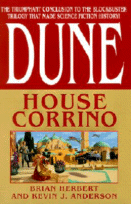
Kevin recently signed the largest science fiction contract in publishing history, to write the prequels to Frank Herbert's SF epic Dune. Each book sold for seven figures. The three immediate prequels to Dune were House Atreides, House Harkonnen and House Corrino. Now, he and co-author Brian Herbert, son of Frank Herbert, are writing three more prequels, which take place earlier in time than the "House" series: The Butlerian Jihad (Tor), The Machine Crusades (Tor) and The Battle of Corrin (Tor). After The Battle of Corrin is published in 2004, Kevin and Brian will work on the sequels to the original six Dune novels, which ended on a cliffhanger due to the death of Frank Herbert.
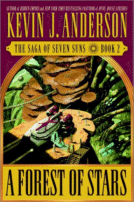
Kevin's most recent solo project is an epic SF series, The Saga of the Seven Suns, published by Warner Books. The first two books in the series are Hidden Empire and A Forest of Stars. The third book in the series, Horizon Storms, is due out in hardcover in 2004. The books are set in Earth's future, when humans have moved out into the stars, with the help of the ancient alien race, the Ildirans, only to find out that the universe is more dangerous than they ever imagined. The series is receiving rave reviews, and is likely to land on future lists of SF classics. Publisher's Weekly says of A Forest of Stars: "He weaves action, romance and science with a rousing plot reflecting the classic SF of Clarke and Herbert and the glossy cinematic influence of Lucas and Spielberg…..Sparked with surprises, enriched by ecological issues that laypersons can appreciate, this saga soars as it exposes the inner and external roots of war."
Unlike some epic SF or fantasy books, which tend to drag on for chapters before anything interesting happens, his books will hook you by the first page. It is this ability to create an instant connection between the reader and his characters which may explain his immense popularity with his loyal fans.
He is known for his ability to create complex and interesting characters, fast-moving plots and his subtle sense of humor. He works at a pace that most writers would consider daunting: he is incredibly prolific. Most people think of writing as a sedentary activity, but not Kevin Anderson. He hikes through the Colorado Rocky Mountains as he dictates his current book into a hand-held tape recorder.
A world traveler, gourmet cook and avid hiker, Kevin lives in Colorado with his family. Kevin spoke to us about the Saga of the Seven Suns, his road to becoming a bestselling author and why he never even considered quitting, even when the rejection slips were piling up. He also talks about his deep love for Frank Herbert's SF classic, Dune, and why he and Brian Herbert feel that Frank Herbert is watching over them beneficently, as they continue his legacy.
What did you like to read when you were a little boy?
When I was a little boy, I was utterly enamored with
| "Greg Benford....and I wrote a short story together and a pretty substantial outline for a novel together that we hope to do someday. Greg is a big Ph.D./physics/astronomy guy and I knew I wanted to basically turn a gas giant planet into a small sun to warm up the small moons around it, so people could terraform it. So we sat around on a hotel balcony with a bottle of wine and tried to figure out how you would go about blowing up a planet. That's the kind of conversations science fiction writers have when they get together. We don't talk about football or anything like that." |
Maybe he knows somehow.
Actually, it's weird. We think that maybe somehow he does know, with all of these strange coincidences that keep happening to us. We're very thrilled with it. Brian and I feel that this is the thing that we were born to do. And since I was always such a fan of Dune, it's amazing. If I could go back in time and tell my younger self that eventually that I'd become very successful writing Dune books after Frank Herbert's death, I would have laughed myself silly, I think, at how strange that prospect would be.
What else would you go back and tell your 16 year-old self?
Oddly enough, I wouldn't go back and give myself encouragement, because that wasn't necessary. I never, not for a nanosecond, doubted that I was going to become a writer. I always knew that I wanted to be a writer. I always knew that everything else I was doing in my life was leading up to it: every job that I had I was learning something that I would later apply to my writing. I went to college and took some creative writing classes, but my main focus was taking classes in physics, astronomy, history and sociology because I felt that was the stuff that I needed to know before I wrote books. I already had the mechanics, but I didn't have the ingredients. So, I wouldn't need to go back in time and tell myself "Keep at it, you'll eventually be successful," or anything like that, but I think that is something I would love to do and say to myself, "You know what, Kevin? You're going to be writing Star Wars someday and you're going to write more Dune books using Frank Herbert's own notes.
You probably wouldn't believe yourself.
I wouldn't believe it, because I'm not just a successful writer in the science fiction genre, I'm am just the geekiest fan boy in my heart. To think that I can pick up the phone and call Harlan Ellison or that I get letters from Arthur C. Clarke is just about as cool as it gets.
What did your parents think when you got so interested in writing?
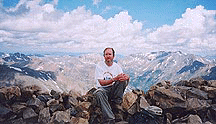 Kevin at the top of Mount Elbert, the highest summit in the Colorado Rockies, 14,433'. |
Did you work on any classified projects there?
Oh, lots of them. I could you tell you about them, but I'd have to shoot you afterwards. No, the great secret behind classified projects is that most of them are so utterly boring and uninteresting that James Bond wouldn't even take a second look at them.
Seriously?
Yes, the thing that makes something classified in a document is a number after a decimal point on a table on page 43 of a 300 pages document because it has something to do with a nuclear cross-section or something like that. There aren't folders full of stuff like secret stealth airplanes that are being built in Area 51 or something like that. In fact, I don't think I've ever worked on anything that was interesting and classified. But because of my background in physics and astronomy, and because I had a minor in Russian history (and this was at the time when the big Cold War was going on) and because I had a lot of freelance writing credits, I walked right into this job as a technical writer for a big research laboratory. I loved doing it. If you have to have a day job, this was a great one. I had an ID badge and a security clearance to go through the gate to go into a huge laboratory with the largest lasers in the world, the world's first supercomputer banks, energy research, and genetics research. It's like a huge toy store for somebody who's interested in science fiction. So I got to spend all of my time everyday at work reading and editing papers about cutting-edge technical research and getting paid for it. Then I'd go home at night and turn what I learned into science fiction stories.
| "This is our typically American-centric idea.... sure President Bush can say that the U. S. government won't fund stem cell research, but believe me, Japan is applauding. Because they will just do it first and get all the patents. Does he think that by him saying that because the U.S. (who theoretically has the most ethical researchers in the world) will not fund it, that no one else will do it? Are you going to let Saddam Hussein's old chemists work on it instead? Do you think that everybody in the world is going to stop stem cell research? That's just dumb thinking." |
I did some stuff for the X-Files that are directly lifted from my daily work at Lawrence Livermore. I wrote a book with my frequent co-author, Doug Beason, called Virtual Destruction, which is a murder mystery set in the Lawrence Livermore National Laboratory. We thought having a crime investigator working inside this environment where people are classifying things and cleaning up things so that the investigator can't see classified material made for an interesting murder mystery. I've used that experience for quite a bit of good effect in five or six books.
Did you come home from your day job and write every night and every weekend?
Yes. Every spare second I would write, somehow. On my lunch hour, too. That's where I met my wife. She was my copyeditor at Lawrence Livermore. She wanted to be writer, too, but found that after editing and writing all day long, she came home so exhausted she just wanted to watch TV or veg out. But for me, I was writing all day long, but I kind of felt like it was practice and I got to do the real stuff when I got home. I was much more interested in writing a short story for Analog or anther magazine than writing this lengthy technical report for the International Society of Respiratory Protection. (laughing)
Well, that's not surprising!
But I always had this non-stop drive. I had to keep sending stories out and every once in awhile I'd get something accepted or get the little trickle of positive feedback like "That's something we could publish if you would try harder." Once I finally sold my first book, at the age of 25 -- this was after hundreds and hundreds of rejection letters -- once I got my foot in the door, it's like they grabbed my foot and dragged the rest of my leg in. Because I rapidly got a three-book contract after that, and consistently have sold book after book after book since then. I think now I'm up to something like 85 different titles that I've published.
So I understand that you also won the coveted Writer With No Future award?
Yes, that was when I was going to writer's conferences. They had this contest as to who could produce the most rejection slips. Everybody else was bringing in their little stacks in their hands and I had to come in almost with a wheelbarrow full.
You save all your rejection slips?
Of course! One of these days I knew I was going to say, "See, I told you so!" To get back to my work with Dune and Frank Herbert's notes, in Frank Herbert's notes and folders, Brian and I found Frank's rejection slips. We found out that Dune -- the bestselling science fiction novel ever written, which has won the Hugo, the Nebula and is basically the science fiction version of The Lord of the Rings, basically as good as it gets -- was rejected twenty-three times. So you look at these rejection slips and you think, "I guess I have a way to go on my own."
I'd like to talk about the Saga of the Seven Suns now. First off, I was struck by what a huge project this is. It's really incredible what a huge undertaking it is. How did this project come into being?
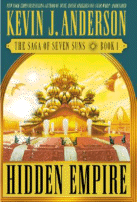
|
Oh, excellent! I was worried it was going to end after three.
Well, I wrote the manuscript for Book 3, and it turned out to be 1400 pages long. Since the other two books were each 700 pages long, I realized that I needed to re-write it and change the climax a little bit. So, I have effectively now written both Book 3 and Book 4. I've got the outline for Book 5 and I know what's going to happen at least through Book 6. But because the thing grows so much, I don't know exactly where the story will break.
Let's start with the first book in the series, The Hidden Empire. Now that was a first chapter that (literally) opened with a bang. It's just an amazing opening.
I blow up a planet in the first sentence or so, don't I? (laughing)
Well, at least in the first paragraph. The humans blow up a gas giant to turn it into a sun, using a device called the Klikiss torch. That's an amazing scene. How did you create it? I understand you had a little bit of help?
| "This was somewhat of a surprise to me, but a lot of people picked up our books first without ever having read Dune. I have literally millions of Star Wars readers that like my Star Wars books. Some of them sort of 'knew' that they should read Dune but were perhaps somewhat scared off by it." |
Like how to beam a neutron star into the center of the gas giant. That was so cool.
If you have the means to do what I described to do, the physics actually works. Because that's another thing. I have enough of a science background that it has to at least make sense. I don't have people opening their helmets in space and trying to breathe vacuum for awhile or some of the other bizarre things I've read in bad science fiction books. Even in my Star Wars books, I threw in details to explain some of the stuff that looked like it was a science glitch. The famous Imperial ships - the Tie Fighters, as they fly along, they have this weird roaring noise that they make. But of course you don't make any noise in space, because there's no air. So I threw in a line that the engines in the Imperial ships always made this strange feedback noise in the communication systems of all the other ships that they were near, so that makes scientific sense, even though it might not be rigidly accurate, at least it makes more sense than the ships making that noise in empty space.
The way you set up the different cultures in the Seven Suns Saga is so incredible. Let's start with the Hanseatic League. That's where we (Earth) would be far into the future -- we have a figurehead king, the church has been consolidated and humanity is moving outward to the stars. What are some of the things that went into your decision to create Earth's future as the Hanseatic League?
I wanted the feel in these books to be like an epic fantasy, with kings, queens, dukes and court politics, but of course like what I was explaining before, about making the science make sense, you have to make the politics make sense, too. You can't just say, "One hundred years in the future we've now got a king ruling the earth." But if you look at the British royal family and take away the scandals and the goofy stuff that's going on, people love to have this king to look up to -- the royals are like celebrities. And I thought, "If you're going to have a big boring commercial consortium that is run by the chairman of the board and diplomatic people, that's not going to make very good press, that's not going to keep people in this large expanding Empire happy. They need somebody whose face is printed on the dollar bill --
Whose attractive face, I assume --
|
Let's talk about the man behind the throne: Basil Wenceslas. What a great character. Is it Bay´-sil or Bah´-sil?
It's Basil (bah´-sil), like Basil on Fawlty Towers. One of my very favorite things to do is to write bad guys. Because I learned that bad guys never think of themselves as the bad guy. They always think that they are doing the right thing. You can't just have some cackling guy saying "I want to take over the world because, well, I don't know, but I just want to take over the world." Or, "I'm going to tie you to the railroad tracks, Nell, because I am EVIL." That doesn't work. You have to understand why they are doing things. In a certain sense, this guy -- who is one of the most evil people in the book -- he's not really that bad at running the show, because he knows what he's doing, he's smart and he's got the big picture in mind. He's like the Godfather, and if you read Mario Puzo's book, he's really a pretty cool hero. That's what I wanted my bad guys to be like. I wanted them to be suave and intelligent. I think Darth Vader is a better villain than the Emperor, because he's conflicted and he's got more personality. I wanted my character, who is the Chairman of the Hanseatic League, to be pulling the strings. He's got his own plan, but he doesn't have any patience with people who won't cooperate with him because he thinks he should be running the show.
He reminded me of the Ultimate CEO.
Well that's what he's supposed to be: the Ultimate CEO.
Let's move on to the Green Priests of Theroc: another fascinating culture in the book. The Green Priests seem to speak for nature in the story. They telepathically communicate with the WorldTrees and tend them. Is this Nature fighting back here?
Well, it is Nature, but it's not Nature fighting back. You can still have a very happy and productive and comfortable life if you are in a situation where you are fully cooperating with nature instead of cutting down the rain forest to build condominiums. It's not an overboard ranting ecological message, but because I've done these Dune books, and I'm a big outdoor hiker and mountain climber, I think that you can get along just fine with forests and things. In the book you have a planet where the trees are sentient and this special group of people can communicate with them. But instead of trees walking around like the Ents in The Lord of the Rings, these trees sit there and love to experience other things vicariously, because they have roots; they can't walk around and do things. The Green Priests, the humans who are connected to these trees, are almost like their ambassadors. They run around and experience things and places where the trees can't go, and the trees themselves store all of this knowledge. So this forest is like a gigantic library or databank, and they can tap into it to get any information they want. Because all these trees are interconnected, when a priest takes a treeling or one of the trees with him to another planet, he can instantly communicate with anyone else who has a tree. They are not a primitive culture, it's just that they don't really care about wealth and technology. They are doing just fine the way they are. They are on a planet that's like a South Sea island environment. It's very calm. The weather is nice, they temperatures are temperate, and there is plenty of food just falling off the trees all over the place. So they don't need to run around and colonize other planets and make fortunes for themselves. What the Terran Hanseatic League find maddeningly ironic is that these primitive people who talk to trees are the only ones who can communicate instantaneously across large distances. And this is the science being realistic. You can't just send a radio message twenty-five light years away and expect to have a regular telephone conversation. It would take twenty-five years each way. So they need the Green Priests to do communications for them, but the Green Priests aren't really all that interested; they have other stuff that they want to do. So that's kind of ironic, but it also makes them become pawns in some of these larger, "wheels within wheels" plans. Overall, if you break down the elements in Hidden Empire and the whole series, you can identify major fantasy icons that are all through it. The Green Priests are like the tree spirits or the people living out in the forest; you also have another group called the Roamers, who are like the Gypsies. The Ildirans, the old, dying empire that has been around so long that they are kind of on the wane, are like the Elves.
They are beautiful and have such an interesting culture. I loved the way you described the incredible Ildiran architecture. Did you have an artist work with you when you sketched that out?
I hired an artist to do a bunch of background work for me. His name was Igor Kordey. He was the painter and the artist who did a wonderful Star Trek graphic novel that my wife and I wrote called The Gorn Crisis. I loved working with Igor and as I was building this whole series, I ended up with one hundred pages, single spaces of just notes about people, the architecture and the city. I went to Igor and asked if he would read the outline and draw some of the things for me, so I would have a visual reference. He read it and just went ballistic with all these neat ideas. He was faxing me like twenty pages a day with sketches of the Prism Palace the Ildiran race, the spaceships, the costumes that the Roamers wear and on and on. Looking at his pictures gave me ideas for other storylines that I put back in. That's why Hidden Empire is dedicated to Igor, because he had such a terrific influence on this whole thing. Then when I sold the series to Warner Books, I had also done a bunch of work with DC Comics, and I took the sketches to them and said, "I would love to do a graphic novel in this universe; isn't this cool?" They looked at Igor's sketches and the outline and they went for it. So I wrote a graphic novel prequel, which comes out in December.
That would be Veiled Alliances?
Yes.
I have never, ever heard of anyone ever doing that in the middle of a book series.
I don't think anyone ever has done it, actually.
So what did Warner Books think about that?
Well, since DC Comics is owned by Time Warner, it all worked quite well. I looked at a lot of other comic book companies, but that was one of the other reasons why I went to them. If you look at the back of Hidden Empire there is an ad for the Veiled Alliances graphic novel at the end. And when the graphic novel comes out, there will be a full-page ad for the book.
I saw the artwork. It's amazing.
This will tell you about the very first Green Priest, a woman named Madeline Robinson and her two sons. They make an amazing discovery --- they are looking through Klikiss ruins and they accidentally wake up the first Klikiss Robots.
Yikes! (laughing)
Yes -- Now those guys are villains!
They are so scary. Robots that lie. They lie…and boy do they have a lot to cover up.
Weren't you mad at me for leaving that cliffhanger at the end?
Oh, I was so irritated! I thought, "Wait, what's going to happen??"
But it's one of those things that's really obvious. It's right in front of your face all along that these guys are lying. But because they are robots, the reader never suspects that they are lying.
That's so true. They are so sophisticated; they know so many things, yet somehow they "don't remember" what happened to the Klikiss race?
You know where they came from? They are based on Gort from The Day the Earth Stood Still. That was the scariest robot that I had ever seen. This came from a conversation that I had with some another science fiction writer. It was about robots. How all robots look the same, like Asimovian robots. I said that was ridiculous, because if you had an alien race that looked like insects, then they would build robots to look like themselves, not to look like people. The author responded, "oh cool". So I had beetle robots. My love for Godzilla movies I think also came through there, too.
There are so many things in this series. But one of the things that was kind of shocking for humans -- and certainly for Basil -- to come to terms with was the fact that, hey, we may not be the center of the universe. There are lot of really great lines in the book, but one where Tasia says, "We're like mice on the battlefield" -- referring to the fact that humans are really just onlookers to this huge battle between titans -- was very insightful. Humans don't like to think of themselves as just mice on the galactic battlefield.
I'm delighted that you got that. Because I had to clarify that for my Warner editor. When she was editing it, she made a comment about "Shouldn't this be more significant -- that the humans are getting more into it?" And my answer back to her was, "Jaime, with the humans getting into this war (once you get into Forest of Stars and learn how incredibly big this war was) this is like Liechtenstein threatening to get into World War II. I'm pretty sure -- because I'm already up to Book 4 -- and I'm trying to remember what happens in each book - I think there's a scene where the Klikiss robots want to wipe out the humans. The Hydrogues answer, "Why are you wasting your time with these guys?" They've got their own agenda, as you'll see in Horizon Storms, the next book.
Will Veiled Alliances go into the history of this great war that happened long before humans got into space?
Veiled Alliances is set about one hundred years before the origins of all these books.
So we find out about the origins of this great war in the next novel, then?
Yes, you find out about it in Book 3, and you'll have a lot more questions, too.
Let's talk about the Roamers. They are rebels, they are totally independent.
Not everybody wants to be a part of the big Hanseatic League. They're doing just fine on their own. Brian Herbert was worried a bit that the Roamers were too similar to the Fremen in Dune, but I think their entire culture is totally different from the Fremen. They are still the renegades from society.
I think they are different culturally -- they trade with the Hanseatic League. They way they make their living is so incredibly dangerous, trying to mine the ekti that is the major fuel source for space travel. It would certainly shape your culture, when everything you do is horrifyingly dangerous.
These are the guys that are literally living in the places where no one else is going to go. They'll live on this molten planet to mine the metal. No sane person would do that. Or they are grabbing comets and doing other types of crazy things. That's the irony that these people are treated like dirt by the civilized society, but they are the ones that are doing all the work that no one else wants to do. They are the illegal Mexican immigrants who do this work, and are treated like crap. But getting back to the fantasy trope here, they are taking the "treasure" which is guarded by a "giant dragon" -- the Hydrogues, who live in the gas giants.
Let's talk about romance. Romance is definitely in the series. It's one of those subjects, where some people think it belongs in fantasy and science fiction novels and some people think it does not. (Mystery readers have the same debate). I thought it worked well because, ultimately, this is a story about people.
You need the romance. It's not a book about romance, certainly. The whole plot is not about the main characters getting into a clinch. You have to have heroic, archetypal characters and when you're following the epic storylines, there has to be the greatest love in the universe, the star-crossed lovers who somehow can't ever get together (you've probably noticed that storyline going through the book).
Absolutely.
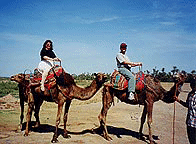 Kevin and wife Rebecca Moesta during their travels. |
Can you give us a sneak peek into the next book?
A lot of things blow up, more people die, a lot of people don't die… (laughing) I read a lot of books that are like this: a really long, epic series. I've done some things in this series that I paid attention to as a fan that either I liked or didn't like from other people. One of the technical things that you'll notice right away is that, at the beginning of Book 2, I did a summary of the story so far, just because the books come out a year apart. If you read them when they come out, you'll want some kind of refresher to remind you.
I like that, by the way, I think it's a very smart thing to do. It's really helpful for people, like me, who read a lot of books.
As a reader, when I pick up Volume 4 in a series, and it's been a year since I read Volume 3, I hate it when they jump right in, because, although I liked the previous ones, I just can't remember all the details. The other little technical thing I put in is a very detailed glossary at the end. So if you can't remember who somebody is, you can look it up.
I like that too. Otherwise, with these really big series, you almost need a notepad next to you as you read to keep up with who's who.
Right. I don't think the author should make the reader do that much work to remember who somebody is. That way the information is at your fingertips, if you need it. But it's not in the way, if you don't need it. Book 2 starts out when I reintroduce one of the characters, I don't want to say, "This character, who did this and that…" And go through this entire summary first.
That's tedious.
Right, I don't want it to be tedious. The books are fat enough, as it is. On a more general level, though, reading some of these long, epic sagas, a couple of times I've gotten the impression that the author was treading water or didn't know where he was going, or was just tying to squeeze an extra book out of it. In every one of these books, and all you can look at now is the first two, I want to make it so that so many things happen in them that you didn't expect would happen in this series, that you realize that you have to read every one of them. That it's not like an "Insert Adventure Here" novel. A lot of stuff at the end of Forest of Stars is very different than at the beginning of the book.
The introduction of the Wentals, for example.
Yes, the water elementals, the Wentals. You've also seen the Fire elementals: the Faeros, the Air elementals: the Hydrogues, and the Earth elementals, the Green Trees. So those are all classic fantasy ingredients.
I can't wait to see what happens to poor Jess Tamblyn, who's floating around in an ocean, filled with the Wentals.
Everybody was most upset about Nira, the little Green Priest, being taken off to the breeding camp.
That was actually pretty horrifying, I have to tell you. It was very upsetting to read about. If you're writing an epic series, I suppose bad things must happen. It was pretty disturbing, though.
Well, she gets better though! Another character is her lover, J'orah, who gets his balls cut off to become Emperor.
Boy, does he pay a big price to be Emperor, and to gain access to the thism, the telepathy that bind the race together.
Well, wait for the next book where he has to start running everything. He, essentially, is like someone who has been suddenly put in Hitler's shoes. He wonders "What do I do now? I can't just shut everything down immediately -- the whole Empire will fall apart." So he's in a really fascinating situation.
As you read the book, you do believe in the concept of the thism -- a sort of psychic connection to every person in the Empire that only the Emperor can see the entirety of. What was so fascinating to me was, before the coronation I was wondering how real it was…but afterwards, it becomes quite real and important.
That scene was basically like just after FDR died, Truman being brought into the White House and told, "Oh, by the way, we have this atomic bomb you can drop on Japan tomorrow." And the successor's reaction is basically, "Oh, no. I didn't know about any of this stuff. Now I'm in charge?"
J'orah is such a good person coming to the throne, now he's taking over for this horribly evil person, his father. I guess after he finds out what all his father was doing -- and why -- and he finds out what he's made of.
You'll learn in Book 3 what's really going on and why it's happening.
How interested are you, generally speaking, in mythology?
I don't consciously study it to see what storylines I could take from it or anything, but I've read tons of it, and I've read tons of it second hand, because I've read so much fantasy and historical fiction, which has it kind of built in. If possible, I like to have the things that I make up be grounded in something, instead of just off the top of my head. That's why, as I mentioned before, you can see "now this is the dragon and these are the elves" and that kind of stuff. I try not to make it really overt, but I at least try to know that it's there. I'm not sure if I finished one point before. I want to make sure that you finish each book it's not just another adventure, that starts and finishes. I want after each one, you to think, "I can't believe he did that. He killed off a main character, he's introducing new main characters." Each book will have a lot of cliffhangers, because I like that. I know it makes everybody crazy, but… (laughing) I will promise that the booka will come out when they are supposed to. I won't get you hooked on this and then go away for five years for you to wait. The first two are out, I've delivered Book 3 to the publisher, and I have a draft of Book 4 already. I know what's going to go on. I always turn in my books on time, so you can always count on a book coming out when it's supposed to.
That's rare.
That is another thing that I learned from reading these other series. I hate it when an author gets me hooked and leaves me dangling for way longer than he's supposed to. Leaving you dangling is one thing if you know that next Saturday morning you'll see the next part of the serial, and they left you on a cliffhanger. That's ok, you're supposed to wait a week, and everybody's happy. But I don't think it's fair to leave you on a cliffhanger and then not meet your responsibilities and delay and take five years for something to come out.
Authors that do that run a risk here. I feel like we have this "Cultural ADD" -- people's attention spans aren't what they used to be. They seem shorter, and you might lose those readers along the way.
The attention spans are shorter. It used to be that if somebody was writing a 700 page book, you would give them a couple of years to write it. You really couldn't expect it any faster than that. Now I'm writing a 700 page book in the Seven Suns series and an 800 page book in the Dune series with Brian every year, plus two or three other books.
Let's talk about Dune now. First off, how did your collaboration with Brian Herbert come about? You didn't already know him, did you?
|
Dune Books in Chronoligical Order of Events: ·The Butlerian Jihad ·The Machine Crusades ·The Battle of Corrin ·House Atreides ·House Harkonnen ·House Corrino ·Dune ·Dune Messiah ·Children of Dune ·God Emperor of Dune ·Heretics of Dune ·Chapterhouse Dune |
Probably some pretty big names, too, I would say.
|
It's such a huge, complex universe, you would have to become totally immersed in it to carry it on, I would imagine.
Right.
It's such a huge task that you took on. Was it a bit scary?
Well, it was really. Because Brian and I hit it off so well, even though it must have been an hour or two into the conversation, we just got lost in all these things we were talking about. And we realized that we could work well together on this project. Brian told me that plenty of other people had approached him before, but none of them seemed to have the enthusiasm or the knowledge or the spark. I mean, I wasn't stupid. I knew we'd make money and sell a lot of Dune books, but I didn't write him a letter saying, "I have a way we can cash in on this and make a lot of money." I wrote him a letter saying, "Your father left this story obviously unfinished, somebody's got to finish it." Clearly, he saw that we were going to be able to do it.
But yes, you're right. This was an incredibly intimidating prospect. It seemed like something where the shoes were just too big for Brian to fill by himself. But with the two of us, with two different sets of feet, we tried to fill them at least. We decided to do this. I asked Brian if his father had left any notes or outlines. Obviously, I wanted to know how the story ended for Chapterhouse. But Brian said that, unfortunately, he didn't think that his dad ever wrote with outlines or notes. That he didn't know of any notes or papers we could use. I flew up to meet with him for a weekend -- he lives in the Seattle area -- and we just spent this exhausting couple of days brainstorming like crazy. We decided what we were going to do, which turned out to be the first three Dune books that we did: House Atreides, House Harkonnen and House Corrino, which are immediate prequels to Dune. We could talk about why we did prequels instead of Book 7 first, but that conversation might go on forever. Well, here's the short answer: By now it had been almost twelve years since Chapterhouse Dune was published. We felt that we wanted to do something that would re-energize people about Dune, that would make them remember why they liked it so much. That required us doing a story that, even if they had just read the first Dune book and not picked up anything else, that they could still relate to it.
It might be a bit intimidating to readers who aren't familiar with the series, to know where to sort of dive into it.
|
By the movie, maybe?
Well, maybe by the movie. But I won't diss the movie, because it brought lots of readers to the original books. But my Star Wars readers knew they liked my writing, and decided to give my Dune books a try. By the time they finished those three books, they could jump right into Dune. I met all kinds of fans who came up to me and said that they started reading the original Dune books because of our prequels. And that made me feel really cool. Also, since our prequels have come out, the sales of Frank Herbert's old books -- the ones that have been out forever and ever-have somewhere between tripled and quadrupled. So readers are coming in from all over the place. If we hadn't done something to shine the light on this great series, then I don't think it would be getting nearly as much attention.
So back to the story. Brian and I met together to decide what we were going to do with our three prequels, because we didn't have the outline for Dune #7 and didn't know anything else. Then I came home about four days later and the attorney for the Frank Herbert estate called up Brian (this is twelve years after his father's death and three days after we had decided what we were going to do). The attorney called up and said "I've just found these two safe deposit box keys in Frank Herbert's old files." So Brian went to a bank in the Seattle area and they opened up the boxes that had been there unknown and untouched for all these years, and there were some old disks, some recipes, some letters and things …and the full and complete outline for Dune 7.
Unbelievable.
| "I was watching when we went into Iraq and I thought 'This is scary, because it's like the Emperor Shaddam going to fight the Fremen.' It looked like Bush was acting like Emperor Shaddam, as in 'Well, we have the right here, we have the bigger armies, so we're going to walk in and take over everything.' He's fighting against the Fremen, these people that are disappearing in the night. They lob a couple of grenades at us and then disappear. It was so creepy that Frank Herbert set all this stuff up ....40 years ago, now." |
It's like finding treasure.
Oh, it definitely was. There were outlines and notes and stories. We found a couple of chapters that he had cut out of Dune: Messiah that had never been published. By some other very weird coincidence, my letter to Brian asking him to consider me showed up at Brian's house on Frank Herbert's birthday.
This is just too weird.
Yes. So, I'm not entirely joking when I say there may be some sort of approval from beyond on this project. The coincidences are just a little too freaky.
So now we've gone back 10,000 years in time for this prequel? The next book is The Machine Crusades.
|
Well, when you read the original Dune books, there are quite a few references to things -- such as the war to free the humans -- that make you wonder, "I wonder what that was anyway?" How much of those things did Frank Herbert already have mapped out?
Once you read our books, you will say, "Oh, that's what it's all about." Frank Herbert did seem to have it all mapped out. And what's amazing to me is that - and remember, that I've re-read these six books over and over - but now we have to be like these religious devotees, looking over every little niche here and there. He did this all without computers -- he did it all in his head. It's just all notes on note cards and things. I defy anybody to find any major mistakes in the original six books which took him approximately twenty years to create.
I don't understand how he kept it all straight, really, because it's so complicated.
It's amazingly complicated. There are one or two little glitches, that if you are a fanatic like we are then you could maybe spot them, although if we have spotted the glitches it's our job, as Kevin and Brian, to find some explanation that makes sense. In fact, I did that with Star Wars quite a few times. On the first couple of pages of my very first Star Wars book, I explained what Han Solo really meant when he said "The Millennium Falcon is so fast it can do the Kessel run in under 12 parsecs," so it makes perfect scientific sense now.
(laughs) There are so many people who have written in that universe, which must also make it difficult to keep straight what everyone else has said. In addition to correcting errors like distance measurements for time measurements. Although I suppose they have bibles now.
A lot of it was compiled while I working on Star Wars. I did a total of fifty-four projects for LucasFilm: I did novels, anthologies, a young adult series co-written with my wife (Rebecca Moesta), comics, pop-up books and all kinds of things. I was lucky in that I was one of the first writers to do it. I don't know how a new author can pick it up now, just because there are so many books to follow.
Now it's at Del Ray, right?
Yes, it's at Del Ray. But it's still owned by Random House, which also owns Bantam, the imprint I worked with. The Del Ray people -- most of their books now fall in something called "The New Jedi Order" which is a big, cohesive story that has been outlined from start to finish. Each author is just writing a piece in it. When I started doing it, the playing field was pretty much open. They told me to tell whatever story I wanted, in any timeframe I wanted. The books were coming out, not necessarily in chronological order. And this is, of course, a group of fans that gets really upset.
Perhaps too easily upset?
|
The one thing I don't understand about those people is, if they hate the series so much, why in the world do they keep reading/watching it? Some of the Star Trek fans do the same thing…they are just rabidly negative it seems.
Claire, if you can answer that, you will destroy sff.net and starwars.net. Their standard routine seems to be, "We hate everything as it comes out until it comes out…until the next one comes out and we hate that one even more."
But yet they're going to rush out to buy it, then get on message boards and talk about how awful it is? It's illogical.
That's the point where I decided not to get upset about it anymore. Rebecca and I did this series called "The Young Jedi Knights," which was fourteen volumes long and on these discussion groups they would just be yelling and ripping them to shreds every time each book came out, even though they kept selling like crazy, won awards and we got wonderful fan letters like you wouldn't believe. But these discussion group people, there was one guy who posted a review of Volume 13 of "The Young Jedi Knights," and he tore it to shreds, saying "This one is just as bad as the other twelve books that I hated so much I could barely read them!" Well, why would he keep buying them? If you don't like them, you don't like them. But it's sort of like saying, "I hate eggplant, so I'm going to eat more eggplant and hate it even more."
But that's really just a small minority of the fans that do that. A small, vocal minority.
Yes, it's actually a very tiny group of people. I'm playing amateur psychologist here, but these are very diehard fans and I think there's a little bit of jealousy here. I think they wish they had gotten picked to write Star Wars books.
I'm sure you get asked all the time how to become a Star Wars author.
I do. But the answer to that is you must develop your own work, become established as an author, before you would ever be asked to work in an established universe. We had this experience with Dune, which was one of the uglier ones. I still kind of shake my head over how unfair they were. Before House Atreides came out, there was an "uprising" on one of the Dune fan boards about: how dare we do this? Even though Frank Herbert was obviously going to write more Dune books, even though he left copious notes behind, and even though he had asked Brian to write a Dune book before he died…but these people just thought it was terrible and they got together and they posted sixty one star reviews of our new book (which wasn't out yet) on Amazon.com. The catch is, the book wasn't even out yet. And the posts would say, "I don't even need to read this book to know that it sucks."
That's just absurd.
Amazon.com has rules that you can't post unless you've read the book, so we were able to get those removed. But it was disturbing how nasty these people were. The light at the end of the tunnel, or the silver lining or whatever cliché you want to use, is that after House Atreides came out, Brian and I received a bunch of apology letters from these people. So we thought, "Well, that's about as good as we can expect." They said that they felt that we had really captured Dune and had not disgraced Frank Herbert's name and they appreciated what we were doing, even they had been against it in the first place.
For our readers who don't know anything about Dune except that it's a big doorstopper book, but who've heard it's great, what is the best entry point to get into the series?
Luckily, we give them three different entry points with what we're doing. Obviously, you could start by reading the original book, Dune, because that's the first book that Frank Herbert wrote. You might think of it as a doorstopper book, but if you look at it, it's really only about 390 pages long. It's not that long really, it just seemed long because when it came out every other science fiction book was only 130 pages long. It was published in 1963. Another place that they can start which sets up everything that is in the Dune universe and will introduce you to all the characters that you will meet in Dune, would be to start by reading House Atreides, which is our first prequel, which is set 15 or 30 years before Dune. You can start by reading that story, and it might be a bit faster of a read, because we wrote it in the late 1990s, instead of the 1960s, and the style is more modern. There's a little bit more action in it and it will introduce you to the concepts that might bog you down a bit if you just picked up Dune to start. Another possibility you could start reading is with the first book in our other trilogy, called The Butlerian Jihad, which is a whole different set of characters, and it establishes and lays the groundwork for everything in the Dune universe. So you can start in any one of those places and, as I said before, Dune is the bestselling science fiction book of all time. It's something you really need to read in your lifetime. If you're going to read The Lord of the Rings, which everyone should, then you have to read Dune, too.
Since the first book was published in 1963, why do you think it has held up so well when so many other writers' works from that period have really fallen by the wayside?
| "I think that in the next -- insert however many years it's going to take -- computers aren't going to take over, that we are going to synthesizing ourselves and we're all going to have…well, wouldn't you like to have an augmented memory chip that you could plug into your head so you don't have to look everything up and remember everything? Today, we're walking around with Palm Pilots. What if we could just implant the Palm Pilot so we could just access the stuff instantaneously? That's what's going to happen, I think. It won't be giant robots standing there with bullwhips making humans…well, what would a robot want a human to do anyway?" |
Interesting.
But it becomes important and meaningful to us now because we are always going to get stuck on needing oil and it's always going to seem unfair to us that the most valuable resource in the world is buried under this ugly bunch of sand duness out in the middle of countries where the people have cultures and religions that we don't understand.
And they're not really very fond of us.
And they're not really fond of us. But it's relevant. I was watching when we went into Iraq and I thought "This is scary, because it's like the Emperor Shaddam going to fight the Fremen." It looked like Bush was acting like Emperor Shaddam, as in "Well, we have the right here, we have the bigger armies, so we're going to walk in and take over everything." He's fighting against the Fremen, these people that are disappearing in the night. They lob a couple of grenades at us and then disappear. It was so creepy that Frank Herbert set all this stuff up thirty-five years ago. Well, 40 years ago, now.
It is amazing, really. And the thinking machines, as well: Artificial intelligence.
There is all that, although that's the one where we're working with it in The Butlerian Jihad. When Frank Herbert did that in the sixties, it was a realistic fear that computers would become super powerful and take over, and men would be enslaved and that's how he set up this whole future. I don't think anybody is particularly worried anymore that their Apple Macintosh is going to take over the world. In fact, in the Terminator movies James Cameron was using a lot of stuff that was set up in the Dune books.
So you don't believe in the scenario that A. I. is dangerous?
I think that in the next -- insert however many years it's going to take -- computers aren't going to take over, that we are going to synthesize ourselves and we're all going to have…well, wouldn't you like to have an augmented memory chip that you could plug into your head so you don't have to look everything up and remember everything?
What, are you kidding me? I could use one today! (laughs)
Today, we're walking around with Palm Pilots. What if we could just implant the Palm Pilot so we could just access the stuff instantaneously? That's what's going to happen, I think. It won't be giant robots standing there with bullwhips making humans…well, what would a robot want a human to do anyway? I don't understand.
I don't know what Gene Roddenberry thought about that, but I remember in one of the later Star Trek shows, Deep Space 9, there was an entire story arc on how augmenting intelligence artificially (illegal genetic manipulation to make someone a genius) had been outlawed in the Federation.
But aren't we doing that now? If somebody comes up with a technology where you can literally increase your RAM in your brain, people would be lined up from here to Antarctica to get it stuck in their heads. You couldn't just pass a law to say it wouldn't happen. Technology is changing so swiftly right now. You've seen the sensor gloves that people put on when they are playing virtual reality games, for example. There are wearable computers being developed now. It's helping us speed up faster, do more and experience more and have better entertainment options which generally drives what our society does. I don't see a day where this would be outlawed…unless you have some fanatical religious crisis that would cause a "burn all the technology so we can all go back to churning our own butter" situation.
It could happen. There are people who want that to happen. The Luddites are at the gates.
But how could a logical person want that to happen? I can't believe that we'd ever really want to give up our DirecTV and our DVD players. The only way we would is if, say, some fanatical Muslim group came and told us to bury all of our TV sets in the backyard, and we had no choice but to do it, or we'd be executed in a soccer stadium. But even still, after we cleared out the Taliban in Afghanistan, what did they do in the first two days afterwards? They dug up their TVs, plugged them in and watched Pepsi commercials.
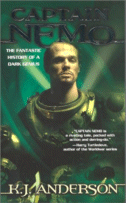
I wanted to touch on another novel of yours that I enjoyed, Captain Nemo, which is a fictional biography of Jules Verne and his more adventuresome friend, Captain Nemo.
Thank you. I love that book.
|
Well, Jules Verne's real life is pretty much sanitized for the book. I did lots of research on him and the more I read, the more I started to hate him (laughing). He was really a putz.
I wondered. Because I didn't get the feeling that you liked his character at all.
I entered into this project with this idealized picture of Jules Verne, because I had read all his stuff and he was so imaginative. And then I started researching his life, and found that he was surly and people didn't like him. He didn't even leave France until he was 45 years old. This guy is writing about everything around the world, but he felt that all he needed to do was look at pictures in magazines and he could get everything he needed.
You're killing me here. I loved Jules Verne when I was a child.
That was such a disappointment to me. Although that story about him running off to join the ship and his father racing to stop him, and pulling him off it and locking him up until he promises that he will only travel in his imagination is supposedly a true story. At least it is in all of the biographies of Jules Verne. I was kind of disappointed that he did seem to be cowardly and unlikable.
He seemed selfish in the book, or at least terribly self-centered?
Right. In fact, in the first couple of drafts of the books, my test readers were yelling at me, saying "He's just too unlikable!" "But it's all real," I would reply. So I had to calm him down and sanitize him. I admire his imagination so much that I wanted to set him up as the counterpoint to the swashbuckling, real Captain Nemo. In another sense, I thought Captain Nemo (who was portrayed as the bad guy in Jules Verne's stuff) needed to have a bit of a fresh look at him, too. You needed to understand that there was actually more of that in The Mysterious Island, where Verne explains more about Captain Nemo's background. You find that there was a reason why he had turned against the world, that his wife and his children had been brutally murdered and he had barely escaped this revolution in Turkey or India, or something like that. There's a little bit more of a heart in him. Jules Verne (the real man) got so much fan mail in which everyone wanted him to write more about Captain Nemo. He was annoyed about that, because he wanted to write other things. I had to research this book for three years, not just to re-read all the Jules Verne stuff, but also to understand the French history during that period, which was very complicated. As I was doing the research and putting it all together, it was like real history was cooperating and falling into place, because that was exactly at the time of the Crimean War and the Charge of the Light Brigade and Florence Nightingale. This was when the Suez Canal was being dug to come out right by the Red Sea, not too far from the coast of Turkey, where I was making this evil Caliph hold court. So I thought, "Of course, he'd want this submarine boat so he could shoot the ships which were coming through the Suez Canal." All of that stuff just cooperated very well. Jules Verne really and truly was a good friend of Alexander Dumas, he was trying to write for Dumas, but Dumas got into financial troubles and told Verne to go write his own stuff instead. Then Dumas fled France.
I found that entire subplot quite interesting and wondered if it were true.
It was as close to real as I could make it. Yes, there were plenty of fascinating things going on, and you also throw in the mysterious island and the pirate battles and the dinosaurs and the passage to the center of the earth. It really has all the magic of history and the magic of Jules Verne's fantasies.
One scene that was just hilarious…. Captain Nemo is pursuing his "War against War" and destroys what he thinks is a war ship. He decides to pick up one survivor from the shipwreck, who turns out to be Phileas Fogg (the lead character from Around the World in 80 Days). And Fogg doesn't care that he's just been fished out of the ocean, or that he's had a horrific experience. He just wants to know how he can immediatelyget back on schedule. Very funny stuff. All your work has lots of what Terry Pratchett calls Easter Eggs -- little fun references sprinkled throughout his work.
Well, one has to keep things tied together. The disappointing thing was that I had trouble selling this book. I was getting these letters from the publishers saying, "Does any know who Jules Verne is, anymore?" "Does anybody even remember Captain Nemo?"
That's horrifying, that they even asked that. I would think everyone remembers Captain Nemo.
It just baffled me. But after a long and serendipitous circumstance, I sold it to Pocket Books to a guy I had been wanting to work with for a long time. We sold him two books: the first one was Captain Nemo and the next is called Mr. Wells and the Martians. That comes out in February, 2004. It's the same kind of thing as Captain Nemo, but it's young H.G. Wells and his professor T.H. Huxley. The Cavorite Sphere is being built in Britain in secret because they are afraid they are going to have to go to war with Germany, and they go off to Mars to prevent the invasion from being launched. And the second storyline involves Percival Lowell, who popularized the theory of man-made canals on Mars, and his friend Dr. Moreau have found a crashed cylinder that has a Martian scout in it. Dr. Moreau does his dissection experiments and actually saves the Martian from the germs that would normally have killed them. Dr. Moreau does experiments on the Martian, while H.G. Wells, Percival and Huxley are off on Mars trying to prevent rest of the invasion from being launched. They stop it. They meet the Invisible Man, all the H. G. Wells things.
That's from Pocket Books?
Yes, Pocket Books, hardcover, March 2004.
I understand you did the novelization of The League of Extraordinary Gentleman. Have you seen the movie?
I've seen the movie and, obviously, read the script a long time ago. I am also a big fan of Alan Moore's graphic novel. The main reason that I wanted to do it, was I felt it was the same kind of thing. That if people liked that one they would like Captain Nemo. Nobody else is writing these things; I'm calling them fantastic historicals -- I can't think of a catchier name for them. I felt that since I'm doing the H.G. Wells book and I did Captain Nemo, that it seemed like an obvious thing for me to be doing The League of Extraordinary Gentlemen. It's a fun movie. It's very fast and very sharply edited.
I think it's a tough thing to translate a graphic novel or comic to the big screen.
Don't go expecting the graphic novel. They basically took the gang of characters and wrote a whole new story for them.
The leader now is Alan Quartermaine; wasn't Mina Harker the leader in the graphic novel?
Well, she was. They've changed it because Sean Connery is in it. He's the leader of the gang. And they've added Tom Sawyer who wasn't in the graphic novel. But it's a whole different story. It's like taking this old-fashioned Justice League of America and giving them a different story to run around in.
I'd like to turn to the subject of writing. Let's talk about the creative process. I understand that you actually dictate while you hike, and then someone else transcribes the tapes for you?
Yes. I find that I can do my writing better if I'm out walking. As you can hear, I just get too many phone calls during the day. If I'm in the middle of a scene and the phone rings, it really disrupts my concentration. So, two things. I like to take my tape recorder out with me to do my writing, even if I'm just walking around the neighborhood here. Just because I'm out of reach from the phone. What I much prefer to do is to go out the whole day, and go to the Rocky Mountain National Park (I live in Colorado) or go into the forests or mountains or something like that. I like to hike all day.
I've hiked in Colorado and I have to tell you that not once did it occur to me to dictate something as I hiked up a mountain. You must be in awesome shape! (laughs)
Well, I do keep in shape (laughs). I've climbed all the 14,000 foot peaks here in Colorado and I'm doing another one this coming Saturday. You're just out hiking and it does a couple of things: one, as you're walking around (presumably you're not hanging by your fingernails from a narrow ledge or something) you can get into a sort of fugue state and concentrate without interruption about your scene or your world or your character or whatever you're doing. I'm surrounded by fresh and interesting details. I'm hearing the sound of the wind in the trees and I'm looking at the wildflowers, smelling the creek I just crossed over…
Lots of sensory input.
|
What's the biggest mistake that you see beginning writers make?
They want to know how to get an agent before they've written anything. I get constant letters and phone calls saying, "I've got an idea for a book, how do I get an agent?" The answer is: You research the book, you outline the book, you write the 400-500 page book, you edit the 400-500 page book, then worry about how to get an agent.
Do you think that most people aren't willing to put in the vast amount of time required to be a published author? I know you put in an amazing amount of time.
That's part of it, too. But also, they get ahead of themselves. You need to write something publishable before you need to worry about the mechanics of it. Before you even have written a story, they are worried about how you're going to find someone to sell the movie rights to. Well that will come later, if you've done a good job of writing the story. I guess that's what I'm trying to say is that they need to focus on getting the story done right and making it publishable, before they worry about the next step.
As a practical matter, it seems to me that you handle an amazing number of life tasks, if you will, especially since you and your wife have a young son. So you're a father, a husband, an author with lots of deadlines, and you obviously spend a lot of time hiking and staying fit. How do you do it? Are you a big scheduler? How do you juggle it all? Many people couldn't handle your workload and that busy of a lifestyle.
I've actually never thought about it! I just try to fit it all in. I multi-process. I'm hiking and writing at the same time, so it's not like I'm taking a day off. Because my wife is also a writer, the "husband time" (that is, the spending time with her) is easy. We are always going off to science fiction conventions together, editing each other's books, brainstorming something while we're both cooking dinner our going out to a restaurant together and we spend all of our time doing stuff. We are full-time writers, both of us. My schedule is to get up at 6:30 or 7:00 and I'll usually work out and have breakfast and start writing by, say, 8:30 in the morning. I work non-stop until I have to stop to make supper (and, yes, I do most of the cooking) and in the evenings we generally watch movies or TV shows or talk or do something. There's plenty of time!
So you love to cook? What kind of food do you like to cook? What are you really good at making?
The one that I make when I'm really trying to impress someone who's coming over is a killer lasagna recipe that's been in my family for five generations. It's an all day (or more) thing, if I can manage it. The sauce has to cook for a couple of days. Each pan of lasagna weighs at least 15- 17 lbs…I also do some Moroccan cooking. I have a handful of recipes that I've either made up or picked up from somewhere. I've always felt, even when I was a bachelor working full-time and coming home from work at 5:30 at night, that I would take the time to cook myself a couple of chicken breasts and make a salad or something because I work too hard, and I deserve to have a decent meal instead of heating up a pot pie or something like that. I don't know if that makes me a gourmet cook or not. I think that you make time for the things that are important. That really is an answer for a whole bunch of the questions you are asking. You don't waste time on things that aren't important.
Well, that's the trick, isn't it?
Yes, and that's why there are so many leaves in my front yard.
I'm curious. What are the kinds of things in the science or political news know that really fire your mind? I have to admit that one of the things that surprised me, as far as how fast science is progressing, is about a year ago, on TV is the president of the United States telling people that we were not going to be cloning humans. While most people jumped off on the issue of whether that was morally right or wrong, I was more focused on the shocking fact that we've come so far that our politicians are talking about cloning people. That speech would have been impossible to imagine the president giving ten years ago, because it would have been an absurd thing to talk about: I mean cloning people. It sounds like science fiction.
Yes, that's true. But what gets me about that is that you have people talking about cloning and they are saying things that anybody with eighth grade science knows that what they're saying is wrong. Nobody is calling them on it. Or what they do on the talk shows when they have a discussion about human cloning, is to have an expert in genetics speaking on one side of the issue, and the expert on the other side is somebody from the local church choir who just thinks "It's bad." They are putting these people up as equally informed and I get so mad listening to these people. Say the topic is whether you can keep stem cells to do any sort of research on them in order to help people who have severed spinal columns or something. The woman from the church choir is ranting that "You are killing babies! These stem cells could eventually be made into human beings!" And the answer is "No, it can't!" Even though the experts know that's wrong, the expert isn't given any greater credibility than the moron who doesn't know what she's talking about.
|
This is our typically American-centric idea. As you mentioned earlier about the idea in the Seven Suns books about how shocked we are that we aren't the center of the universe, sure President Bush can say that the U. S. government won't fund stem cell research, but believe me, Japan is applauding. Because they will just do it first and get all the patents. Does he think that by him saying that because the U.S. (who theoretically has the most ethical researchers in the world) will not fund it, that no one else will do it? Are you going to let Saddam Hussein's old chemists work on it instead? Do you think that everybody in the world is going to stop stem cell research? That's just dumb thinking.
Is it a coincidence that the uproar over stem cell research happened right after the crazy Raelians claimed to have cloned a baby and we had all just seen the latest Star Wars film: Attack of the Clones. I'm being somewhat facetious here, but can we blame LucasFilm? Remember the scene when Obi Wan walks in to the facility and discovers they're building a clone army? Is that what everyone thinks is going to happen if we allow stem cell research to proceed?
You can blame them for the uneducated people getting the wrong impression. But the people who make policy decisions should damned well know what they are talking about before they make the decisions. There is nobody who is an expert on cloning who would be afraid after seeing Attack of the Clones. Ok, I'm getting off on a rant here. But this is one of the reasons I was baffled and perplexed that under our jury system that you are guaranteed a jury of your peers. So you have this O.J. Simpson trial where an expert on DNA analysis is put on the stand for days explaining DNA. And another expert was also put on, refuting some of the technical details that the first guy said and to explain that there may well have been some other person on the planet Earth who had this same DNA as O.J. You have those two people explaining highly technical material, and the people who are making the decisions are people who have such limited lives that they can't get out of jury duty?? You are talking about the waitress and the street cleaner and the guy who's out of work who used to be a disc jockey, deciding this DNA test was accurate or not. They didn't know beans about a DNA test. What you were saying about the Luddites earlier, I think that's what's happening with making these decisions about stem cell research.
Is that where this is coming from?
Where it's coming from is that I don't think that the people who are making the policy decisions are the people who know the most about the subject, on either side of it. They are being swayed by the church choir lady who doesn't like stem cells because they could be babies, so this is abortion somehow. Which is just absurd. What I'm surprised is that people are asking, like Hitler did, what if someone comes up with an eugenics program. And to them I ask, "Ok, but what if we can make Christopher Reeve walk again?"
Next subject, the space shuttle.
Grrrrr…..
Ok, sore subject, obviously! Where should we be going with the space program?
First off, let me vent about this: It's been how many years since the Challenger disaster and we never replaced that space shuttle? And now we've lost the Columbia and we still have no plans to replace it so our fleet of five ships is now down to three ships, all of which are very old. And no one's even got a new one on the assembly line. Talk about short-sighted thinking. Now, it's been since forever that NASA and the other contractors have been attempting to come up with the next generation space shuttle. I obviously think this is where we need to go. I mean, we need to have a regular commerce between the surface of the Earth and at least near-Earth orbit from which we can build other things and send them to the Moon or further. It's the stepping stone. You have to have it. Having said that, whether NASA is, with it's apparently crippling bureaucracy, the place to get it done or whether the Sultan of Brunei should just say "Here's my money, build me a space shuttle." That may be the best thing to do. I have long -- and I don't know very much about the man, so I'm not saying anything him personally -- I think that Ted Turner was this wonderful thing that happened to the communications industry. He showed up, did everything his own way, which wasn't the way that anybody else did it, and created CNN. Because of CNN, our entire way of receiving news is totally different than it was before.
They laughed at him when he founded CNN, saying nobody would want to want to watch 24 hours a day of news.
Of course. They laughed at the new style of CNN Headline News, which had the ticker at the bottom, but it took about all of three weeks for every news station to copy it. All of that is a lead up for me saying that I think that somebody with the resources and innovation and the idea is going to come out of nowhere and come up with a successful space travel program, whether it's Bill Gates wants to do "Geeks in Orbit" or whether the Sultan of Brunei decides that he wants to have a satellite named after him or what. But I'm not convinced that the NASA space program is the best and most efficient way to retool everything. However, I'd rather that they build another space shuttle and that we'd at least have four of them working than just sitting around waiting for some miracle to happen.
What's your opinion on the debate about manned vs. unmanned space flight? What about those who say that manned space flight is just too dangerous and they should all be unmanned? Of course others say that they must be manned, for a number of reasons.
I agree that it has to be manned, for a number of reasons. Don't they watch Star Trek? I mean, it's where no man has gone before. You can't just send cameras up to orbit and that's it. It's the difference between looking at a National Geographic magazine and actually walking around in Morocco. You must have people who are actually there. Because I think one of our manifest destinies is to get people up in space, whether it's a colony on the Moon or on Mars, or just in a practical commercial sense, that you want to build factories in orbit because you can make things there cheaper, such as pharmaceutical, materials, and crystals, and all kinds of things that you can't do on Earth. I think that you need people to do stuff like that. I read somewhere, it was in Space magazine a long time ago that the most lucrative business on the planet Earth apparently is tourism in some form or other. If you started getting Hiltons up in orbit, they would be full every day of the year. Because people would pay to go up there. I'm not saying don't send probes, you need to send them first, but it's like this: do you want Columbus to go across the ocean, or do you want to put a message in a bottle and hope that it lands somewhere? I'd rather have actual people be there. Whether they look like Americans or like the inhabitants of some other country, depends on who has the most drive.
Return to the October 2003 issue of The IWJ.
More from Writers Write