
Reviews of Writing Books
Flip Dictionary by Barbara Ann Kipfer, Ph.D.
Writer's Digest Books, January, 2002Paperback, 693 pages
ISBN: 1582971404
Ordering information:
Amazon.com
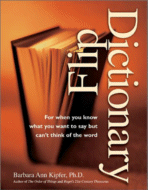 Flip Dictionary is not a true dictionary in the sense
that it does not have complete definitions and pronunciation
keys. However, its design makes it incredibly useful for editors
and writers. It is more like a thesaurus -- each listing in the
dictionary includes references to words with
a related or similar meaning (like synonyms). For example, if
you look up the listing for writers it says: author, biographer,
calligrapher, columnist, composer, copyist, correspondent,
composer, etc. People can "flip" back and forth through the dictionary
as they discover related words and phrases.
This can be helpful if you know the word you want to use,
but you are drawing a mental blank.
You can simply look up a word with a similar meaning and
see if the word you want is listed
next to it; if not, you can "flip" around some more until
you locate it. Flip Dictionary is better than
a thesaurus in that it
also contains numerous tables with related subjects and words.
For example, look up combat sports and you will see
a table listing aikido, boxing, fencing, savate, wrestling
and many other combat sports.
The Flip Dictionary was compiled by lexicographer
Barbara Ann Kipfer, who holds a master's and Ph.D. in
linguistics.
For professionals such as editors, librarians and writers
who quickly need to find a particular word, the Flip
Dictionary is a terrific tool.
Flip Dictionary is not a true dictionary in the sense
that it does not have complete definitions and pronunciation
keys. However, its design makes it incredibly useful for editors
and writers. It is more like a thesaurus -- each listing in the
dictionary includes references to words with
a related or similar meaning (like synonyms). For example, if
you look up the listing for writers it says: author, biographer,
calligrapher, columnist, composer, copyist, correspondent,
composer, etc. People can "flip" back and forth through the dictionary
as they discover related words and phrases.
This can be helpful if you know the word you want to use,
but you are drawing a mental blank.
You can simply look up a word with a similar meaning and
see if the word you want is listed
next to it; if not, you can "flip" around some more until
you locate it. Flip Dictionary is better than
a thesaurus in that it
also contains numerous tables with related subjects and words.
For example, look up combat sports and you will see
a table listing aikido, boxing, fencing, savate, wrestling
and many other combat sports.
The Flip Dictionary was compiled by lexicographer
Barbara Ann Kipfer, who holds a master's and Ph.D. in
linguistics.
For professionals such as editors, librarians and writers
who quickly need to find a particular word, the Flip
Dictionary is a terrific tool.
Thinking Like Your Editor by Susan Rabiner and Alfred Fortunato
W.W. Norton, March, 2002Hardcover, 284 pages
ISBN: 0393038920
Ordering information:
Amazon.com
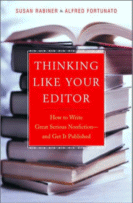 Thinking Like Your Editor helps
writers put together a book proposal and
submission package that will get the book
noticed by agents and editors. Authors Susan Rabiner,
a senior book editor for St. Martin's Press
and literary agent, and her husband
Alfred Fortunato, a freelance editor and writer,
provide anecdotes and tips from their
careers, as well as advice and examples of
proposals and letters to help writers develop
a professional nonfiction manuscript submission package.
They also explain the business behind the
scenes, including how books are selected
for publication. They help writers learn
what to put in a proposal, what editors look for
in a sample chapter, how to format your table
of contents in your book proposal, when it is
time to get an agent's help and much more.
The second section in the book covers the writing process and
includes advice on making an argument, fairness,
narrative tension, epilogues and introductions.
Thinking Like Your Editor helps
writers put together a book proposal and
submission package that will get the book
noticed by agents and editors. Authors Susan Rabiner,
a senior book editor for St. Martin's Press
and literary agent, and her husband
Alfred Fortunato, a freelance editor and writer,
provide anecdotes and tips from their
careers, as well as advice and examples of
proposals and letters to help writers develop
a professional nonfiction manuscript submission package.
They also explain the business behind the
scenes, including how books are selected
for publication. They help writers learn
what to put in a proposal, what editors look for
in a sample chapter, how to format your table
of contents in your book proposal, when it is
time to get an agent's help and much more.
The second section in the book covers the writing process and
includes advice on making an argument, fairness,
narrative tension, epilogues and introductions.
Ms. Rabiner worked as an editor for Random House and Basic Books and later become a literary agent. Mr. Fortunato has worked as a freelance editor and book doctor for 25 years. Together, the two authors provide a great deal of information for anyone wanting to write a nonfiction book. Writers must be upset at first to learn that "for the typical serious nonfiction book, which will advance perhaps 5,000 to 7,500 copies into the bookstores initially, publicity opportunities are few and virtually no co-op money is set aside by the publisher." But this kind of information makes writers understand how serious they need to be if they are going to make it in this business -- and how important it is that they get advice from experts like Sabiner and Fortunato. The book helps writers become more knowledgeable about editors, learn book submission techniques and find out where they stand (as authors) in the publishing process. Highly recommended.
Writing Mysteries edited by Sue Grafton with Jan Burke and Barry Zeman
Writer's Digest Books, April, 2002Paperback, 312 pages
ISBN: 1582971021
Ordering information:
Amazon.com
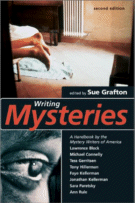 Writing Mysteries is jam-packed with excellent advice
from top authors including Lawrence Block, Jan Burke,
Tony Hillerman, Faye Kellerman and Michael Connelly.
Edited by bestselling mystery author Sue Grafton
(author of the alphabet mystery series, P is for Peril, etc.),
this Mystery Writers of America (MWA) handbook is a collection of
articles by top authors writing in the mystery genre. The
articles in the book cover numerous mystery
writing subjects. For those just getting started and
working on honing their craft, there are articles
covering characters, plot, point of view and dialogue. For
writers who are ready fto submit a manuscript,
there are articles covering editors, markets
and literary agents. The book also covers specialty
mystery writing topics; an article by Linda Fairsten covers
legal thrillers, and Tess Gerritsen covers medical in her
article, "The Medical Thriller." As editor Sue Grafton
says, "From beginning, to middle, to the rousing climax
of your book, we're here, like an army of experts, to
offer guidance and assistance." Mystery
writers will find that this "army of experts" is good
to have around. This is a great collection of advice from the
MWA to help and motivate inspiring mystery writers.
Highly recommended.
Writing Mysteries is jam-packed with excellent advice
from top authors including Lawrence Block, Jan Burke,
Tony Hillerman, Faye Kellerman and Michael Connelly.
Edited by bestselling mystery author Sue Grafton
(author of the alphabet mystery series, P is for Peril, etc.),
this Mystery Writers of America (MWA) handbook is a collection of
articles by top authors writing in the mystery genre. The
articles in the book cover numerous mystery
writing subjects. For those just getting started and
working on honing their craft, there are articles
covering characters, plot, point of view and dialogue. For
writers who are ready fto submit a manuscript,
there are articles covering editors, markets
and literary agents. The book also covers specialty
mystery writing topics; an article by Linda Fairsten covers
legal thrillers, and Tess Gerritsen covers medical in her
article, "The Medical Thriller." As editor Sue Grafton
says, "From beginning, to middle, to the rousing climax
of your book, we're here, like an army of experts, to
offer guidance and assistance." Mystery
writers will find that this "army of experts" is good
to have around. This is a great collection of advice from the
MWA to help and motivate inspiring mystery writers.
Highly recommended.
Return to Book Reviews Index
Return to the June 2002 issue of The IWJ.
More from Writers Write