
Interview With Neil Gaiman
by Claire E. White
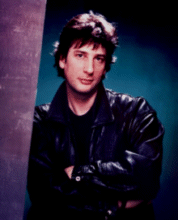
It would be difficult to find an author who appeals to
|
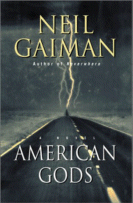
Now, with the publication of his new novel American Gods (HarperCollins), which debuted at number ten on the The New York Times bestseller list, Gaiman has attracted yet a new following: serious literary critics and readers of mainstream novels. Kirkus Reviews calls American Gods, "A magical mystery tour through the mythologies of all cultures, a unique and moving love story -- and another winner for the phenomenally gifted, consummately reader-friendly Gaiman."
The novel opens as Shadow has just been released from prison. After learning that his wife has died in a car accident, he is devastated. He then meets the mysterious Mr. Wednesday who offers him a job. Shadow accepts and sets out with Wednesday on a mission to round up all the old gods in America, who have fallen on hard times. Shadow and Wednesday have all kinds of adventures and meet all kinds of people and deities, many of whom who would like to wage war on the old gods and claim America's souls for themselves. Gaiman uses this premise to explore many complex and interesting themes. It is a brilliantly written, clever, funny and, at times, disturbing novel. Certainly, some of his observations about American culture and obsessions are uncomfortably close to a truth that mainstream America would prefer to forget, or ignore altogether.
Like Shadow, the protagonist of American Gods, Gaiman's work seems to act as a mirror which reflects what people want to see in it. But whether American Gods is read as an urban fantasy, a shocking mystery/thriller or even as a love story isn't really the point. What is most interesting about the book is the view of America and its beliefs that Gaiman (an Englishman) sees. It is an examination of America's culture, its myths and the pagan influences that exist solidly beside such Americana as roadside attractions and Easter egg hunts. Few people think it odd that their children consume chocolate eggs and chocolate bunnies on a holiday that is supposed to be celebrating the resurrection of Christ, for example. But the early church fathers were a canny bunch: they simply took the underlying pagan festivals and slapped a Christian one on top of it. Voilà! Everyone is happy, and the festival date is the same as it always was. Gaiman does an excellent job of showing the America that is just underneath the surface, delving deep into the American psyche. The book also examines the mythology and belief systems that made their way to America with the emigrants who came here hoping to find a new life. American Gods is certainly his most complex work to date.
In my previous interview with Neil, he speaks about his childhood and how he got his start as a writer. I spoke with Neil again, just before he headed off on a grueling multinational tour for American Gods. In this new interview, he talks candidly about American Gods, book reviewers, and the joys and heartache of blogging. He also shares some of his fondest memories of his friend, the late Douglas Adams.
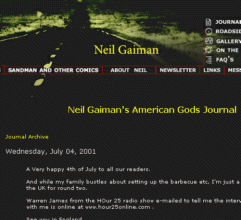
I've been reading your online journal for American Gods. It's quite entertaining. Do your editors get mad at you? Is it draining off any of your creative energies that you would be using to write more fiction?
No one's gotten mad at me -- yet. The only time it actually does
|
The fun of the journal for me is getting to try to explain what goes on backstage of an author tour. It's kind of funny; If you went back and read the original Sandman scripts, there's an awful lot of the kinds of things in them that now turn up in my weblog. Of course, no one ever read those original scripts except the artist and the editor. There are all kinds of odd things in there, perhaps even a minor diversionary essay on gardening. What I wanted to do with the journal was to try to show what happens to an author after he finishes a book. Most people have a very vague idea of what happens then. Most people think that it goes like this. You write a book. You hand in the book. You put it in the post to the publisher. Then, six months later, they phone you to say, "Hey, you'll never believe this! Your book has hit the The New York Times list!" Or, "You'll never believe this! I just saw your book on a remainder table." Most people probably don't even think about the second option. I really wanted to try to show the great amount of stuff that is happening behind the scenes when a new book comes out. There is so much that is being done, that is being created, and being built. There is an enormous amount of work going on.
It's a lot of work for a writer. I don't think many writers realize how much work still is to be done, once the final copyediting is done.
Yes. One thing that gets a little frustrating is that I'm not actually totally hands-on behind the scenes of the website and the blogger. Which means that stuff that I think would be a lovely thing to do doesn't necessarily get done, because there are two layers of people who have to implement it, and they are busy people with jobs. For example, I'd love to know how many people actually visit my journal, because I know it's a lot more than visit the front page of the site. Before we had a counter, I had absolutely no idea whether anyone was even reading it at all. My favorite moment so far happened a couple of months ago. I did an online search. I typed the words "Blogger" and "Gaiman" into google.com to see if anyone was even reading it. I found a bunch of links to it. My favorite comment was one that I read on one of those websites. The owner of the site said, "You know, I had always wanted to be a writer -- until I read this horrendous essay on copyediting that Neil Gaiman wrote on his weblog. It's too much work! I don't think I want to be a writer now." I thought, "Oh, good. I've actually done something worthwhile here." So I felt incredibly proud of myself.
Let's talk about the new book, American Gods. Looked at in terms of plots, American Gods is a complex book -- there's a lot going on here. There's a road trip, but there's also a nasty little murder mystery going on in a seemingly charming small town. In a way, the entire book is a bit of a puzzle for the reader to solve. I must admit, I hadn't thought of you as a mystery author before this book, but this is (among other things) an excellent murder mystery. What attracted you to the murder mystery element? How did that part of the plot evolve?
It was all very organic, really. Before I began writing the
|
I had one very, very strange conversation with a lady from USA Today, who hadn't read the book, but who was doing an article about me and "Snow Glass Apples," the radioplay starring Bebe Neuwirth which is on SciFi.com. We had this odd conversation. She said that she needed to mention American Gods in the article and would I tell her what kind of book it was. I said, "Well, it's a book about murder." "But, isn't it science fiction?" she asked. I thought for a second and replied, "Yes, if you want to look at it that way. " "Is it a thriller?" she asked. "I certainly hope so," I replied. "Is it a fantasy?" she asked. "Why, yes," I said. "Horror?" "Yes, and it's mainstream literature, too," I noted.
Don't forget the romance!
Yes! There is a romance which some people seem to notice and some people don't at all, which I think is kind of fun. I suspect (and it's hard to say this from the point of view of an author) that's it's the kind of book that repays what you put into it. I've seen a couple of reviews now by people who really didn't get it. Oddly enough, I got an email last month from someone "outing" themselves as an anonymous Publisher's Weekly reviewer who let me know how pissed they were that they didn't get the book to review. Then that was followed by a really dim Publisher's Weekly review which said, "Only the Gods themselves could understand this aimless plot." I thought that was so odd. I mean, it's not a difficult plot to understand. It's not aimless. And it's not beyond the comprehension of mere mortals.
Or, mere reviewers?
Yes, or mere reviewers. Actually, it's fairly straightforward. It is a book which is designed to repay a second reading.
Have you been surprised at the responses to the book?
Well, I'm not really sure what the response to the book is at this point. That's really the joy of this. I think I'm starting to get a sense of the response which is that (so far) the people who were on the wavelength of a book like this, love it and "get it." There was a complete joy in sending out the book to early readers for blurbs. Tim Powers read it, loved and sent me a lovely blurb. He even talked it up to his email list. When people like Peter Straub, Tim Powers, and Jonathon Carroll -- people who are really gifted -- love the book, then that makes me thing that I'm doing something right. On the other hand, there was a review in Booklist by Ray Olsen -- who has given me lovely reviews for everything else -- which showed that he didn't get it, on a world-class scale. I suppose that bad reviews rankle. This was one of those reviews which began, "Shadow, a Stephen Seagal type…"
What?
Yes, Stephen Seagal. Then he says that the book is confusing, has no plot and that it's a huge misstep after delightful books like Neverwhere and Stardust, and here's hoping that Gaiman will write a decent book next time.
Were we reading the same book?
It was just terrible. It wasn't even the kind of review that

|
There's definitely a horror element in that scene. It's shocking, I suppose.
Well, I think there's definitely some horror in there. There are some pieces in there which are, in their own way, quite creepy. My favorite pieces are those that take place in the hotel rooms in the middle of America. It's not really horror, but it's one of the creepiest chapters I've ever written.
The road trip -- Shadow's quest across middle America with Wednesday -- is the other place where most of the action takes place. As an Englishman, what was the appeal of middle America? The America that many adults remember from family road trips, with ghastly diner food and strange roadside attractions which seemed quite magical when one was a child. You seem to have a fondness for the whole experience, and to view it through the wondering eyes of a child seeing it for the first time.
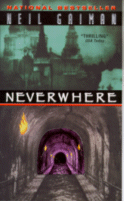
I hope so. I am proud of one thing that I did with Neverwhere (and I'm not going to bang the gong saying that Neverwhere is
|
At the beginning of each chapter is a bit of a poem, or a song, or an interesting quote. There is quite a bit of foreshadowing, if you will, and perhaps some embedded clues in those little prefaces. How did you choose those quotes? Did you write the chapters and then find something appropriate, or did a quote or poem spark the writing of the chapter?
A bit of both. Sometimes, I knew exactly what I was doing when I started the chapter and had something completely appropriate already sitting in my head. Sometimes I had a few of these little quoty bits sitting in my head and I wasn't sure which chapter they fit with. I would play with it, try out different things, until I thought, "Aha, there it goes. Perfect." Then when I got to the end of the book, I had about three chapters with nothing at the beginning. So I had to spend several hours or most of a day, going through strange old books to find something that really fit and that set things up. The last one to be put in is that wonderful quote about the huge scale of America.
Yes, that is a good one. The one from Lord Carlisle to George Selwyn?
Yes. Chapter 17 begins,
"Everything is upon a great scale upon this continent. The rivers are immense, the climate violent in heat and cold, the prospects magnificent, the thunder and lightening tremendous. The disorders incident to the country make every constitution tremble. Our own blunders here, our misconduct, our losses, our disgraces, our ruin, are on a great scale."American Gods is certainly the most organic thing I've written since Sandman. It was the longest thing I've written since Sandman, When I finally knew what I was doing, I figured that 95,000 words was the longest that it would turn out to be. I thought that I'd just take a deep breath and be done by March. I actually wrote the last page the following January. It ended up being twice as long as what I had originally envisioned, and at least twice as complicated.
I'd like to talk about some characters in the book. Let's start with Shadow, who could be analyzed on several levels. There is the obvious Christ parallel, with sacrifice, the three days, coming back from the dead and redemption. But there is also the quest of a man to find out who he is. How did you create the character of Shadow? Now, obviously your inspiration was the actor, Stephen Seagal? Sorry, I'm kidding. I can't seem to get past that.
(laughing) Nor can I. You know, I'm very tempted -- and I
| "This entire book is a con game. You asked about the mystery, earlier. It's a mystery novel, because if you're going to write about a con game that's what you're writing about. The joy for me of writing a really good con game is, as I say, is putting the ball under the cup before the reader even realizes there is a ball under a cup. And when the cup gets lifted, the reader thinks, 'Oh my God, how did that ball get under there?'" |
Well, quite frankly, as an author you don't know whether your book has been handed to the literary reviewer or the romance reviewer.
Or perhaps the horror reviewer. No, you really don't know. So you don't know what expectations that reviewer is bringing to the book. But I'm very, very tempted. I really may do the giant review of the reviewers and see what happens. Maybe I'll do a little checklist. For example, #1: Did the Reviewer Understand the Book? There definitely are reviews in which it is clear that the reviewer completely did not understand the book.
(laughing) You are a man who enjoys risk, are you not?
Well, I don't know that I'll do it. I suppose that it really is, on some level, breaking the rules.
Ah, well. It would certainly be entertaining to read.
It would be incredibly entertaining. But it really would breaking all these unwritten rules. One of which is that reviewers get to review in a vacuum. And the only thing that an author can do about is a review is this. The really, really stupid authors get quite huffy about bad reviews and write letters to the editor.
Hmmm. Well you could do like Stephen King does and just mention it in your next book.
Actually, my favorite treatment of bad reviews is James Branch Cabell who, in the back of the 18 volume beautiful, huge collection of all of his works the Biography of Manuel, did a final section detailing what the reviewers said for each of his books. The book reviews go like this. The first 5 or 6 books, the reviews he quotes say something like: "Beautiful illustrations by the artist; such a pity about the words." Then you get to the reviews of Jurgen: A Comedy of Justice and the reviews say: "This a terrible book. It has no redeeming features; it's simply awful; a major misstep." And then every single review for every book he wrote after Jurgen begins, "Well, this isn't Jurgen. Apparently the author has lost the facility with which he wrote that delightful book." So he did put this wonderful parade of the ridiculous things that the reviewers said over time. As I mentioned in the blog, the only final thing that you can say about the reviewers, is this. The same day that the Publisher's Weekly review came in which said, "The road trip plot was completely aimless, but I liked the stuff in Lakeside," the Summer Book Forum book review came in which said, "The roadside stuff is amazing -- the novel only loses focus when you get to the stuff in Lakeside."
Well, that stuff will just make you crazy.
If you actually pay any credence to it, it does make you crazy. So you just kind of smile and think, "Maybe someday I'll review all the reviewers someday." But you probably won't.
So, back to Shadow. How did he evolve?
I actually wrote the entire first chapter in the first person. That was my first try at Shadow. It really felt odd. It didn't
|
Well, that's true.
So I thought that I would merely write how events strike a person and how they change him, and I will go from there. The hardest thing with Shadow was figuring out what he was called. Most characters turn up with names. I have so many drafts of fragments which would eventually wind up in American Gods. In every version he has a different name.
He is aptly named. He is a bit of a Shadow. But he's also a mirror, which when held up reveal different facets of the people around him.
Exactly. I got a letter from a friend who was scared that she was upsetting me terribly. She said, "I don't like Shadow. But I loved him when he was pretending to be Mike Ainsel, the con man. I really like that character. Why couldn't he have been him all along?" Isn't that fun? One of the strangest things I found when writing Shadow is that he has no personality unless he's with somebody. At which point he will adopt a personality, or occasionally mirror them. His speech patterns are ever so slightly flexible. People would get very confused. Someone who's in the middle of the book said about Shadow, "But he's just this big, dumb guy." "No, he's not," I say. "He was with big, dumb guys at the time, so he was talking like a big, dumb guy."
There are some lovely little weird moments. I love the moment when he pretends to be Andy Haddock, head of A-1 Security Services, for a couple of paragraphs and he has some wonderful little conversations with various people.
Which brings up another part of the book, which is certainly a part of our culture, and that's the grift, or the classic con game.
Yes. This entire book is a con game. You asked about the mystery, earlier. It's a mystery novel, because if you're going to write about a con game that's what you're writing about. The joy for me of writing a really good con game is, as I say, is putting the ball under the cup before the reader even realizes there is a ball under a cup. And when the cup gets lifted, the reader thinks, "Oh my God, how did that ball get under there?" So I knew from the very beginning that there were grifts involved. I knew that there were con games involved. The hardest part for me was making sure that the book did that cool thing that a really good grift does: if you stopped reading it before it finished, you would not understand what the grift had been. You would think that everything was leading to other places or doing other things. I read dozens and dozens and dozens of books on grifts and cons, but actually there was only one which stayed with me. That was the book which contained the story of the line, "Sure it's crooked, but it's the only game in town." It's called The Big Con by David W. Maurer, and it's back in print. I had always heard that line, but I had never put it into context. The context is this. You have crooked gamblers, people who made their living bilking people in the late 19th century by bilking people in games of faro. In their off-time, they played faro, that's what they liked to do. One of these crooks, was playing a crooked game of faro. His friends called him over and asked him why he was playing this game. "They are cheating you and the game is crooked." And he answered, "Sure it's crooked, but it's the only game in town." Thus we have that line, "It's the only game in town." I loved the idea of the end of the game. At the end of the novel, there is so much that is happening. Is it crooked? end of the novel? Well, sure it's crooked. But it's the only game in town.
Another interesting question that underlies the story is: who is really running the show? Shadow gets to go backstage, but we never see who's pulling the strings until the very end of the novel. To what extent are your own religious beliefs portrayed or hinted at in the book? Were you telling us anything of your own beliefs, or were you just writing the book?
I was really just trying to write the book. I wrote most of the book by hand in a great big leather bound notebook. It's a good way to write. I really wanted to make sure that there was a discontinuity between the first and second drafts. Doing a first draft by hand really helped to do that. I didn't end up with four giant notebooks and then have to type out the novel or anything. Every couple of chapters I would stop and type it out. There was one point where I turned to the back of the book and I wrote that the most important thing about writing a novel is knowing what happened. That for me was the challenge with American Gods. I'm not saying that that would be the way to write every book, but I really wanted to just see what would happen. This is what these characters would do, this is the way it occurred, and every now and then when the book would hiccup or stop, or crash to a halt, it was because that wasn't what happened. I remember at one part of the book I knew the characters would be in Cairo, Illinois, and I was going to meet the Egyptian gods there, and it was going to get very exciting at that point. Shadow had escaped from the spooks at that point, so why not make things exciting? Now this was when it was when it was still a novel kind of like Neverwhere. That was the point where the action quotient was going to bump up. There were murders and kidnappings and god knows what else. I wrote about four pages of this, and then I thought, "This is so much not what happened!" So I stopped. I wasn't feeling like I had made a mistake as a writer, it was just that this wasn't the story. A few weeks later, I thought, "Shadow just works for them. He goes and works for Mr. Jacquel and Mr. Ibis -- they are just funeral directors and he's going to work for them." I wrote what is easily my favorite chapter in the book. It was a lovely chapter to write. It was completely pastoral. In some ways, it's the nearest to a break that Shadow gets in the whole book. He even gets to have sex -- kind of. It's sort of nice, sitting and drinking beer and riding the surf.
It made good sense from a pacing standpoint, too.
It did, because of the way the book worked. If it had gotten terribly exciting at that point, it would have been a much shorter book. It was much more along of the lines of, well, this is what happened next.
It also gives him the semblance of a family life for a while.
Yes. And there were several bits which were written and then thrown out. One of the only bits that went with regret, really with huge regret but it had to go because it just didn't work, and some of the other bits that were thrown out were things that I can reuse somewhere else. They will end up in a short story collection, most likely. When Shadow was on the train where he met somebody who very well might have been Jesus. The scene was written where it was a lot like meeting Steven Spielberg. He meets this man who lives in a gorgeous Spanish-American hacienda type of place. He is sitting in this huge office and he has a baseball cap on. He's a good guy, obviously very, very rich, and he and Shadow are having a very pleasant conversation and drinking wine. I wound up throwing it out not because I was worried about offending anybody - God knows, just look at the book! (laughs)
No, you couldn't possibly have been worried about that!
(laughing) No. Someone who was worried about offending people would certainly not have written American Gods. But it was deleted because it just didn't work. It didn't work in context at that point, and there was nowhere else that I could have put it that it would work. Shadow had had too many cool and interesting dreams anyways. I liked that fact that his dreams follow a plot of their own, and this certainly wasn't in that plot. So I dropped it out. I'll probably stick it up on the website, along with a lovely scene with Isis which never made it into the book. In the scene she explains a theory (which happens to be mine) of how things begin as sacred mysteries, then become myth and then become fairy stories. You can follow a kind of progression. You have the holiest of holies which eventually wind up as children's stories. In this scene, Isis cites this wonderful imaginary example of that. It's a story told in completely magnificent faux phrasure (sort of like The Golden Bough) -- so it sounds very, very real. You have a Goddess and a sacred Queen, you watch how that becomes Snow White, and it was a lovely little sequence. But Isis never made it into the book and there was nowhere that it belonged, so it was cut. That's why I like to write by longhand. That way, good scenes are still there, even if they're crossed out. At least while I can still read my own handwriting.
American Gods has the feel of a book written by someone who has experienced quite a bit of life and still finds a sense of wonder in creation. Is this the kind of book you could have even started ten years ago?
It would have been a different book. Well, actually, I guess I
| "There has to come a point where you take a deep breath and say, 'It's good enough for jazz.' Perfection is not given to us. Perfection is not something that we get as an option. There comes a point where, as a writer, you have to say, 'You know what? This as is good as it gets. Any more and you face the law of diminishing returns. Maybe I'll get it right next time.'" |
What about from a technical standpoint? How do you feel that you've grown as a writer?
I'm very proud of the book. I'm not sure…but I think that I could have started a novel like this ten years ago, but I probably wouldn't have finished it. If I had started a book this complex ten years ago, I would have gotten four chapters in and said, "Oh, fuck it. What am I thinking?" This time, every four days, I thought. "Oh, fuck it. What am I thinking of??" but I kept going. The strangest moment for me in American Gods -- and this is something that only a writer could understand and probably not even all writers would understand -- was this (which had never really happened to me before except once in a short story). I wrote a first draft and it didn't work. It had much of American Gods in it, but the ending went wonky. I hadn't quite figured out for myself where the book was going. I had written the story, but there were details of the grift that I hadn't quite figured out and it didn't quite come together. And it felt odd. This was at the beginning of October. I then went off on a reading tour, took some deep breaths, and round about November I rolled up my sleeves and wrote another 16,000 words, then chopped it down to 5,000 words or so. Still it was all down to Chapter 18: what actually happened? We'd been building up to the storm, we'd been building up to the battle, what happens then? I took the novel and typed and assembled and cut and pasted some Chapter 18s that I had written. One night I had this thing that wasn't a novel, and next morning I started typing and trying to assemble it together. All the material had now been written, but now I was shaping it. About 4 o'clock in the afternoon, I looked up and realized that the novel was done. It was there. It was real. Chapter 18 worked, which meant that the whole of the book worked.
Was there a lot of editing?
Yes, after it was done I did a great deal of editing. At its longest, it was over 200,000 words. Now it's about 186,000 words. I think my editor would have loved me to cut another 10,000 - 15,000 words. She sent me back a version of the manuscript, with many of the pages with lines completely through them (laughing). Her notes said, "Do we really need this?" So sometimes I'd cut it out. What I tended to cut out at the end of the day was what they refer to in Hollywood as "shoe leather." Shoe leather is things like showing people walking away from a scene, after the scene is done. Coming in and going out of doors, that kind of thing. I lost a lot of that stuff. But there were also places where she said, "We really don't need this." For example, the scene on the Indian reservation. She would say, "You've just done this scene with Whisky Jack, that's lovely, but why don't we now cut to the next exciting thing, perhaps. Why are you doing this whole thing of having Shadow go down to the reservation, going to the pool hall, and watching the pool game, getting this old car that doesn't run. You could summarize all of that in a sentence." If we'd done that, we'd have saved ourselves five pages. I looked at the scene and thought, "Well, I could do that. But if I take Whiskey Jack out of context, then he'd just be another magic Indian. We've had magic old wise Indians in book after book, and film after film, and the whole point of him is that I didn't want him to be that. I wanted him to be something else. He is a Native American who helps put the South Dakota Native American experience into context. The Ocala Sioux reservations are, quite literally, some of the poorest places in the country. I'm not even banging any kind of social drum here. I'm just saying we need this stuff to occur to give this context. The title of the book is American Gods, and it's about both things. It's about the Gods and it's also about America. If you cut scenes so that it's just about the Gods, then you lose the context, and these characters suddenly become superheroes, which is what I really did not want to happen.
It's interesting where in America the book takes us. This is solidly middle and lower-middle American. Shadow is certainly not touring the country clubs and debutante balls across the land. Were you trying to get to the common man's experience? Because it's more real, perhaps?
Yes. I think that it was much more fun to stick the characters into aging cars and having them driving places. There are moments at the beginning of the book where Shadow makes his first big speech. He demands $500 a week from Wednesday. The reader is thinking, "Shadow, you know that's not really a lot of money any more, put in context." (laughing) But that's all he's going to ask for.
You took a risk here with Shadow, in terms of his appeal, which I thought was quite interesting. He's a criminal, in jail when we first meet him. I kept waiting for him to explain that he was wrongly accused, but he never did. He did it, although he does wish now that he hadn't.
It was very odd, because you can -- with a careful reading -- figure out everything that happened that sent him to prison, although there's never a big scene that explains it explicitly. You have to just pick it all up, little bits here, little bits there, as to why he was in prison in the first place. It was an odd thing to do, because I assumed I would have a big flashback scene where the reader finally says, "Aha, this is what happened." But it wasn't really part of the book, so I left it out. What's interesting about that is the two accounts that we get -- or is it three -- all differ very slightly. Mr. Town's account is certainly not Shadow's account of what happened. (laughs)
Shadow is haunted throughout the book by his dead wife. But she's not the most likeable of characters.
Yes. She's such a lovely character. It was very interesting writing her. As I was writing the book, there were editors agents and various other people reading it as I went along, who -- until the end -- were very puzzled as to why he was with her. They all asked me, "What is Shadow doing with that awful woman? Why is he with her? I don't like her. She's manipulative and deceitful." So it was fun writing the sequences at the end of the book where -- all of the sudden -- you feel sorry for her. I'm still not entirely clear about how big a part that Shadow's wife Laura actually played in the events which sent him to jail. I think she was very much running the show.
So you're heading off on a long tour for American Gods. What have you learned from years of touring? Are there any rules for yourself? Any indispensable items you never travel without?
Well, you'll laugh at this. The most indispensable item that I always take with me is a little pillow. My own pillow. It's not a very big one. It's a little buckwheat seed pillow and it's marvelous. Bear in mind that I've done every kind of signing that one can do. I've signed books, comics, and even people. I've had the signings where you sit in an empty store for three hours with nobody there. In Holland, I came in for a signing at a bookstore. The guy who was supposed to promote it and organize it had terrible experiences with authors. The last two authors who were to come in had backed out on him at the last minute, which was quite embarrassing for him. He was convinced that I wouldn't show up at all. So he hadn't done anything at all to tell people that I would be doing an appearance. In fact, he seemed quite taken aback when I actually showed up. So for three hours I just sat there in an empty store. It was very weird.
I've done everything from the kind of signings where you have 12 people, and you have an hour to kill so everybody gets five minutes. I've had signings where it's 10:45pm, the store is going to close at 11 pm and you still have 300 people to get through. The worst thing is that you get back to your hotel so late, and then you have to get up so early the next day, because you have to go somewhere else. So you take along your favorite pillow. I also take my laptop. I wear only black, so I never worry about matching socks. What have I learned? (laughing) To post your underwear home.
You must have an understanding wife!
Yes. I may wind up doing it on this trip because I don't think I'm at any hotel long enough to get laundry done. There comes a point where I am sending gifts and things home, and so I use the underwear, socks and t-shirts as padding and send it off Fed Ex. You're not getting clean underwear, you're not getting laundry done, so you have to improvise, because there is no time. It's a bit scary. This particular tour, I think I am actually in San Francisco for two days, so I think joyfully, "I can get laundry done there!" What else have I learned? Bring pens.
I've also learned that many stores do not understand
|
I understand your son recently graduated from high school and left for college. You are quite young to have a son in college. How did his graduation affect you? Did it feel like a milestone in any way for you? How did you feel about that?
I was merely puzzled by the whole thing, actually. I had this conversation with my mother the other day.
"I got this graduation announcement the other day. What exactly does that mean?" she asked me.It's a big deal.
"Well, in America, as far as I can tell, it means that you are supposed to send him a check -- it's kind of a bill, really," I replied.
"Really, dear, why?" she asked.
I said, "Well, they've graduated."
"They don't really wear caps and gowns, do they?"
"Oh, yes they do," I said.
"But this is high school, is it not? I mean, they are basically celebrating the fact of their breathing through the last five years or so? I mean it's not like university or anything is it? What is the significance of this?"
"Honestly, mum, I just don't know. I have no idea." I replied.
I know that it's a big deal, only because people have told me that it's a big deal. I watched it happening. Not only was it a big deal, it was interminable. It's all very strange and quite interesting. He had a huge graduating class. But it didn't have that scary "milestone" quality that taking a short road trip back in April did. We went on a trip to look at colleges who had accepted him to decide which one he would be attending. Now that was scary -- it had "milestone" written all over it.
I'm sure you'll miss him when he goes.
I will really miss him when he goes. Even apart from the fact that he is the one who set up the house's computer network and is the only person who understands it. I've told him to try to set up a webpage where I can reach him in case anything goes terribly wrong. I shall send urgent messages along the lines of "Mike, what do I do now???" (laughing)
I'd like to turn to a sad subject. We recently lost a great author in Douglas Adams. What are some of your memories of Douglas Adams?
First of all, how incredibly tall he was.
That's what Terry Pratchett said when I interviewed him last year! He kept telling me how amazingly tall he was.
Well he was incredibly tall. And incredibly baffled. Not baffled in the kind of Simon Jones or Arthur Dent way, though: "I'm English and I'm truly baffled." Douglas was a combination of bafflement and bemusement, not really quite understanding how it had all happened. Which was always kind of fun. It made him very, very charming. He was a brilliant man. Completely brilliant. I've only known maybe three geniuses in my life. And then there are smart blokes who can do things very well. I would put myself in the "smart blokes who can do things very well" category. I put Terry Pratchett in that category. He's probably the funniest writer alive. But I wouldn't classify Terry as a genius, if that makes any sense. Richard Curtis, who wrote Four Weddings and a Funeral and Black Adder and so on, is one of the sweetest guys and a most amazing screenwriter. He's a smart bloke who knows what he's doing, and does it with craftsmanship. Not a genius, though. Douglas was a genius. He saw things from a very specific perspective, which was his alone. He could describe things in terms that made you surprised that you'd never seen them that way, but once you have seen them that way, it became the way you had to see it forever. If Douglas had a tragedy it was that I don't think that he really was a writer. He wasn't a novelist. Despite the fact that he made his fortune from novels.
He had trouble with deadlines, did he not?
He had trouble with deadlines in the same way that the planet Jupiter is bigger than a duck. But that wasn't it. It was much more the fact that he didn't enjoy writing. He didn't enjoy writing books. He wrote Hitchiker's with Simon Brett first, then with Geoffrey Perkins, working incredibly hard to get scripts out of him. At one point he had to collaborate with John Lloyd in order to keep writing. He took the stuff that he'd written as radio scripts and turned them into novels. And the novels did well. Certainly, Douglas was a bestselling novelist.
His fans certainly wish he had written more novels.
I think everybody wishes he had written more novels.
| "I've only known maybe three geniuses in my life. And then there are smart blokes who can do things very well. I would put myself in the 'smart blokes who can do things very well' category. I put Terry Pratchett in that category. He's probably the funniest writer alive. ...Douglas Adams was a genius." |
Do you think your journalistic training has helped you to reign yourself in when you have to?
No. I think, well maybe to some extent. I missed by deadline on American Gods by one year. I just didn't miss it by ten years. There has to come a point where you take a deep breath and say, "It's good enough for jazz." Perfection is not given to us. Perfection is not something that we get as an option. There comes a point where, as a writer, you have to say, "You know what? This as is good as it gets. Any more and you face the law of diminishing returns. Maybe I'll get it right next time." You take a deep breath and you write the end, or you do your final edit and say third draft -- it's good. That's enough. I'm not messing with it any more.
But back to the comment about him not being a writer. He was a writer. He just wasn't a novelist. I don't think he was a natural novelist. He wound up a novelist through strange, default means. He started out being a radio writer and he ended up as a bestselling novelist. I think he was something else. I think maybe it's something that doesn't exist yet. Maybe in fifty years' time, there will be people with jobs like "Explainer." Maybe, like his own Slartibartfast, he was a world designer. Maybe there was something else where you would finally say, "Ah, this is what he was." And I could see Douglas looking up and saying, "This is what I've been waiting for my whole life," and suddenly doing that. I think it's a terrible shame that he left us before that happened.
He was extraordinarily kind, as well. I met him when I was a 23 year old journalist, and he was incredibly kind to me and did interviews and stuff. Then I was given a commission to write a Hitchiker's Guide to the Galaxy Companion which was a book that someone else had been hired to write, but they had never done it. The publisher said to me, You've interviewed Douglas, can you do this? And I said sure. Douglas was incredibly sweet, letting me have the run of his filing cabinets (laughing) saying, "There you go; have at it!" There were old shoe boxes full of information and old scripts and what have you. So I sat there going through it. He was a very kind man. Very kind indeed. Douglas will be greatly missed. He will be enormously missed.
What projects are you working on now? What's next? There's no rest you know. We all must know what's next.
What's next? Hmmm. Well, the next novel, Coraline, was actually handed in to my publisher last May, say 14 months ago. It was a book which I began in 1990. It was meant to be an entertainment for my then-youngest daughter, Holly, who would have been about 6 or 7. The idea was that it was a book that I was writing in my own time. I ran out of the concept of my own time, though. I looked up and realized that I had another daughter who was then five, and that if I didn't finish it soon, she would be too old for it by the time it was done. So I sent the manuscript off to Jennifer Hershey, my wonderful editor at HarperCollins, and said "Jen, read this." She did and said, "It's marvelous. What happens next?" And I said, "If you give me a contract, I will tell you." So she gave me a contract. And I'd write a bit of it every evening. I actually wound up with a notebook by my bed and every night before bed, I'd try to write five to ten lines. That is a very, very strange way to write a book.
You don't write on the computer much, lately, do you?
Well, I write the weblog on the computer.
I remember for Stardust you said you had a special pen and wrote it entirely in longhand.
Yes, Stardust was a special project. Generally, anything script-wise I input directly into the computer. I like computers for writing scripts. I like writing dialogue. I love using screenwriting software for that. I write short stories sometimes on the computer and sometimes by hand. I like the process of writing by hand, for prose. For me as a writer, a lot of the process is fooling myself into writing. When I started writing, it was so much easier to write on the computer because I wasn't making paper dirty. Now, after nearly a decade of writing on the computer, I realize that for me, if I'm just writing on paper it's not real. It becomes real once it actually hits the keyboard. So it's the process of trying to trick myself.
So Coraline will be out next year? And it's a children's title?

|
I'm working on lots of film projects. What I should be doing today is working on The Ramayana, an animated feature for DreamWorks. Meanwhile, I've been waiting on various scripts which have been handed in to various places to find out what the next move is.
I still find it very difficult to
|
The joy for me is that of getting to take people backstage. People can get a fairly clear point of view of what is actually happening backstage, which was a metaphor that I used in American Gods which seemed very applicable here and to the journal as well. You get to come backstage and watch things that you never see like the process of getting blurbs. It was fun.
Everyone who thinks he wants to be a writer needs to read the weblog archives first, in my opinion.
Yes, absolutely. You will have to put up with my occasional meanderings, like on the rhubarb, for example, in order to get to the stuff about writing and publishing. There are things in there like the essays on copyediting, on blurbs, things like that where you are trying to explain to people how it works, what actually goes on. It will be very interesting writing it, during whatever time I get, probably while I am on airplanes doing the little blogs on what happened at each signing.
One of my essays was "The Eleven Things to Remember
| "Really what I'd like with American Gods is for it to be the kind of book where somebody finishes it and says, 'Oh my God, so-and-so has to read this!' And then passes it on to a good friend and says, 'You will love this. Read this.'" |
What reaction to your book by a reader would make you really happy?
The thing I'd like most is for people to want to read it again. Not as a chore. Not as a sort of, "Oh no, I really must go read that again." But as a "Oh, that's so cool. I want to go back and see how he did that." Somebody asked me the other week, it was my doctor actually, oddly enough he is a family friend and a writer in his own right, very nice man. He asked me, "What do you really want from this book? What are your goals?" Which I hadn't thought about. "Do you want to be on the bestseller lists? What are you actually after?" It's important to the publishers that the books make the bestseller lists, of course. But in terms of how my sales patterns work, Neverwhere didn't hit any bestseller lists. But I've probably sold more copies of Neverwhere than the average New York Times bestseller. They come out and they sell all their books in the first few weeks and that's it. Whereas, Neverwhere sells the same number of copies every month. My sales patterns tend to be perennial sellers.
Really what I'd like with American Gods is for it to be the kind of book where somebody finishes it and says, "Oh my God, so-and-so has to read this!"
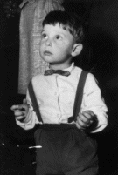 Neil as a young boy. |
Return to the July 2001 issue of The IWJ.
More from Writers Write