
Talking to Ourselves: an Interview With Patricia Barnes-Svarney and Thomas Eugene Svarney
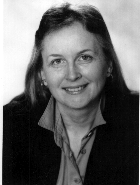
Patricia Barnes-Svarney has been a non-fiction and science fiction writer
|
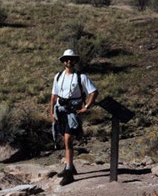
Thomas Eugene Svarney is a non-fiction writer and researcher, specializing in science and nature. Tom has a formal education in engineering science, physics and materials science, and spent eighteen years working in the interdisciplinary field of failure analysis. He has written more than 30 technical articles for national and international journals over the last 18 years. Such magazines
|
Successful husband and wife writing teams are a rarity in an industry where most writers work in solitude. Patricia Barnes-Svarney and Thomas Eugene Svarney have been happily married for 23 years and have achieved great success in both their personal and professional lives. They met at a bank -- Pat worked there summers to earn her way through college. A friend introduced the two by telling Pat, "Hey, he's studying to be a physicist, you're studying to be a geologist." (To this guy, a science was a science.) After saying "hi" in passing for two years, one day Tom asked Patricia out on a date. They were married soon after. Or as Pat says, "I guess, in scientific terms, the 'chemistry' was right..."
We asked these two successful authors to interview each other and to give us some insight into the life of science writers who work as a team. The couple found the experience enlightening, proving that no how matter how long you've been married you can always find out something new about your spouse...
Patricia Barnes-Svarney: Now that we're both sitting here with a soothing cup of tea... ummm... that is tea, isn't it?
Thomas E. Svarney: Beats me. Something about "rose hips and peppermint leaves" on the side. Just wake me up if I start to nod off.
PB-S: Check. My first question: How did you become interested in science writing?
TES: I've always been interested in the outdoors, and spent as much time as
|
PB-S: Poof. Just like that?
TES: Well, it was definitely a round-about route--an evolutionary process if you will. Now how about you?
PB-S: I came into writing through the back door. I've always liked anything to do with science, especially astronomy and geology. I would drive all my friends and family crazy talking about something I saw through my telescope, or some mineral or fossil I found. My parents were great too--they took me to the library in search of science books, and encouraged me by buying me my first real, handmade telescope at the age of 13. I thought about going into astronomy, but decided on geology--and I eventually received two degrees in the field. While I was in graduate school, the writing seed was beginning to really germinate: A very perceptive professor told me that many of the papers I wrote "read like something from a magazine." At first, I was insulted. Then she explained that I had a knack for interpreting difficult concepts in the sciences. Add to that, my parents always telling me, "You should write an astronomy book," for most of my life--and the rest is 15 years of science writing history.
TES: When did you write your first book?
PB-S: I answered an ad in a national writer's magazine--they were looking for children's writers to do certain books in a series. They liked my magazine and science background, and asked me to write the book. The result was published in 1989--The National Science Foundation in a series for Chelsea House Publishers. Remember when we went to Washington, D.C. to do the research for it?
TES: How could I forget. They were calling it "the worst snowstorm of the century." Everything closed down the day after we arrived. Except the Smithsonian. We had the Air & Space Museum all to ourselves that day.
PB-S: Yes, but I did get enough information to write the book, too. My next book was also for Chelsea House, then on to other books--all for other series. My first stand-alone book was Traveler's Guide to the Solar System for Sterling Publishers in 1993. I think that book's a collectible now.
TES: Time to wrap it in plastic!
|
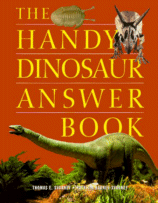
TES: Actually, the best part of science writing for me is not the writing, it's the research. I'm naturally inquisitive and curious, a person who likes to find things out. So when a new subject comes up, I'm in heaven. The process of immersing myself in a field of study, especially dealing with the natural world, is extremely gratifying. Especially if it involves field trips, like those I went on while researching The Handy Dinosaur Answer Book.
PB-S: Bones everywhere, dinosaur tracks at every turn...
TES: Not to mention a hot Sun and hard rocks. And what do you like best about science writing?
PB-S: I think it's the research, too--but I like the "moving" type of research. When we're out in the field, or I'm interviewing a scientist about her or his work, that's the best part for me. I also like coming up with ideas. I guess I have an overactive mind--sometimes I have too many ideas! Another thing I like is the actual writing. When I twist a phrase just right, it's gratifying--even if the editor decides to get rid of the sentence! Now what do you like least about science writing?
TES: There are two things that I don't like about science writing. First, I don't like the actual mechanics of writing because it usually happens indoors. I overcome that by taking a laptop outside when it's nice; winters are tough, though. The second thing I don't like is being between projects. When I don't have a book to do, sometimes it's hard to come up with proposals and new ideas. The wait until something new comes up is hard. I try to fill in those empty times with travel, learning new skills, etc.. And you?
PB-S: I don't mind the waiting around. Even though it's frustrating, I realize that's part of the process. In the book world, everything seems to come in cycles. In the magazine world, you're always living in the future--it's usually months in advance before something is published. (Maybe that's why I'm so into science fiction and the future!) I think the worst part of science writing for me is missing a good story. Sometimes I see an article or book and say, "Darn, missed again!"
TES: Let's get into habits now--
PB-S: Hey, I don't bite my nails anymore!
TES: No, I mean writing habits. How do you write?
PB-S: I'm what I call a "chunk" writer. I usually get up early, write up my
|
TES: Are you going to tell them about the stack of boxes filled with rocks in the basement?
PB-S: Nope. Now your turn. How do you write?
TES: I'm a "non-chunk" writer. When I'm writing, I usually follow a set routine. I get up very early, and do my normal hour of Taijiquan, then have breakfast. After that I sit down and write steadily for an hour, then take a 15 minute to half hour break, doing small chores like filling the bird feeders. Then, back for another hour of writing, then another break, and so on through the morning. Usually, a total of four hours of writing is enough creative effort for one day, although I have gone as long as six. In the afternoon, I do research, correspondence, or phone calls. Before supper I stretch, and race-walk or follow a calisthenics/aerobic exercise video. Evenings are time for a wind-down. I usually follow this routine for three or four days, then take an entire day or two off, just going for a hike, visiting with friends, birding, or continuing my soaring practice.
PB-S: Is that where you've been all these years! Now you tell me. Anyway, I have a better question: Why do you write?
|
PB-S: Ah, you're tripping into my territory here. I think this is why we both like to write together--we both have the same goal. I'd like to think something we've put together will inspire someone to take a step to preserve the planet--or even help us reach out to the stars.
TES: Which is a question we seem to be asked many times: How do we write together as husband and wife? Or is that wife and husband?
PB-S: You can go first; I'll go first next time. Anyway, I think it's what we just said: We both have the same goal of explaining nature to people. We both want to get people--young and old--to understand just why we're so enamored with what's out there.
TES: I think there's another reason, too. We both compliment each other in terms of writing. We both like to think of ideas. I do a great deal of the research--I really like that part. You like the writing part--you're good at putting words together. We're both good at editing each other's work, too. I think we just keep passing jobs back and forth until we come out with something we like.
PBS: I have another good question for you: What have you found to be the best teacher of writing?
TES: Definitely reading. I've always been a ravenous reader, going through all types and styles of books. It helps you get a sense of rhythm, of how the language is actually used. Although I do read all types of books, my favorites are the hard-boiled PI mysteries. The more you read, I think, the better writer you can become. Of course, you still have to sit down before a blank sheet of paper or computer screen and actually create something. And that's the hard part.
PB-S: I agree with reading as my writing teacher, too. My parents are great readers and they always read to me when I was young. I was surrounded by books all my life--all types of books. And when I made my first trip to the library, I thought I was in heaven. At 4 years old, borrowing a book can be a heady experience! Even years later it is. I still seek out bookstores and libraries on all of our trips--they're like magnets to me. As for my favorite types of books, I like to read science fiction (of course) and mystery short stories; in non-fiction, it's usually about gardening, nature, or a good science book.
TES: What tools do you use to write your books?
PB-S: Oh, remember that old computer I had? 64 megabyte hard drive, green screen with the "C" and the ">"? In those days, I used to write my magazines articles and books out in longhand first--just an outline. Then go to the computer and hope I'd have enough space. With our newer computers, I can be like the pink, drumming bunny in the battery commercial: I keep writing and writing. But I still have yet to break my habit of writing a book or magazine article outline first in longhand. Oh, and I have to use a certain type of paper and one of my favorite pens! How about you?
TES: For the actual writing, I prefer to use a computer. I can type faster and easier than writing with a paper and pen, and it allows me to cut and paste text with ease. Also, the spell-checker is invaluable. The specific software I use is Microsoft Word 6.0. The other tool I use heavily is the Internet, which is really a world-wide library. In fact, using the Internet has replaced much of my library visits for research, although for historical records libraries are still invaluable. The Internet also allows me to communicate with sources all over the world, and very quickly, too.
PBS: Now this is a harder question: What was your favorite book to write and why?
|
PB-S: I remember some of those dinosaur sites--thank heaven for water and Tilley hats! Any particular dinosaur sites that stand out in your mind?
TES: Probably hiking around the area of Dinosaur Hill, south of Fruita, Colorado, will always remain in my memory. It was a beautiful, sunny day, with puffy white cumulus clouds. Colorado National Monument loomed in the distance. And in front of me was the quarry, really a mine into the hillside, where Elmer Riggs and crew had discovered and dug out the skeleton of an Apatosaurus around the turn of the century.
PBS: Are there any experiences associated with The Handy Dinosaur Answer Book that are significant to you?
| "I came into writing through the back door. I've always liked anything to do with science, especially astronomy and geology. I would drive all my friends and family crazy talking about something I saw through my telescope, or some mineral or fossil I found." --PB-S. |
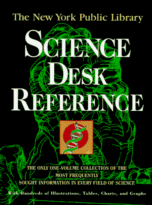
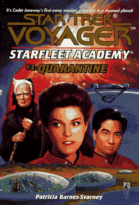
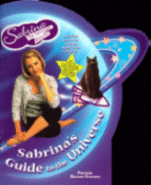
PB-S: That's a hard one. I like many of them so far. First, let me address the books I've written on my own. In fiction, I really liked working on Star Trek: The Next Generation: Loyalties--because it was Star Trek and I've followed Trek for years, and because it was my first science fiction book for middle readers. But I also liked Star Trek: Voyager: Quarantine because I liked the story, if I do say so myself! As for non-fiction, even though it was a huge book, I liked putting together The New York Public Library Science Desk Reference. When Stonesong Press asked if I wanted to edit and write the book, I jumped at the chance--it was a book I always wanted to see on the shelves. Even now, I use it as a reference source for my work. Another non-fiction book I had a great time with was Sabrina, the Teenage Witch: Magic Handbook. The book contains all sorts of science experiments--and I tried every one of them.
TES: Yes, I remember. Like the one with the yeast--the one that got carried away?
PB-S: Hey, every science experiment has its quirks.
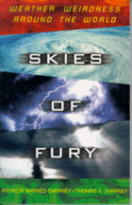
TES: I think we'd both agree that for books we both wrote, Skies of Fury, a book about weird weather phenomena, was also enjoyable to write.
PB-S: That one, along with The Handy Dinosaur Answer Book. And what experiences stand out for you associated with Skies of Fury?
TES: There are actually two experiences that stand out for me, one indoors
| "The more you read, I think, the better writer you can become. Of course, you still have to sit down before a blank sheet of paper or computer screen and actually create something. And That's the hard part." --TES |
PB-S: I was sure glad you were driving. And remember all those people turning off at the closest exit--including us? We waited out the storm with dozens of other people at that fast-food restaurant.
TES: Yes, they had a good business that day. Now the second experience
|
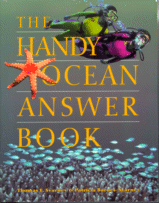
PB-S: And we can't forget The Handy Ocean Answer Book. That book was probably the most fun for me--at one time, I worked in the field of oceanography. And didn't you at one time want to be an oceanographer, too?
TES: That was a while back.
PB-S: I won't go there if you won't.
TES: It's a deal.
Return to the April 2000 issue of The IWJ.
More from Writers Write