
Ella Enchanted by Gail Carson Levine Review
Harper Trophy, 1998.Paperback, 232 pages.
ISBN: 0064407055.
Ordering information:
Amazon.com.
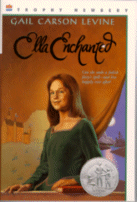 Imagine Cinderella, Gulliver's Travels and The Hobbit all spun
together in a fantastical fairy tale for middle graders, and
there you have Ella Enchanted. Ella is indeed an enchanting young
girl. Alas, she has been enchanted by the fairy Lucinda's whimsical
and thoughtless spell given to her at birth which makes her
perfectly obedient. She must obey any direct command, which can
lead her to danger, even death. Ella's story is about her quest
to find Lucinda, the fairy that placed the spell on her and
persuade her to lift the spell so Ella can lead a normal life.
Well, as normal as a life can get when you live among gnomes,
elves, ogres, giants, and centaurs all speaking different languages.
Fortunately, Ella is good with languages, a talent that proves
invaluable as she faces her many challenges.
Imagine Cinderella, Gulliver's Travels and The Hobbit all spun
together in a fantastical fairy tale for middle graders, and
there you have Ella Enchanted. Ella is indeed an enchanting young
girl. Alas, she has been enchanted by the fairy Lucinda's whimsical
and thoughtless spell given to her at birth which makes her
perfectly obedient. She must obey any direct command, which can
lead her to danger, even death. Ella's story is about her quest
to find Lucinda, the fairy that placed the spell on her and
persuade her to lift the spell so Ella can lead a normal life.
Well, as normal as a life can get when you live among gnomes,
elves, ogres, giants, and centaurs all speaking different languages.
Fortunately, Ella is good with languages, a talent that proves
invaluable as she faces her many challenges.
All is well with Ella until her beloved Mother dies. She is distraught with grief comforted only by the cook, Mandy, (also a fairy) until she meets Prince Char at her mother's funeral. They become the best of friends, but then Ella's father decides to send her off to finishing school. There, Ella must contend with her future stepsisters, Hattie and Olive, one who accidentally discovers Ella's secret. Miserable, Ella escapes determined to find her father and Lucinda. Ella has discovered from the elves and gnomes she encounters on her journey that Lucinda and her father will be at the wedding of a giantess. Fortunately, after many misadventures, she finds Prince Char and his friends. Ella is determined to get to the wedding. When Ella arrives, Lucinda not only refuses to lift the spell, but Ella discovers that her father has lost all of his money. He must marry Dame Olga, mother of Harriet and Olive. Lucinda decides to flaunt her powers again by giving Ella's father and Dame Olga the gift of always being in love. Ella's father flees in horror, and Ella becomes the slave of her evil step sisters and Dame Olga. Prince Char must go to another country to complete his education, but Mandy saves the day by serving as the messenger between Char and Ella. As they continue their correspondence they fall in love, and Char asks Ella to marry him. She realizes that while she is still under Lucinda's curse, to marry him would put him in danger, too.
Meanwhile, Mandy and her fairy friends have decided to give Lucinda the come-uppance she deserves. After a time of having to be totally obedient as well as a squirrel, Lucinda swears off big magic and decides to help Ella. The rest of the story falls into place as the familiar tale of Cinderella complete with balls, carriage and glass slippers. The one twist is that Ella finally discovers only she can lift the curse of obedience. Char orders her to marry him but her love for him is too great to allow herself to destroy him. Her willpower to say no and the excruciating pain it causes her breaks the curse at last.
Ella refuses to become a princess, though, and instead takes the title of Court Linguist. She travels with Char and learns every language. She loves her newfound power to say yes or no, and, of course, they live happily ever after.
Ella Enchanted is full of entertaining plot twists, excitement and Levine's masterful use of imaginary languages. It is fascinating to see the combination of so many fairy stories into a book that older kids will love. Ella is a delightful yet determined girl, realistic in a totally fantasy world. Her willpower and intelligence serve as a vital role model for young girls. Levine's imagination is almost without peer. She successfully interweaves journals, letters, first person and narrative into a book that is a definite page-turner. This book would make a great gift, and definitely is one that many girls would choose for themselves. Congratulations to Gail Carson Levine on her first children's book. It's a winner. Just ask the Newbery Committee.
--Nancy Littlejohn
Return to the October 1998 issue of The IWJ.
More from Writers Write