
Children's Book Reviews
Page Two of TwoGirl Coming in For a Landing by April Halprin Wayland
Knopf, August, 2002Hardcover, 144 pages
ISBN: 0375801588
Ages 12 and up
Ordering information:
Amazon.com
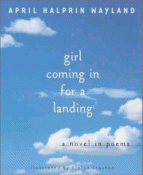 Girl Coming in for a Landing is a different kind of
experience in novel reading. It is like a highly personal
journal written in poetry, which is even more intimate
than prose because one experiences the feeling and supposes
the action. The action is outside the person and the
feelings are inside, reacting to what happens outside.
In a world that is largely prose-oriented, this novel made
up of the shorthand of poetry is a new and delightful experience.
The teen years are particularly sensitive
to the voice of poetry, because the rushing emotions of
growing up find their best expression in this form.
Girl Coming in for a Landing is a different kind of
experience in novel reading. It is like a highly personal
journal written in poetry, which is even more intimate
than prose because one experiences the feeling and supposes
the action. The action is outside the person and the
feelings are inside, reacting to what happens outside.
In a world that is largely prose-oriented, this novel made
up of the shorthand of poetry is a new and delightful experience.
The teen years are particularly sensitive
to the voice of poetry, because the rushing emotions of
growing up find their best expression in this form.
It would be difficult to choose a special poem from Girl Coming in for a Landing because the entire collection is part of a whole experience that should be savored from beginning to end. There are several themes in this novel, but the dominant theme has to be how a young woman finds her voice on the written page. First love, parental love, peer pressure, friends and the establishment represented by the inspiring, yet remote, teacher are all worked into the experience of young writer who must find herself in this confusing maze of feelings and events. The reader is carried along page after page by all the different emotions different subjects engender.
Ms. Halprin reaches out in this collection not only to the adolescent, or to those who can remember what coming of age was like day by day, she also reaches out to the writer that lives inside the reader. In her After Words, the author gives excellent advice to young writers about how to write and how to find that publisher who will crown the writer's efforts with publication. The last poem is Shakespeare's "Sonnet Number Twelve" which, like all poetry, must be read aloud to really be understood. The sonnet is about death, yet as we all know, Shakespeare became immortal through his poetry. Perhaps the author wants to encourage young writers to put words on paper in order to hold on to fleeting time. Young readers will find great pleasure in this unique novel written in the form of a collection of short poems.
--Sarah Reaves White
Sparks by Graham McNamee
Wendy Lamb Books, August, 2002Hardcover, 128 pages
ISBN: 0385729774
Ages 8-12
Ordering information:
Amazon.com
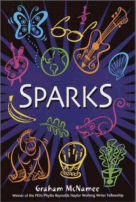 It is an obvious fact that some students do not
fit into our structured educational system, which places
such a high value on clerical skills and
abstract reasoning. It is also sometimes puzzling to find
out at twenty year reunions that some of the least
promising students have become quite successful in
real life. Author Graham McNamee was a special
needs student who was a slow learner and a class clown.
Now he has written a story about Todd Foster who
did so well in the special needs class in fourth grade
that he was moved into a regular classroom for fifth
grade. Now he is the class dummy and as he puts it
he needs "to grow a brain. Fast."
It is an obvious fact that some students do not
fit into our structured educational system, which places
such a high value on clerical skills and
abstract reasoning. It is also sometimes puzzling to find
out at twenty year reunions that some of the least
promising students have become quite successful in
real life. Author Graham McNamee was a special
needs student who was a slow learner and a class clown.
Now he has written a story about Todd Foster who
did so well in the special needs class in fourth grade
that he was moved into a regular classroom for fifth
grade. Now he is the class dummy and as he puts it
he needs "to grow a brain. Fast."
Todd tells his own story, and as he tells it the reader is immediately drawn in by his hilarious, wry remarks. Todd does not take out his frustration in anger. His predicament puzzles him and sometimes he feels discouraged. He suffers the usual torments of childhood with sibling rivalry and peer pressure, mixed in with the expectations of the adult world. Todd tries to terminate his friendship with the exuberant Amy who is still in the special needs class. Amy is a walking social disaster for a boy who is trying to make his way in the hypercritical and competitive world of the fifth grade.
Adults are seen through the clear but unpracticed eyes of childhood. Todd's father is trying to quit smoking, but Todd notices that his dad is actually overdosing on smoker's gum -- he has a huge wad of it in his mouth. Mr. Blaylock, Todd's sympathetic teacher, seems huge to Todd. Todd cannot figure out how Mr. Blaylock got to be so large.
It is Mr. Blaylock's assignment of a project for social studies that helps Todd find his way to success. The project is to write about how a pygmy named Ota Benga was brought to New York in 1906 and displayed in a monkey cage at the Bronx Zoo for people to see. The project is tied to how this little man must have felt. In doing his project, Todd discovers a creative way to do the project, and he learns to work on it for an extended time. When he receives a good grade on the project, Todd is thunderstruck. That afternoon in the after school study group, Todd asks if he really had made a B-plus since it was the first one he had ever made. Mr. Blaylock explains that his imaginative writing had made the difference, because imagination is more important than knowing facts alone. Thrilled with his success, Todd decides to make up with his friend, Amy, who is still in the special needs class.
Graham McNamee has written a book that will get any young reader to reconsider the way he treats students who may be different. Todd Foster is such a funny, likeable boy that any young reader will instantly be drawn into his story.
--Sarah Reaves White
Children's Book Reviews
Page One | Page Two
Return to Book Reviews Index
Return to the October 2002 issue of The IWJ.
More from Writers Write