
Interview with Rebecca Forster
by MaryAnna Clemons
|
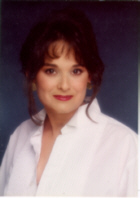
Rebecca Forster has been writing for a total of twelve years, six of those in the legal thriller field. Her books include Keeping Counsel, Character Witness, The Mentor and Beyond Malice. She holds an M.B.A from Loyola University and spent many years as a busy marketing executive before resigning to write fulltime. She is the proud mother of two sons and wife to a Superior Court Judge in Los Angles, California.
Her books have been acclaimed by Publisher's Weekly, Barnes and Noble and she was one of USA Today's bestselling authors. As an executive Rebecca got started writing when she admitted to her secretary that she didn't know her client's wife, Danielle Steele, but that she was sure that she "could do better than that." Her secretary dared her to try and twelve years later Rebecca not only writes full-time, she lectures and teaches writing to students of all ages, from kindergarten students to retirees.Do you ever miss your marketing career?
Yes, all the time. I miss getting dressed up, I miss seeing the people at the office, I miss that sense of "I have some where to go." I think one of the hardest things about being a writer is feeling that you work, live and breath the same space 24 hours a day. I very seldom go outside a five mile radius and that's to pick up my children from school.
Probably not as faced paced either?
Oh, no. Don't you think one of the hardest things about writing is you have to rely on yourself for everything, for the pace you set, for the hours you work, for the momentum your have or don't have?
Yes, I do agree. For six years you kept your day job, why?
Financial reasons. I think the reason I transitioned so successfully is that I didn't have that jarring sense of "I've lost everything, job, paycheck, friends." It was a family consideration, mostly I think if you are a two income family, writing is a very iffy profession. You can't just drop everything and say, "now I'm going to be a writer." It is just too market driven, in that they (New York) don't want the most creative story, they want a commercially successful story and your never sure that's what you have.
Were you still writing woman's fiction when you decided to write full time?
Yes, you can even see during that period most of them were some kind of legal thriller, yet they were being marketed under woman's fiction. I'll never forget one The Image Maker; it was about advertising and politics and it went from Los Angeles to San Francisco to Washington. They changed the title to Vows and put all these flowers on the front. I was getting letters from women who thought the book was about marriage vows and it wasn't. I didn't have any control over that. The thing that concerns me as a marketer is type size. I understand they want to conserve paper, but you get to a type size that is too small and my audience, which is mostly 40 and over, won't read it. Too much work, books are meant to be fun. So those are the kinds of things that to me are a bigger consideration.
When you went to legal thrillers you were pretty much already writing them but not getting being marketed correctly?
I was already there, in fact my first romance was a female federal prosecutor falling in love with a defense attorney in a child pornography case. I look back at that and say, "I knew where I wanted to be all along." But I think women, especially women, think we can only write a certain type of book.
That is something I wanted to make a point of -- that women don't have to be pigeon-holed.
Exactly. And the funny thing is that people will say, "Oh, you write just like a man." That's a compliment, but it's also an incredible statement about the way people look at this writing business -- that women should write this and men should write that. I look at something like The Horse Whisperer and that was a romance. It didn't have a happy ending, but it was a romance. And yet it was marketed as literary fiction.
Do you think that is because it was written by a man?
I do. I definitely do.
What do you think would have happened if a woman had wrote it using a man's name?
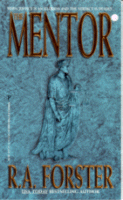
Click here for ordering information. |
You like it right up front?
Yeah, I do and I find very few women really do it the way I like it done. Patricia Cornwell, I really like her writing.
Do you think a lot of women start out with one idea but do another thinking that it will sell?
You got it. I think what they think is, "I want to write a book that will sell." Like romance, even though their heart may be in another genre, like science fiction. I did that for years, thinking that when I was financially able I would write what I want. Well that time never came. Finally I sat down and said, "I am going to write books from my heart." Do you know, Keeping Counsel just went into it's third printing?
That's great. You show a very in-depth knowledge of the legal field, where do you get that?
That comes from my husband who is a Superior Court Judge. I am a legal voyeur and have been for 25 years. I thought I wanted to go to law school, but I didn't have it in me to do that. But I love the law. I am fascinated by all the different levels, everybody thinks justice is separate from politics but it isn't; they are bedfellows. When I look at how it's changed in the last 25 years, I am blown away. My husband began his career just when women were beginning to become a big force in the profession and now 50% of the legal field are women. You can go into any court room and see a woman judge, a woman prosecutor, a woman defense attorney, even a woman defendant. It's like, wow, look at this, it's no longer the arena of men. That is why I love writing about women lawyers and women judges; I think they bring something quite different to the table. As far as researching, I have a such a wonderful variety of people I can call on, from FBI agents to DEA agents. I don't think I will ever run out of ideas.
Do you try to be realistic?
My books are extremely realistic. In fact with Character Witness I had the transcripts of the actual case.
| "It's like dating -- you have to date before you settle on a husband. It's the same with agents. I did a lot of "dating" but now I feel I found the agent that will benefit me the most." |
Did you have to get a new agent and publisher when you changed?
The agent I had at the time had no interest in promoting anything of mine but women's fiction. She didn't have any kind of a vision that I could move out of that. I felt very strongly that this was the direction I needed to go.
So if you had been less strong, she may have held you down?
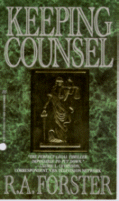 Click here for ordering information. |
Thank you very much for coming.
Thank you.
Return to the May 1998 issue of The IWJ.
More from Writers Write