
![]() ![]() |
|
|
|
|
Index Interviews: Jeanne M. Dams Build-A-Song Part V: Melody First Time Novelists Look to the Net for Success Upcoming Events Calendar Return to This Issue's Index Return to Homepage Subscribe
|
|
Reviews of Writing BooksWhich Lie Did I Tell? by William GoldmanPantheon, March 2000.Paperback, 485 pages. ISBN: 0375403493 Ordering information: Amazon.com. | Amazon.co.uk
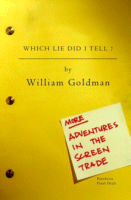
Which Lie Did I Tell? is a follow-up to
Adventures in the Screen Trade,
by extremely successful screenwriter
and novelist William Goldman, which
exposed Hollywood politics and stardom
and provided screenwriting know-how.
In his new screenwriter's aide, Goldman again
amazes with his
immense knowledge of screenwriting, the
movie business and the bizarre,
stress-ridden lifestyle of the screenwriter.
Goldman guides screenwriters through the
world of screenwriting, providing tips
on surviving rejection, examples of what makes
a good screenplay (and what doesn't), as well as methods
for pitching scripts. He also discusses
his own triumphs and failures and
tells stories about working with famous Hollywood
actors and legends such as Rob Reiner,
Mel Gibson, Michael Douglas, Chevy Chase,
Clint Eastwood and many others.
To aide the budding screenwriter, Goldman provides
excerpts and analysis of some of his own screenplays
such as Absolute Power, Butch Cassidy
and the Sundance Kid and The Princess Bride, as well as
excerpts from screenplays by others, including
There's Something About Mary, When Harry
Met Sally and Fargo.
With each script excerpt Goldman explains what works
and why.
William Goldman is an Oscar award-winning screenwriter and bestselling novelist. Some of his well-known work includes Butch Cassidy and the Sundance Kid, The Stepford Wives, All the President's Men, Misery, Maverick and Marathon Man. His insight into screenwriting and Hollywood is both incredibly enlightening and often hilarious -- and maybe even frightening to the budding screenwriter. "You meet people in this business, and one thing you must know is that just about everyone you come in contact with seems shockingly normal. Don't be fooled. Since movies succeed by word of mouth, something you cannot manufacture, everyone in the business is constantly in fear of losing their sport by the fire. Since they have no idea what go them there in the first place, this all makes for a certain lunacy and insecurity. Everyone assumes, correctly, that being writers, we are already loony and insecure." A great read for aspiring screenwriters and anyone interested in the inner-workings of the movie business. Highly recommended. 2000 Children's Writer's & Illustrator's Market Edited by Alice PopeWriter's Digest Books, January 2000.Trade Paperback, 394 pages. ISBN: 089879935X Ordering information Amazon.com. | Amazon.co.uk Note: This book is published annually. For the latest edition be sure to check the Writer's Bookstore.
This annual reference guide for
children's writers and illustrators
contains articles, interviews with
authors and publishers, tips and market
listings. Each year, the Editor of the guide updates the market
information and adds new features and
improvements to the book. This
year, the book features a new Agents
and Art Reps section, which contains
listings of literary agents and art reps who
specialize in or represent a good percentage
of children's writers or illustrators.
Markets covered in the book include
book publishers, magazine publishers,
greeting card companies, puzzle,
game publishers, play publishers and
special markets for young writers and
artist. Each listing includes contact
details, website information, details
about the publisher's needs for
both writers and illustrators and
payment and legal terms for accepted
work.
In addition to the information about
places to submit work and get published,
the guide also includes listings of
contests, conferences, workshops and
other web and print resources for
writers and illustrators.
Children's writers and illustrators
should not be without this information-packed reference
and market guide.
Formatting & Submitting Your Manuscript by Jack & Glenda Neff, Don PruesWriter's Digest Books, November 1999.Trade Paperback, 248 pages. ISBN: 089879921X Ordering information: Amazon.com. | Amazon.co.uk
Writers will be very pleased with this
detailed guide to manuscript
formatting and submitting.
The guide provides detailed
instruction, full-page samples
with pointers and do's and
don'ts to help writers learn how
to submit their work appropriately.
The book covers all types of
manuscripts and submissions, including
freelance articles, freelance queries,
book manuscripts, book proposals,
agent and editor queries, fillers, short stories,
novels, screenplays, television scripts,
plays, poetry and greeting cards.
The appendix includes information about
record keeping and forms, a permission
form to use copyrighted material, a sample
release form and a letter of agreement.
This book does the best job to date of showing writers how to submit their work in the correct format and style. The most valuable parts of the book are the highly detailed samples which show the correct format needed for each type of manuscript. The samples include even the tiniest details -- such as margin size, where to indent, center and underline, word counts and page numbering -- that you need to catch an editor's eye. This is a reference that writers will consult over and over again. Highly recommended. Return to Book Reviews Index ** More information on writing-related books can be found in the Writer's Bookstore. |