
![]() ![]() |
|
|
|
|
Index Interviews: Karen Swenson Articles: Where Do You Get Your Ideas...? (Part I) You've Finished Writing the Play: Now What? (Part II) An Inside Look At... george jr. Upcoming Events Calendar Book Reviews Reader Mail Return to This Issue's Index Return to Homepage Subscribe
|
|
Non-Fiction Book ReviewsPage One of ThreeToy Wars by G. Wayne MillerTimes Books, Feb., 1998.Hardcover, 348 pages. ISBN: 0812929845. Ordering information: Amazon.com. | Amazon.co.uk
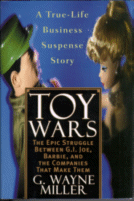
Popular toy Mr. Potato Head was originally rejected by the toy
compannies
because, made from a real potato with plastic eyes and ears,
toymakers thought it would soon spoil and smell up the house. Mighty Morphin
Power Rangers, the blockbuster TV show with all its valuable
spinoff merchandising opportunities, was rejected by every
major network and toymaker before Fox Children's Network programming genius
Margaret Loesch picked it up. These are just a tiny sampling of the fascinating
details which emerge from G. Wayne Miller's new exposé of the
competitive toy industry. Unlike the happy go lucky image
of the toy industry shown in the movie Big starring Tom Hanks,
the real toy industry is for adults-only and bears more resemblance
to a killing field than a playground. Toy Wars is a behind the scenes
look at Hasbro and its founders, the Hassenfeld family, and its
struggle with toy giant Mattel for supremacy in the highly competitive
industry. Populated with intriguing and sometimes zany characters,
Toy Wars reads more like a novel than the probing industry analysis that it is.
Given unprecedented access to personnel, product and confidential meetings, Miller, an award-winning journalist from the Providence Journal-Bulletin, crafts a remarkable true tale of a vicious, competitive business and the men and women who run it. Founded in 1920 as a pencil box company by immigrant brothers Hillel and Henry Hassenfeld, Hasbro eventually became the multi-million dollar conglomerate toy company so loved by fund managers under the tutelage of CEO Stephen Hassenfeld, until his death from AIDS (at the time a closely-guarded secret) in 1989. After Stephen's death, younger brother Alan picked up the reins of the company and guided it through a brutal restructuring and fended off a hostile takeover bid by arch-rival Mattel. Along the way, he grows as a person as well as a business leader to emerge victorious with a bright future -- for him, the children at the heart of the industry -- and the all-important stockholders. A story of power, greed, corruption, philanthropy, love and loyalty, Toy Wars is an exceptional telling of the extraordinary story of the brutal world of toys. --Claire E. White The Good, The Bad and The Very Ugly: A Hollywood Journey by Sondra LockeWilliam Morrow & Co., Nov., 1997.Hardcover, 320 pages. ISBN: 068815462X. Ordering information: Amazon.com. | Amazon.co.uk
In her Academy Award nominated film debut, The
Heart is a Lonely Hunter, Sondra Locke portrays Mick Kelly, a young
girl with dreams to move beyond the provinciality of her
small Southern hometown, to escape an emotionally distant
mother and to pursue the "greatness" within her. Her journey
is arduous at best and on the road growing up she loses a man
she loves. But she survives, a stronger, wiser and more determined
woman. Sondra Locke's life as detailed in The Good, The Bad and
The Very Ugly, mirrors this film. From a childhood interest in fairy
tales, she searched for a magic kingdom and her Prince Charming.
Along the way, she met Gordon Anderson who would become her
best friend, inspirer, supporter and husband -- despite his avowed
homosexuality. Their journey took them to Hollywood where in 1975,
Locke met superstar Clint Eastwood. With an instant mutual attraction,
they became involved, with Eastwood assuming an almost Svengali-like
control over Locke. For 13 years she devotes herself and her career
to him, stopping at nothing to please him.
When she directs her first picture and attains a limited degree of autonomy, the dreamworld collapses culminating in one of the most acrimonious and appalling Hollywood break-ups to date. Locked out of her home, her clothes thrown out, her car vandalized, and her phones tapped, Locke uncharacteristically pursues the first of two lawsuits against Eastwood, while admitting that "even thought I loved him deeply, I never viewed him as a highly evolved person." During the protracted legal battle, she discovers that she has breast cancer and undergoes a double mastectomy, while Eastwood never acknowledges her illness. It is at her most physically and emotionally vulnerable that he offers a settlement: a director's contract at Warner Brothers. Locke settles only to find after that the deal is an Eastwood-orchestrated sham. She files a fraud lawsuit against him and Warner Brothers in a move assuring career suicide. her stamina, strength and faith are tested once again. With the constant insight, encouragement and inspiration from her lifelong friend, Gordon, Locke emerges victorious physically, emotionally and professionally to start her life anew -- in peace. In a surprisingly interesting book, Locke spins a tale in the southern storytelling tradition with images of firefly-lit nights, homecooked meals, and colorfully eccentric characters. From sleepy Shelbyville to überwired Hollywood home of flickering street lamps, three martini lunches and self-centered amoral characters, Locke retains a down home perspective devoid of any pretense or ego. She quite candidly exposes her unconventional marriage to her homosexual best friend, her borderline supernatural experiences in her quest for God and the uncharacteristic naiveté of an assumed Hollywood insider. Locke tells her story with minimal rancor, occasional humor and frequent astonishment. Like her character, Mick Kelly, she emerges stronger and wiser on the road to find the greatness within her. An insightful story of growth and self-awareness as well as a compelling tale of Hollywood greed, betrayal and politics. --John J. Tucker Non-Fiction Reviews Page Two | Page Three Return to Book Reviews Index ** To visit the archives of nonfiction books reviewed in The IWJ, please click here. |