
Computer Book Reviews
Creative Thinking in Photoshop by Sharon Steuer
New Riders, April, 2002Trade Paperback, 223 pages
ISBN: 0735711224
Ordering information:
Amazon.com
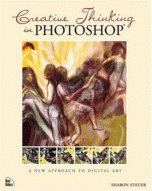 Creative Thinking in Photoshop offers a new
perspective on Photoshop from the point of
view of the artist. In this book, painter and illustrator
Sharon Steuer explains how she makes use of
Photoshop and provides practical advice and tips
to other artists interested in using Photoshop.
This is a different look at Photoshop,
because most Photoshop books
focus on the graphic artist, web designer or
layman user. Throughout the book, Steuer
uses her own artwork to show how she
gets the most out of Photoshop. Steuer teaches artists how
to use composite images, Photoshop layers, colors, tools
and special effects, plus many other techniques.
She also provides a chapter on collaboration and
a section about how to arrange
your workspace so that it supports your
creative workflow.
Creative Thinking in Photoshop offers a new
perspective on Photoshop from the point of
view of the artist. In this book, painter and illustrator
Sharon Steuer explains how she makes use of
Photoshop and provides practical advice and tips
to other artists interested in using Photoshop.
This is a different look at Photoshop,
because most Photoshop books
focus on the graphic artist, web designer or
layman user. Throughout the book, Steuer
uses her own artwork to show how she
gets the most out of Photoshop. Steuer teaches artists how
to use composite images, Photoshop layers, colors, tools
and special effects, plus many other techniques.
She also provides a chapter on collaboration and
a section about how to arrange
your workspace so that it supports your
creative workflow.
Steuer does a superb job of explaining the technical aspects of Photoshop to artists and helping artists learn new ideas about how to use computers more creatively. She also does a great job of highlighting differences (and similarities) between computer art, which she refers to as printmaking, and physical art, such as painting -- and explaining which medium is most useful for which tasks. Although sometimes even Steuer gets lost between the different mediums. As Steuer explains, "There are times when I'm painting in my studio when I suddenly realize, 'Oh my God, I can't undo!'". It makes for some very interesting reading, as you learn how painter and illustrator Sharon Steuer makes use of digital technology via Photoshop. This book is also an excellent learning aide for the professional artist looking to use Photoshop to turn his computer into an artist's tool.
Skip Intro: Macromedia Flash Usability and Interface Design by Michelangelo Carpraro and Duncan McAlester
New Riders, April, 2002Trade Paperback, 252 pages.
ISBN: 073571178X
Ordering information:
Amazon.com
 Finally, there is a Flash book that focuses
on the important concept of usability -- instead of
just providing pages and pages about how to create
ultra-cool Flash effects. Now, if we could just get the
developers of all those awkward and irritating Flash
designs on the Internet to read it. This book helps Flash
developers learn how to build Flash sites and menus that
web surfers will be more comfortable using. Chapter 1
of the book, "Bad Flashers Anonymous" gets readers
off on the right track by helping them learn how to identify
bad design and teaches some basic usability concepts.
Chapter 2, "Basic Training", covers Flash basics including
the Flash coding environment and debugging.
The brunt of the book teaches Flash developers interface
design through example designs for real Flash sites,
which include step-by-step procedures, code
and screenshots. The book also includes
listings of additional Flash and usability resources including
books and websites. A CD-ROM also comes with the book
which includes the code and project files from the text.
Skip Intro does a thorough job of explaining usability and
interface design concepts. Armed with this knowledge,
Flash developers can provide a more user-friendly
website for their customers. A must-read for professional
Flash developers.
Finally, there is a Flash book that focuses
on the important concept of usability -- instead of
just providing pages and pages about how to create
ultra-cool Flash effects. Now, if we could just get the
developers of all those awkward and irritating Flash
designs on the Internet to read it. This book helps Flash
developers learn how to build Flash sites and menus that
web surfers will be more comfortable using. Chapter 1
of the book, "Bad Flashers Anonymous" gets readers
off on the right track by helping them learn how to identify
bad design and teaches some basic usability concepts.
Chapter 2, "Basic Training", covers Flash basics including
the Flash coding environment and debugging.
The brunt of the book teaches Flash developers interface
design through example designs for real Flash sites,
which include step-by-step procedures, code
and screenshots. The book also includes
listings of additional Flash and usability resources including
books and websites. A CD-ROM also comes with the book
which includes the code and project files from the text.
Skip Intro does a thorough job of explaining usability and
interface design concepts. Armed with this knowledge,
Flash developers can provide a more user-friendly
website for their customers. A must-read for professional
Flash developers.
XML and ASP.NET by Kirk Allen Evans, Ashwin Kamanna and Joel Mueller
New Riders, April, 2002Trade Paperback, 822 pages.
ISBN: 073571200X
Ordering information:
Amazon.com
 The book helps ASP developers learn how to
use XML and ASP in Microsoft .NET web
applications. Some of the .NET technologies
covered include Xpath, XSLT, XML Schemas and
the Microsoft XML Parsers. Other
concepts covered in the text include
using XML with ADO.NET, the .NET
Framework classes, whitespace handling in
XML, validating XML documents, using Visual
Studio .NET, XML serialization, creating
XML Web Services, SQL Server 2000 and WAP and WML
programming. The appendixes in the book
provide handy reference sections on ASP.NET objects,
MSXML and XSLT.
The book helps ASP developers learn how to
use XML and ASP in Microsoft .NET web
applications. Some of the .NET technologies
covered include Xpath, XSLT, XML Schemas and
the Microsoft XML Parsers. Other
concepts covered in the text include
using XML with ADO.NET, the .NET
Framework classes, whitespace handling in
XML, validating XML documents, using Visual
Studio .NET, XML serialization, creating
XML Web Services, SQL Server 2000 and WAP and WML
programming. The appendixes in the book
provide handy reference sections on ASP.NET objects,
MSXML and XSLT.
Users that prefer to learn by studying the code will be pleased, because the book includes a great deal of sample code. Unfortunately, there is not a CD-ROM included with the book so readers will need to copy code from the book. Some prior experience with XML and ASP is recommended before reading XML and ASP.NET. Programmers already using XML and ASP will get the most benefit from this book as they learn how to transfer their knowledge to .NET applications.
Return to Book Reviews Index
Return to the June 2002 issue of The IWJ.
More from Writers Write