
Fantasy/SF Book Reviews
The Best Military Science Fiction of the 20th Century Edited by Harry Turtledove with Martin H. Greenberg
Del Ray, May, 2001.Trade Paperback, 544 pages.
Ordering information:
Amazon.com.
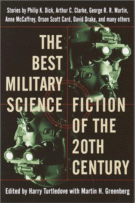 Editors Harry Turtledove and Martin H. Greenberg
took on a difficult project when they decided to
select the very best military SF stories of the
20th century for this anthology. The pieces they selected
all certainly qualify as excellent: thirteen stories
by such luminaries in the field as Philip K. Dick,
Orson Scott Card, Joe W. Haldeman, Arthur C. Clark
Anne McCaffrey, C.J. Cherryh, George R. R. Martin
are all represented here. A unifying theme
seems to be short stories which led to greater
things. The short story which inspired the brilliant, novel-length
form of Ender's Game by Orson Scott Card is here, as
is the McCaffrey short story which started the Dragonriders of
Pern phenomenon (which is really a novella). "Hero" by
Joe Haldeman led to The Forever War.
Editors Harry Turtledove and Martin H. Greenberg
took on a difficult project when they decided to
select the very best military SF stories of the
20th century for this anthology. The pieces they selected
all certainly qualify as excellent: thirteen stories
by such luminaries in the field as Philip K. Dick,
Orson Scott Card, Joe W. Haldeman, Arthur C. Clark
Anne McCaffrey, C.J. Cherryh, George R. R. Martin
are all represented here. A unifying theme
seems to be short stories which led to greater
things. The short story which inspired the brilliant, novel-length
form of Ender's Game by Orson Scott Card is here, as
is the McCaffrey short story which started the Dragonriders of
Pern phenomenon (which is really a novella). "Hero" by
Joe Haldeman led to The Forever War.
The book represents older stories written in the 1950s through more recent ones, such as "Scapegoat," C.J. Cherrah's interesting tale about communication and the misunderstandings of war. While some of the stories seem a bit dated in the technological department, they nevertheless hold their appeal because of the authors' skill with characterization and imagination. This is an excellent anthology that is a must-have for fans of the military SF subgenre.
Cloak of Deception (Star Wars) by James Luceno
Del Ray, May, 2001.Hardcover, 342 pages.
ISBN: 0345442989
Ordering information:
Amazon.com.
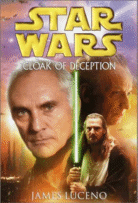 James Luceno steps behind the wheel for this
interesting and well-imagined look at the political
maneuvering orchestrated by Senator Palpatine
just before the events chronicled in The Phantom
Menace. The Galactic Republic is falling apart.
Terrorists are attacking Trade Federation ships,
many worlds are unhappy about the Trade Federation's
virtual monopoly power over the shipping lanes,
and a controversial taxation plan is being hotly debated.
When Jedi Master Qui-Gon Jinn and his padawan
Obi-Wan Kenobi stop an assassination attempt against
Supreme Chancellor Valorum, it becomes clear to the
Jedi Council that someone is pulling the strings behind
the escalating events which seem to indicate the impending
breakdown of the Republic.
Qui-Gon and Obi-Wan travel offworld for
the trade conference which Supreme Chancellor
Valorum will be attending, much to the annoyance of his
security advisers. Intelligence suggests that another
assassination attempt will be made at the conference.
But the Jedi Knights don't yet realize the nature and power of their
enemy: the Sith Lord, Darth Sidious.
James Luceno steps behind the wheel for this
interesting and well-imagined look at the political
maneuvering orchestrated by Senator Palpatine
just before the events chronicled in The Phantom
Menace. The Galactic Republic is falling apart.
Terrorists are attacking Trade Federation ships,
many worlds are unhappy about the Trade Federation's
virtual monopoly power over the shipping lanes,
and a controversial taxation plan is being hotly debated.
When Jedi Master Qui-Gon Jinn and his padawan
Obi-Wan Kenobi stop an assassination attempt against
Supreme Chancellor Valorum, it becomes clear to the
Jedi Council that someone is pulling the strings behind
the escalating events which seem to indicate the impending
breakdown of the Republic.
Qui-Gon and Obi-Wan travel offworld for
the trade conference which Supreme Chancellor
Valorum will be attending, much to the annoyance of his
security advisers. Intelligence suggests that another
assassination attempt will be made at the conference.
But the Jedi Knights don't yet realize the nature and power of their
enemy: the Sith Lord, Darth Sidious.
Cloak of Deception is a crucial book for understanding why Prime Chancellor Valorum fell from power, and how Senator Palpatine brilliantly manipulated events and people as he follows his own dark path to power and glory. With less action and more time spent following Palpatine's machinations, Cloak of Deception is an interesting departure from the normal Star Wars books. The glimpses inside Palpatine's mind make for great reading, as he pulls strings in the Senate and off-world with equal ease. Although politics are the focus of the book, Qui-Gon and Obi-Wan see enough fast-paced action to satisfy everyone. This is a must-read for Star Wars fans.
The Eugenics Wars: The Rise and Fall of Khan Noonien Singh (Star Trek) by Greg Cox
Pocket Books, July, 2001.Hardcover, 404 pages.
ISBN: 0671021273
Ordering information:
Amazon.com.
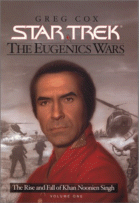 One of the best Star Trek motion pictures was Star Trek II: The Wrath
of Khan, which expanded on the story from the original series
entitled "Space Seed." Superman Khan Noonien Singh,
portrayed by Ricardo Montalban, nearly takes over the
Enterprise after he is thawed out from a cryonic freezing chamber
aboard a space ship that left Earth hundreds of years before.
Greg Cox mixes the storyline started in "Space Seed" with
another popular episode from the original series which
featured Gary Seven, a human genetically engineered
by a distant alien society to save Earth from itself during
the 1960s. The story opens as Captain Kirk must review
historical tapes of the latter part of the 20th century in order
to prepare for an upcoming meeting in which genetic enhancement
will be a hot issue. The story then follows super agent Gary Seven,
his secretary Roberta Lincoln and the shape shifting cat Isis
through their adventures from 1974 onward. The team
first must infiltrate Chrysalis, a secret genetic
engineering project whose goal is to wipe out humanity with
bioweapons, then turn the planet over to a genetically engineered
superrace. One of the children born of the project is Khan, who
is rescued by Seven. Seven attempts to recruit Khan over the
years to assist in his missions, but the arrogant Khan has
other plans: namely, world domination.
One of the best Star Trek motion pictures was Star Trek II: The Wrath
of Khan, which expanded on the story from the original series
entitled "Space Seed." Superman Khan Noonien Singh,
portrayed by Ricardo Montalban, nearly takes over the
Enterprise after he is thawed out from a cryonic freezing chamber
aboard a space ship that left Earth hundreds of years before.
Greg Cox mixes the storyline started in "Space Seed" with
another popular episode from the original series which
featured Gary Seven, a human genetically engineered
by a distant alien society to save Earth from itself during
the 1960s. The story opens as Captain Kirk must review
historical tapes of the latter part of the 20th century in order
to prepare for an upcoming meeting in which genetic enhancement
will be a hot issue. The story then follows super agent Gary Seven,
his secretary Roberta Lincoln and the shape shifting cat Isis
through their adventures from 1974 onward. The team
first must infiltrate Chrysalis, a secret genetic
engineering project whose goal is to wipe out humanity with
bioweapons, then turn the planet over to a genetically engineered
superrace. One of the children born of the project is Khan, who
is rescued by Seven. Seven attempts to recruit Khan over the
years to assist in his missions, but the arrogant Khan has
other plans: namely, world domination.
As we learn more about Seven and his adventures behind the scenes to save humanity, it becomes clear why the Star Trek history and the history that we know differ so greatly. Seven had a hand in everything from the fall of the Soviet Union to the worldwide release of the information about the hole in the Ozone layer and global warming. Along the way, he and Roberta meet many characters alluded to in the Star Trek universe, and save humanity from itself countless times. Cox clearly loves the characters and the Star Trek universe, and he does an excellent job of portraying events and people with just the right touch. There is action, excitement and plenty of humor. The first of a projected trilogy, The Eugenics Wars will only whet fans' appetite for more of what looks to be one of the very best sub-series written in the Star Trek universe.
Return to Book Reviews Index
Return to the July 2001 issue of The IWJ.
More from Writers Write