
Mystery/Thriller Reviews
Lost in a Good Book by Jasper Fforde
Viking, Penguin USAHardcover, 416 pages
ISBN: 0670031909
Ordering information:
Amazon.com
 Special Operative Tuesday Next, literary detective,
has become a national celebrity after her last case, in which she
saved the literary masterpiece, Jayne Eyre from
destruction by the evil villain Archeron Hades.
(See, The Eyre Affair for further details).
To make matters worse, the love of her life,
her husband Landon, has been eradicated from this
timeline by the evil megalithic Goliath Corporation.
Tuesday has the rare ability to be able to
read herself into a book -- literally. Goliath
demands that she enter Poe's The Raven
and release a criminal whom she imprisoned there.
If she releases the infamous Jack Schitt, then her
husband will be restored (right now, no one remembers
that he ever even existed.) Tuesday is determined to
find her husband, but her boss insists that she
work on the case of a heretofore undiscovered
Shakespeare play, Cardenio, the discovery of which
could have devastating results
in the next political election. With the help of Miss Havisham
from Great Expectations and the Cheshire
Cat from Alice in Wonderland, Tuesday sets out on a
dangerous literary adventure from which she
may not return.
Special Operative Tuesday Next, literary detective,
has become a national celebrity after her last case, in which she
saved the literary masterpiece, Jayne Eyre from
destruction by the evil villain Archeron Hades.
(See, The Eyre Affair for further details).
To make matters worse, the love of her life,
her husband Landon, has been eradicated from this
timeline by the evil megalithic Goliath Corporation.
Tuesday has the rare ability to be able to
read herself into a book -- literally. Goliath
demands that she enter Poe's The Raven
and release a criminal whom she imprisoned there.
If she releases the infamous Jack Schitt, then her
husband will be restored (right now, no one remembers
that he ever even existed.) Tuesday is determined to
find her husband, but her boss insists that she
work on the case of a heretofore undiscovered
Shakespeare play, Cardenio, the discovery of which
could have devastating results
in the next political election. With the help of Miss Havisham
from Great Expectations and the Cheshire
Cat from Alice in Wonderland, Tuesday sets out on a
dangerous literary adventure from which she
may not return.
Tuesday Next lives in an alternate universe version of 1985 Great Britain where the Crimean War is still dragging on, Goliath Corporation runs just about everything, dodos, Neanderthals and woolly mammoths have been re-engineered, great literature is the great passion of the public, and time travel is possible. It's an absurdist universe, but one that is strangely recognizable. In fact, the Goliath Corporation descriptions bring to mind Enron executives busily manipulating California's energy market in order to make a profit. Jasper Fforde is a truly delightful writer: he excels at witty dialogue, vivid characterizations and insanely devilish plotting. The only annoyance? It will be an entire year until The Well of Lost Plots, which chronicles Tuesday's further adventures in literature, appears in American bookstores.
--Claire E. White
Utopia by Lincoln Child
Doubleday, December, 2002Hardcover, 400 pages
ISBN: 0385506686
Ordering information:
Amazon.com
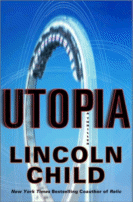 Dr. Andrew Warner, a brilliant computer engineer, is requested
to return to the theme park he helped design for some
troubleshooting. Warner designed the Metanet, an
intricate self-learning computer system that controls all the
robots in Utopia, an amazing hologram-based
theme park that attracts over 65,000 people per day.
The park has stunning displays, thrilling rides and
themed worlds like Camelot, Boardwalk and Gaslight,
whose holographic-realism put Disneyland to shame. Warner
has brought along his teenage daughter, Georgia, who has been
eager to see the park. Unfortunately, this day will be no walk
in the park for Warner and his daughter.
Warner has been mislead about the
extent of the computer problems and terrorists have decided to
pick his day of visiting the park as a time to launch an attack.
Warner has to figure out what is going wrong in Utopia and
stop it before it can harm thousands of innocent park visitors,
including his own daughter.
Dr. Andrew Warner, a brilliant computer engineer, is requested
to return to the theme park he helped design for some
troubleshooting. Warner designed the Metanet, an
intricate self-learning computer system that controls all the
robots in Utopia, an amazing hologram-based
theme park that attracts over 65,000 people per day.
The park has stunning displays, thrilling rides and
themed worlds like Camelot, Boardwalk and Gaslight,
whose holographic-realism put Disneyland to shame. Warner
has brought along his teenage daughter, Georgia, who has been
eager to see the park. Unfortunately, this day will be no walk
in the park for Warner and his daughter.
Warner has been mislead about the
extent of the computer problems and terrorists have decided to
pick his day of visiting the park as a time to launch an attack.
Warner has to figure out what is going wrong in Utopia and
stop it before it can harm thousands of innocent park visitors,
including his own daughter.
Lincoln Child, who frequently writes entertaining thrillers like Relic, The Ice Limit and The Cabinet of Curiosities with coauthor Douglas Preston, has completed a successful solo mission with Utopia. Utopia is a fascinating and unique thriller with an absolutely remarkable setting in a futuristic theme park. Child has planned the theme park, Utopia, so well that it appears to be a very reasonable view of what a future theme park might be like. The park creates elaborate settings and rides, using holograms and advanced technological wizardry to amaze and stun its audience. Child's Utopia does not just have an appealing backdrop -- the characters are also interesting and entertaining and the threat of terrorism on the park conveys urgency and genuine danger. Utopia is a great read for both thriller and science fiction lovers alike.
Click Here to Return to the Book Reviews Index
Return to the February 2003 issue of The IWJ.
More from Writers Write