
Children's Book Reviews
Page One of TwoBoston Jane: Wilderness Days by Jennifer L. Holm
HarperCollins, September, 2002Hardcover, 242 pages
ISBN: 0060290439
Ages 10 and up
Ordering information:
Amazon.com
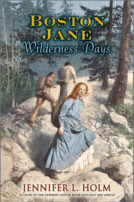 Boston Jane is a spunky, red haired sixteen year-old girl
who has an excellent finishing school education that
has given her few skills for surviving in the frontier
territory of Washington in the 1850s. She has followed
a young man to the American West, lured like so
many young women, with a promise of marriage.
On arriving, Jane finds that her intended has married
another woman and left her stranded in a strange land
full of rough men, rough living conditions and little hope.
Soon after the first blow of finding that her intended
had failed to wait for her, Jane receives the last letter
from her father which was mailed after his death. Jane
finds herself in a world of men who all seem untrustworthy
and ungrateful. Forced to wash clothes, cook and sew,
Jane's resentment and distrust of men grows out of
proportion to reality, and she soon finds herself in
a depressed
state. Her one hope of escape, going into the oyster
harvesting business with her landlord, ends in disaster
when he gambles away all the profit of their first
shipment and leaves nothing to pay the laborers who
worked for them. All seems lost. Even the proposal
of marriage from Jehu, the young ship captain, appears
dangerous. Jane knows that a man who is married
can claim twice the amount of land that a single man can claim.
Boston Jane is a spunky, red haired sixteen year-old girl
who has an excellent finishing school education that
has given her few skills for surviving in the frontier
territory of Washington in the 1850s. She has followed
a young man to the American West, lured like so
many young women, with a promise of marriage.
On arriving, Jane finds that her intended has married
another woman and left her stranded in a strange land
full of rough men, rough living conditions and little hope.
Soon after the first blow of finding that her intended
had failed to wait for her, Jane receives the last letter
from her father which was mailed after his death. Jane
finds herself in a world of men who all seem untrustworthy
and ungrateful. Forced to wash clothes, cook and sew,
Jane's resentment and distrust of men grows out of
proportion to reality, and she soon finds herself in
a depressed
state. Her one hope of escape, going into the oyster
harvesting business with her landlord, ends in disaster
when he gambles away all the profit of their first
shipment and leaves nothing to pay the laborers who
worked for them. All seems lost. Even the proposal
of marriage from Jehu, the young ship captain, appears
dangerous. Jane knows that a man who is married
can claim twice the amount of land that a single man can claim.
Then, a young couple arrives, and Jane thinks that she will now have another woman like herself as a friend. Mr. and Mrs. Frink are very charming, and they intend to open a hotel. But Mrs. Frink is too charming. She has all the men in town competing to do things for her. Everything she does seems charming and gracious, and Jane feels even more unappreciated and lonely. Then a stranger who is kind, and has gracious manners appears suddenly when most of the men of the area have left for a few days. When he leaves, he gives Jane a gold watch which will pay for her passage back to Boston. Only when she is ready to go does Jane find out that the man who was so kind may very well be planning a horrible revenge on Mr. Russell. Mr. Russell and others from Shoalwater Bay have gone to meet with the governor of the territory and all the native tribes. The Governor is determined to buy land from the Indians and then move them all to a reservation. Jane, Jehu and a young Keerukso must make a fast journey across the territory to stop the impending disaster.
Ms. Holm has done a masterful job of taking the reader back to a time and culture, the rules of which are now largely forgotten. The difficulties that pioneer women had to overcome were enormous, yet they had few rights. Somehow they managed to perform astounding amounts of work, while keeping to social mores that seem strangely out of place on the frontier. Boston Jane's adventures will keep any young reader's attention and it will give the reader a real initiation into how one generation laid the foundation for a new world.
--Sarah Reaves White
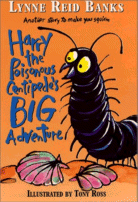
Harry and the Poisonous Centipede's Big Adventure by Lunne Reid Banks, Illustrated by Tony Ross
Harper Trophy, January, 2003Trade paperback, 180 pages
ISBN: 0060291397
Ages 7-10
Ordering information:
Amazon.com
 Young readers who have enjoyed the earlier book
Harry the Poisonous Centipede, will be happy to
find that Lynne Reid Banks has provided them with
a book of new adventures of the likeable little
arthropod. The amusing bug's eye view of the world
we all inhabit makes the tale not only enjoyable but
is also subtly instructive.
Young readers who have enjoyed the earlier book
Harry the Poisonous Centipede, will be happy to
find that Lynne Reid Banks has provided them with
a book of new adventures of the likeable little
arthropod. The amusing bug's eye view of the world
we all inhabit makes the tale not only enjoyable but
is also subtly instructive.
Harry has been warned by his mother about all sorts of dangers that exist in the outside world. There are flying swoopers (eagles), hard-air prisons (jars that people who like insects use for specimens), and worst of all, there are Hoo-mins (humans) that either collect bugs or try to stop them (kill them). They all live in a world that has no-end puddles (the ocean) and can be easily trapped by a Hoo-Min in a straight-up hard thing (a shoebox).
At the beginning of the story Harry is captured by a small Hoo-Min, who adds him to his growing collection of insects, spiders and dung beetles. Harry and the other prisoners are miserable because they are starving. It seems that the boy does not read books, therefore he has no idea of what the proper requirements for his prisoners are. The big jail break occurs when the boy's mother comes in to clean his room, is startled and ends up spilling the entire collection on the floor, breaking all the bottles and allowing the prisoners to escape. Even though he has now escaped, Harry shows loyalty by going back to rescue George the other centipedes. Adventures begin to follow one after another. The centipedes are dropped from the air by a flying swooper (eagle) into the no-end puddle (ocean), meet their distant relatives (marine centipedes) which they learn to dislike, escape the terrible army ants and finally end up in a straight-up hard thing (shoe box) and threatened by a hairy biter (badger). They are released from this serious situation when something bites the hairy bottom of the hairy biter. Harry's mother has come to his rescue, and all ends well with the two little centis happy and comfortable back in their dark, damp tunnel.
The whimsical and amusing drawings of illustrator, Tony Ross, add even more humor to the story of Harry and George. The facial expressions are hilarious, and add a great deal to the enjoyment of this story about the world under our feet.
--Sarah Reaves White
Children's Book Reviews
Page One | Page Two
Return to Book Reviews Index
Return to the February 2003 issue of The IWJ.
More from Writers Write