
A Marathon Children's Book Week
by Hazel Edwards
The Australian Children's Book Week is held nationally around the last week in August (16th-23rd in 2003) From a short list promoted earlier in the year, the Children's Book Council judges select books to win or be commended in specific categories such as picture book, junior readers, non fiction and older readers. "Oceans of Stories" was this year's theme and visiting authors and illustrators spoke in schools and libraries to thousands of children.My YA ( young adult eco thriller) Antarctica's Frozen Chosen fit the theme because it is set in the Great Southern Ocean en route for Antarctica.
It's the kids' questions that make Children's Book Week visits worthwhile. Discussing where you'd look for a lost voice, Michelle in Grade 5, said. "The cat."
"Why?"
"That saying, the cat got your tongue. You need a tongue for a voice."
It was worth the 45 minute drive to Salisbury Downs, navigating with a few false turns in a hire-car, for an 8 am Author Breakfast, to encourage THAT mind!
"Children's Book Week is the authors' speaking marathon," said an author colleague. "In the month before, I get into training."
She's right about the endurance required, but with twenty 45 minute talks in five days to get to the right places interstate, on time, plus hauling books, it's closer to orienteering. Librarians and teachers also require stamina.
My Children's Book Week
- A Qantas strike. Luckily, I fly Sunday and the extra box
of books are known as authors' "tools of trade".
- My agent Carole Carroll meets me at Adelaide airport, to
finalize the Channel 7 Bookplace televised reading late Monday.
- St Peter's librarian collects me. The silver scooter in her car
is a "bikie gang" prop in the staff-performed melodrama. Enthused,
the student audience Hiss and Boo to cue cards. The Book Club
"award" their review choices with Hollywood fanfare. Great to
see boys so keen about reading. The accessible library is
buzzing with "foody" books for the "Feast" theme.
- I use an iceberg as a writing symbol. "Only a tenth shows,
but there's all the work underneath".
- Since Grade 5 study Antarctica, they ask,
"Are there any toilets out on the ice?"
They'll remember my F.U.D. (female urinary device) for use under freezer suits!
- Do they think the Hagg tracked vehicle can be seasick
(like most en-route to Antarctica)? Can it talk on its
own radio, or do I need an expeditioner to speak? They enjoy
being part of the process of characterising the Hot
Ice Pack vehicles.
- Words are "all senses clues on paper" for the reader.
"Do you think in words, pictures, smells, sounds, movement, textures or abstract? Or in some other way?" One boy thinks in numbers. I think in abstract. So I explain how I work with illustrators who think in pictures or theatre directors who think in movement and sound. Creativity is often collaborative.
- Channel 7 shoots a reading of There's a Hippopotamus on Our Roof
with pre-schoolers. One child picks his nose and we re-shoot. 4 year
old "Tom" loves "Stickybill TV Duckstar", so we talk about that on
camera. Smiling, the real director empathises with the satirised TV
duck who has to "direct" difficult people.
- As one-person "ideas" businesses, authors have to maintain
projects, by email or mobile, even when on tour. I use an
Internet café to download details of a possible pollutant
from my Antarctic "boffin" contact.
- Early Tuesday I write for an hour in my hotel, then leave my
expeditioner character slipping on an ice floe, trying to
rescue a vial of pollutant. At this tour's pace, he'll be there
for a few days before I rescue him in the next chapter.
- 9-9:30am. A school traffic jam. Under trees, "Dads" and "Male Family
Friends" read to groups. Adventure and non-fiction are popular. It's
quietly satisfying.
- Wednesday. Authors notice names. "Smile" hire-car is apt for the 7.15 am.
pick-up. A Glenelg street has the same surname as the librarian. Yes,
historic family connections. And a courteous escort of children on
author-spotting duty in the sports carpark alongside the school.
- "This is ordinary for you, but it's special for us to meet the author.
Thank you for coming."
- A teacher graphed my Winning a Giraffe Called Geoffrey novel for
readability with his class. Chapter 6 peaks. I can't remember
what's in Chapter 6 until I check. I leave him with my draft
manuscript Where Did My Birthday Go? which explains the maths
of leap years. He likes that.
- Glenelg illustrator Leanne Argent used the local pier in my
"Not Lost Just Somewhere Else" ten years ago. Local kids are
thrilled. In the lunch break, I walk to look at the pier and
grab a yoghurt in transit because the voice is getting croaky.
- Censorship occurs unexpectedly. "You mention a tampon in your
book Duty Free. I couldn't ask a male teacher to read that.
We don't have sex education here."
- In another school, Duty Free goes on the Asian studies list
because it's set in China. Should novelists choose their
subjects to fit the curricula?
No.
- Murphy's Lore: the speaker's room is furtherest from the entrance where you
park. My wheeled suitcase for books is the BEST investment. So are four
pieces of coordinated, drip-dry clothing, and comfortable shoes.
- 7pm. Appreciating my evening audience has already put in a
day's work, I share humorous anecdotes of Antarctica and "behind
the books" tales. My website has free teachers' notes and I
participate in Internet book raps because I'm conscious of
time-poor librarians. Feedback is valuable and they buy lots
of my books from the bookseller despite
"Don't like the covers much."
- Thursday. The scenic route. Children have made sparkly snail
mail letters and I autograph the school books. Mock TV
interviews where kids ask questions of the author.
- Friday I'm tiring, but I know the route, and arrive
right on 8 am. Workshopping today, we create Sal and Lis the
Salisbury Downs sleuths who solve the mystery of the lost
key on site. I leave teachers with follow-up dossiers. The
librarian and I devise a Stickybill book rap.
- Return the hire-car, show my ID, get my e-ticket, have
my nail scissors confiscated at the scanner and then:
"Anyone with the incorrect boarding pass?"
Checking I discover that I have become Dr David Edwards. At least Qantas don't off-load me. And my voice still works.
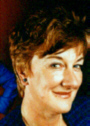 **Hazel Edwards is the Melbourne-based author of
150 books for adults and children including the
classic, There's a Hippopotamus on our Roof Eating Cake.
Antarctic Writer on Ice
is in its fourth reprint, and is available on audio
and in Braille, a YA eco-thriller Antarctica's
Frozen Chosen (Lothian 2003) and an Antarctic play in
Right or Wrong (Phoenix Education) are some of the writing
based on her Antarctic Division polar resupply Voyage 5
to Casey Station in 2001.
My Dad's Gone to Antarctica,(Lothian 2004)
a picture book, is in progress.
Recent children's books include Stickybill TV Duckstar
The Cyber Farm with Hobbit
director Christine Anketell.
You can visit her website at
hazeledwards.com.
Married with two adult children, Hazel's hobbies
are swimming, belly dancing and asking questions.
**Hazel Edwards is the Melbourne-based author of
150 books for adults and children including the
classic, There's a Hippopotamus on our Roof Eating Cake.
Antarctic Writer on Ice
is in its fourth reprint, and is available on audio
and in Braille, a YA eco-thriller Antarctica's
Frozen Chosen (Lothian 2003) and an Antarctic play in
Right or Wrong (Phoenix Education) are some of the writing
based on her Antarctic Division polar resupply Voyage 5
to Casey Station in 2001.
My Dad's Gone to Antarctica,(Lothian 2004)
a picture book, is in progress.
Recent children's books include Stickybill TV Duckstar
The Cyber Farm with Hobbit
director Christine Anketell.
You can visit her website at
hazeledwards.com.
Married with two adult children, Hazel's hobbies
are swimming, belly dancing and asking questions.
Return to the December 2003 issue of The IWJ.