
Reviews of Writing Books
The Art of the Book Proposal by Eric Maisel, Ph.D.
Tarcher/Penguin, May, 2004Hardcover, 288 pages
ISBN: 1585423343
Ordering information:
Amazon.com
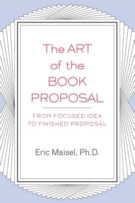 The Art of the Book Proposal is an excellent tool for helping writers focus on what
they need to do to develop a saleable nonfiction book. If you have an idea
for a book, but don't know what it takes to turn your ideas into a solid
manuscript and book proposal that can pitched to an agent or publisher, then
this is the guide for you. Author and psychotherapist Eric Maisel, Ph.D.
teaches numerous methods for
developing your book, selecting a title, organizing the table of contents,
distinguishing your book from the competition and effectively expressing your
credentials. No matter what problem you're having in writing your nonfiction book,
Maisel is there with an answer. For example, if you have trouble with chapter summaries, Maisel
offers twelve techniques for summarizing. If you are stuck on how to get the book
written, Maisel discusses a concept called chunking which helps you write the book
in different chunks -- the building blocks of your nonfiction book. He also explains
book proposals and helps writers select a sample chapter, create the marketing
points and write the query letter. Exercises and checklists are also provided to
help writers achieve their objectives. If you are considering writing a nonfiction
book, do not miss out on this wonderful book that will help you plan, organize and
create a winning book and book proposal. Highly recommended.
The Art of the Book Proposal is an excellent tool for helping writers focus on what
they need to do to develop a saleable nonfiction book. If you have an idea
for a book, but don't know what it takes to turn your ideas into a solid
manuscript and book proposal that can pitched to an agent or publisher, then
this is the guide for you. Author and psychotherapist Eric Maisel, Ph.D.
teaches numerous methods for
developing your book, selecting a title, organizing the table of contents,
distinguishing your book from the competition and effectively expressing your
credentials. No matter what problem you're having in writing your nonfiction book,
Maisel is there with an answer. For example, if you have trouble with chapter summaries, Maisel
offers twelve techniques for summarizing. If you are stuck on how to get the book
written, Maisel discusses a concept called chunking which helps you write the book
in different chunks -- the building blocks of your nonfiction book. He also explains
book proposals and helps writers select a sample chapter, create the marketing
points and write the query letter. Exercises and checklists are also provided to
help writers achieve their objectives. If you are considering writing a nonfiction
book, do not miss out on this wonderful book that will help you plan, organize and
create a winning book and book proposal. Highly recommended.
Dojo Wisdom for Writers by Jennifer Lawler
Penguin, August, 2004Paperback, 204 pages
ISBN: 0142196312
Ordering information:
Amazon.com
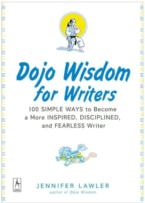 Writers are always seeking inspiration and encouragement
that can help them tap into their muse. Dojo Wisdom
for Writers gives aspiring writers the strength and wisdom
of the dojo (a martial arts training room) to
tap into their creativity. Author Jennifer Lawler, who also has
a black belt in Tae Kwon Do, has used
this wisdom to quit smoking, lose weight and get into
top physical shape. She has also learned to apply these
techniques to her writing and in Dojo Wisdom for Writers
she passes along her experiences and knowledge so that writers
can learn to use them to increase both creativity and productivity.
Lawler offers 100 lessons from the martial arts and 100 exercises
to go with them. The lessons and exercises focus on dojo
concepts like "Practice daily, regardless of circumstances,"
"Discipline leads to strength," "Sometimes, remain silent,"
"Accept criticism to grow" and "No one gets the jump
spinning wheel kick on the first try." Lawler teaches writers
how each of the lessons applies to writing and how they
can use the wisdom to become a focused, disciplined and
successful writer. The hard truth is that for many writers the problem is
not a lack of time or writer's block, but a lack of discipline
and focus. Dojo Wisdom for Writers is the perfect book to help you gain the
discipline, strength and commitment you need to achieve your
writing goals.
Writers are always seeking inspiration and encouragement
that can help them tap into their muse. Dojo Wisdom
for Writers gives aspiring writers the strength and wisdom
of the dojo (a martial arts training room) to
tap into their creativity. Author Jennifer Lawler, who also has
a black belt in Tae Kwon Do, has used
this wisdom to quit smoking, lose weight and get into
top physical shape. She has also learned to apply these
techniques to her writing and in Dojo Wisdom for Writers
she passes along her experiences and knowledge so that writers
can learn to use them to increase both creativity and productivity.
Lawler offers 100 lessons from the martial arts and 100 exercises
to go with them. The lessons and exercises focus on dojo
concepts like "Practice daily, regardless of circumstances,"
"Discipline leads to strength," "Sometimes, remain silent,"
"Accept criticism to grow" and "No one gets the jump
spinning wheel kick on the first try." Lawler teaches writers
how each of the lessons applies to writing and how they
can use the wisdom to become a focused, disciplined and
successful writer. The hard truth is that for many writers the problem is
not a lack of time or writer's block, but a lack of discipline
and focus. Dojo Wisdom for Writers is the perfect book to help you gain the
discipline, strength and commitment you need to achieve your
writing goals.
Write Away by Elizabeth George
HarperCollins, March, 2004Hardcover, 272 pages
ISBN: 0060560428
Ordering information:
Amazon.com
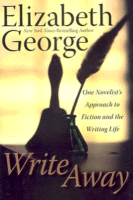 A high school English teacher who became a bestselling novelist has written a book on
writing fiction. This is cause to celebrate. Write Away is a textbook
on how to write
fiction, written by someone who actually knows how to write fiction.
The result is a down to
earth, honest and immensely practical guide on how to do it with plans, examples,
summaries and the encouragement that a master teacher always gives.
A high school English teacher who became a bestselling novelist has written a book on
writing fiction. This is cause to celebrate. Write Away is a textbook
on how to write
fiction, written by someone who actually knows how to write fiction.
The result is a down to
earth, honest and immensely practical guide on how to do it with plans, examples,
summaries and the encouragement that a master teacher always gives.
Elizabeth George is a teacher who will patiently take the would be novelist, or the person who teaches writing, through the process. She never rhapsodizes about writing a great novel or how inspiration can drive one to a work of genius. Instead, she demands that the would be writer understand that writing is a craft requiring self-discipline, tools of the trade (not word processors but plans, lists, notes, outlines and other practical if not often inspiring devices.) This book could be titled How to Build a Novel.
Elizabeth George states repeatedly that to be a writer one must have three qualities: talent, passion and discipline. If, she asserts, you have only the first two qualities and lack the third, you will not be published. To reinforce this concept she has titled chapter 16 "Bum Glue" which is defined is the ability to sit oneself down in front of the typewriter or computer and not get up until a certain amount of pages of work have been accomplished. She is honest enough to share her own feelings of inadequacy and depression that go with the very hard work of being a writer. Nevertheless, she observes, for a writer there is no other real choice.
Since Write Away is a handbook on how to write a novel, it is divided into the elements of storytelling. Part I is an overview of the craft with chapters on the expected character, setting, landscape, and plot. It is followed by sections on the basics, technique, process, examples, and guides. This is to be expected. What is a pleasant surprise is that the author's style and well chosen, if rather long examples, never bore. One is forced to look at examples of technique that please while they teach. As a teacher of creative writing courses, Elizabeth George cannot close the class without a final summary, aptly named "The Process in a Nutshell." Write Away is full of techniques such as character charts, step outlines, the hook, as well as stream of consciousness writing.
A minor annoyance that runs through Write Away is the author's constant use of the feminine pronouns "her" and "she" when discussing what a writer should do to produce good writing. It makes the writing sound as if it were written for a creative writing class at a women's college. Yet the author consistently uses examples of male writers for which she has great admiration. Perhaps this is just a stylistic device, but it does seem to serve no positive purpose.
Write Away will be very helpful for any aspiring writer of novels, but it will also be very helpful for teachers who teach writing . Best of all, Write Away is a very interesting book to read just get an insight into what a writer really goes through to provide us with a book we are going to enjoy.
--Sarah Reaves White
Return to Book Reviews Index
Return to the August 2004 issue of The IWJ.
More from Writers Write