
Reviews of Writing Books
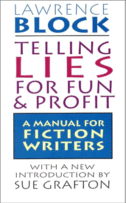
Telling Lies For Fun & Profit by Lawrence Block, Introduction by Sue Grafton
William Morrow, February, 1994.Paperback, 256 pages.
ISBN: 0688132286
Ordering information:
Amazon.com
 For the aspiring writer, nothing is more
intimidating than figuring out how to begin one's
career. You may know that you want to be a
writer, but how do you figure out what to write?
How do you start? And once you start, how do
you keep going, when the going gets tough?
Luckily for writers, Lawrence Block, bestselling
author of more than fifty novels, is willing to
share his secrets. Block, a Mystery Writers of America
Grand Master and a multiple winner of the Edgar,
Shamus, and Maltese Falcon awards, is the author of
the Matthew Scudder novels, and the New York Times
bestseller Hit Man. This book is an edited collection of
Block's popular writing columns from Writer's Digest magazine.
Block covers everything from choosing what to write,
how to write, how to overcome writer's block,
how to write a great opening and just about
every other aspect of the life of a published writer.
For the aspiring writer, nothing is more
intimidating than figuring out how to begin one's
career. You may know that you want to be a
writer, but how do you figure out what to write?
How do you start? And once you start, how do
you keep going, when the going gets tough?
Luckily for writers, Lawrence Block, bestselling
author of more than fifty novels, is willing to
share his secrets. Block, a Mystery Writers of America
Grand Master and a multiple winner of the Edgar,
Shamus, and Maltese Falcon awards, is the author of
the Matthew Scudder novels, and the New York Times
bestseller Hit Man. This book is an edited collection of
Block's popular writing columns from Writer's Digest magazine.
Block covers everything from choosing what to write,
how to write, how to overcome writer's block,
how to write a great opening and just about
every other aspect of the life of a published writer.
This classic writing book is just as timely and useful today as it was when it was last published in 1994. The print version is a must-have for any beginning writer. Now Block has released the title as an audio book, which has nine hours of playing time. The tapes are read by Block himself, who has a pleasant reading voice, and a deadpan delivery of his enormously witty and entertaining prose. Listening to the tapes is just like having Lawrence Block sitting down next to you, giving you encouragement and regaling you with writing war stories which are bound to inspire you to crank out that mystery novel you just know you've got waiting inside you. Highly recommended.
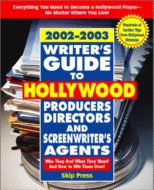
2002-2003 Writer's Guide to Hollywood Producers, Directors and Screenwriter's Agents by Skip Press
Prima, June, 2001.Trade Paperback, 432 pages.
ISBN: 0761531874
Ordering information:
Amazon.com
 Skip Press returns with an updated edition
of his must-have guide for screenwriters.
Each year, Skip puts together a complete
resource for screenwriting, with articles,
advice, analysis and contact information
for agents, directors and producers.
The first section of the book, the articles,
provides advice about finding agents, breaking
into the business, gurus, digital
filmmaking and screenwriting software.
The book is peppered with great web links and
resources. Skip also provides
articles about online resources, including "The
Hollywood Library: How to Research Tinseltown"
and "Working the Hollywood Web."
Budding screenwriters who purchase this book
will collect a virtual treasure trove
of resources from which to expand their knowledge
and research.
Skip's listings of agents, directors and producers are more
than just simple contact listings; for each listing
Skip writes a personal anecdote,
which includes some of his coveted Hollywood knowledge.
Skip Press, who is an author, writer, professional screenwriter
and instructor, is also the
author
of
The Complete Idiot's Guide to Screenwriting.
Skip's advice in the 2002-2003 Writer's Guide
is practical and sincere. It will soon become obvious
to the reader that Skip is familiar
with every screenwriting market, tool and resource
on the planet. Skip's annual Writer's Guide is required reading
for all screenwriters.
Skip Press returns with an updated edition
of his must-have guide for screenwriters.
Each year, Skip puts together a complete
resource for screenwriting, with articles,
advice, analysis and contact information
for agents, directors and producers.
The first section of the book, the articles,
provides advice about finding agents, breaking
into the business, gurus, digital
filmmaking and screenwriting software.
The book is peppered with great web links and
resources. Skip also provides
articles about online resources, including "The
Hollywood Library: How to Research Tinseltown"
and "Working the Hollywood Web."
Budding screenwriters who purchase this book
will collect a virtual treasure trove
of resources from which to expand their knowledge
and research.
Skip's listings of agents, directors and producers are more
than just simple contact listings; for each listing
Skip writes a personal anecdote,
which includes some of his coveted Hollywood knowledge.
Skip Press, who is an author, writer, professional screenwriter
and instructor, is also the
author
of
The Complete Idiot's Guide to Screenwriting.
Skip's advice in the 2002-2003 Writer's Guide
is practical and sincere. It will soon become obvious
to the reader that Skip is familiar
with every screenwriting market, tool and resource
on the planet. Skip's annual Writer's Guide is required reading
for all screenwriters.
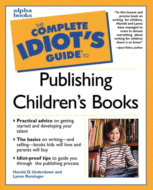
The Complete Idiot's Guide to Publishing Children's Books by Harold D. Underdown and Lynne Rominger
Alpha Books, February, 2001.Trade Paperback, 341 pages.
ISBN: 0028639758
Ordering information:
Amazon.com
 For writers new to the children's writing scene this
book provides organized advice and suggestions on the process
of publishing a children's book. Writers learn the basics
of writing and submitting children's books, as they
progress through each chapter. Basics like how to submit,
what kinds of children's books exist, what to write and
how to submit a manuscript are all explained.
The book covers the complete process, from
starting to write a children's book to what one does after
it has been accepted for publicaiton. The book contains
a great deal of information about the business of children's
publishing and provides answers to questions
as: how much do publishers pay to print picture books?
How long does it take to receive a response from your submissions? and
What if you don't like the pictures the publisher selects for
your book?
The book also includes informational
sidebars providing cautions and warnings, tips, vocabulary words,
tidbits about additional resources and inspirational
quotes from published authors.
In addition to the advice, the book also includes
writing exercises, sample cover letters and a glossary
of terms. If you are interesting in being published as a
children's book author and don't have any idea how to begin,
this is a great book to get you started.
For writers new to the children's writing scene this
book provides organized advice and suggestions on the process
of publishing a children's book. Writers learn the basics
of writing and submitting children's books, as they
progress through each chapter. Basics like how to submit,
what kinds of children's books exist, what to write and
how to submit a manuscript are all explained.
The book covers the complete process, from
starting to write a children's book to what one does after
it has been accepted for publicaiton. The book contains
a great deal of information about the business of children's
publishing and provides answers to questions
as: how much do publishers pay to print picture books?
How long does it take to receive a response from your submissions? and
What if you don't like the pictures the publisher selects for
your book?
The book also includes informational
sidebars providing cautions and warnings, tips, vocabulary words,
tidbits about additional resources and inspirational
quotes from published authors.
In addition to the advice, the book also includes
writing exercises, sample cover letters and a glossary
of terms. If you are interesting in being published as a
children's book author and don't have any idea how to begin,
this is a great book to get you started.
Return to Book Reviews Index
Return to the August 2001 issue of The IWJ.
More from Writers Write