
Computer Book Reviews
Page One of TwoThe Cold Fusion Web Application Construction Kit 2nd Ed. by Ben Forta
Que, Feb., 1998.Trade Paperback, 1024 pages.
ISBN: 0789714140
Ordering information:
Amazon.com.
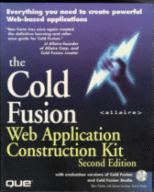 Cold Fusion is a web application development platform
from software company Allaire. This excellent guidebook
to Cold Fusion,
which also comes with a CD-ROM that contains a free
thirty-day trial of the software, helps to get you up to speed
on this powerful tool. The first and second sections of the
book cover an introduction to Cold Fusion, installation procedures and
administration of Cold Fusion using your browser. The third
part of the book covers basic topics including creating databases
and tables, SQL, Cold Fusion forms, form data validation
and debugging and troubleshooting. The fourth section covers
more advanced topics including advanced SQL, online commerce,
transaction processing, cookies, directory services, event scheduling
and custom tags. The last section includes appendixes with
quick reference indexes on Cold Fusion functions and tags.
Coverage of Cold Fusion Studio, an interactive development
environment, is also included in the book.
Cold Fusion is a web application development platform
from software company Allaire. This excellent guidebook
to Cold Fusion,
which also comes with a CD-ROM that contains a free
thirty-day trial of the software, helps to get you up to speed
on this powerful tool. The first and second sections of the
book cover an introduction to Cold Fusion, installation procedures and
administration of Cold Fusion using your browser. The third
part of the book covers basic topics including creating databases
and tables, SQL, Cold Fusion forms, form data validation
and debugging and troubleshooting. The fourth section covers
more advanced topics including advanced SQL, online commerce,
transaction processing, cookies, directory services, event scheduling
and custom tags. The last section includes appendixes with
quick reference indexes on Cold Fusion functions and tags.
Coverage of Cold Fusion Studio, an interactive development
environment, is also included in the book.
This comprehensive book provides concrete instruction on Cold Fusion which can aid the reader in developing simple and complex online applications to enhance websites. A recommended book for any serious Cold Fusion developer.
Presenting XML by Richard Light
Sams.net, Sep., 1997.Trade Paperback, 414 pages.
ISBN: 1575213346
Ordering information:
Amazon.com.
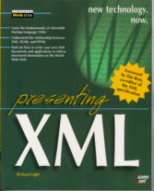 XML or eXtensible Markup Language, a new buzzword
in internet publishing, is making the
headlines a great deal lately. This guide to XML provides
in-depth instruction
on how to understand and take advantage of this web
publishing markup language. The book provides an introduction
to XML which explains the differences between XML, SGML
and HTML, what XML is and how it is a useful web publishing
tool. The second section of the book teaches you how to code in
XML including topics on logical structures, physical structures,
XML rules, linking with XML, style and the XML processor.
The third section covers how to turn existing HTML into XML
and how to develop an XML Memo Application and the final
section looks at XML software and future uses of XML.
A companion website is also available which includes a web
tour of XML resources.
XML or eXtensible Markup Language, a new buzzword
in internet publishing, is making the
headlines a great deal lately. This guide to XML provides
in-depth instruction
on how to understand and take advantage of this web
publishing markup language. The book provides an introduction
to XML which explains the differences between XML, SGML
and HTML, what XML is and how it is a useful web publishing
tool. The second section of the book teaches you how to code in
XML including topics on logical structures, physical structures,
XML rules, linking with XML, style and the XML processor.
The third section covers how to turn existing HTML into XML
and how to develop an XML Memo Application and the final
section looks at XML software and future uses of XML.
A companion website is also available which includes a web
tour of XML resources.
This introduction to XML will give you insight into this new mark-up language developed from SGML. Recommended for those who want to get a jump on the language while it is in its early developmental stages.
Click Here For Computer/Web Design Book Reviews Page Two
Return to the April 1998 issue of The IWJ.
More from Writers Write