
Reviews of Writing Books
Page Two of TwoThe Savvy Author's Guide to Book Publicity by Lisa Warren
Carroll & Graf, February, 2004Paperback, 253 pages
ISBN: 0786712759
Ordering information:
Amazon.com
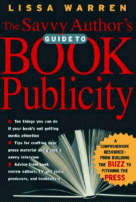 Lisa Warren, who has worked in the publicity
departments of David R. Godine, Houghton Mifflin
and Perseus Publishing, opens the doors to the inner workings of
a book publicity department in her new book,
The Savvy Author's Guide to Publicity. Her book covers everything
an author needs to know about book publicity, presenting numerous
ideas to help authors promote their books and
start generating sales. Ms. Warren does not sugar-coat
the difficult task of getting publicity for a book.
She tells authors how and why the publicity campaign provided by
the publisher often falls short of an author's expectations.
She also explains how in-house publicists
often fear outside publicists, even though the freelance
publicist could benefit both the author and the publisher.
Lisa Warren, who has worked in the publicity
departments of David R. Godine, Houghton Mifflin
and Perseus Publishing, opens the doors to the inner workings of
a book publicity department in her new book,
The Savvy Author's Guide to Publicity. Her book covers everything
an author needs to know about book publicity, presenting numerous
ideas to help authors promote their books and
start generating sales. Ms. Warren does not sugar-coat
the difficult task of getting publicity for a book.
She tells authors how and why the publicity campaign provided by
the publisher often falls short of an author's expectations.
She also explains how in-house publicists
often fear outside publicists, even though the freelance
publicist could benefit both the author and the publisher.
Ms. Warren helps authors overcome common promotion obstacles: she explains how to create "buzz", how to approach the media for interviews and reviews, and what not to do. She offers sample galley letters, sample tour schedules and copies of book press releases. The book includes lots of helpful material about contacting the media, doing interviews and what to expect. The complexities and expenses involved in arranging a book tour are explained and suggestions are given about how to manage one effectively. The book also covers the Internet, including an interesting explanation of the Amazon.com rankings that authors watch obsessively. The Savvy Author's Guide also contains contact information for outside publicists and author escort services. This is an absolutely terrific resource that every author should have on her bookshelf. Highly recommended.
The Story Behind the Story Edited by Peter Turchi and Andrea Barrett
W.W. Norton, January, 2004Trade paperback, 479 pages
ISBN: 0393325326
Ordering information:
Amazon.com
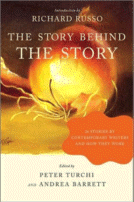 The process of writing evokes our curiosity. The process
by which an accomplished writer progresses from an idea
to a polished, thought provoking and enjoyable story is not
only fascinating, but helpful to others who would like to
follow in these footsteps. We all know that the principles
of writing are rather well understood, that certain elements
such as voice, characterization and point of view are all
part of the end product, but we also understand that there
is something else involved as well. In reading The Story
Behind the Story, the salient fact appears to be that some
stories seem to write themselves. Some of the characters
begin as one person and develop into surprising and
unanticipated beings. The different authors all appear to
work in different ways. Some do not plan at first, but just
let the ideas flow, while others begin with an idea and
build on it. One author who tells about writing a short
story admits that he writes novels in a completely different
way from the method he used on the included short story.
The process of writing evokes our curiosity. The process
by which an accomplished writer progresses from an idea
to a polished, thought provoking and enjoyable story is not
only fascinating, but helpful to others who would like to
follow in these footsteps. We all know that the principles
of writing are rather well understood, that certain elements
such as voice, characterization and point of view are all
part of the end product, but we also understand that there
is something else involved as well. In reading The Story
Behind the Story, the salient fact appears to be that some
stories seem to write themselves. Some of the characters
begin as one person and develop into surprising and
unanticipated beings. The different authors all appear to
work in different ways. Some do not plan at first, but just
let the ideas flow, while others begin with an idea and
build on it. One author who tells about writing a short
story admits that he writes novels in a completely different
way from the method he used on the included short story.
After choosing a particular short story, the reader often finds that the story is completely different from what was expected. Kevin McIlvey's "The People Who Own Pianos" is not about people who love music, but about how they seem -- to a person -- of a different class who moves pianos for a living. "That's Right, You're not from Texas" by David Haynes explores the same theme: the feeling of not being included or not understanding certain types of people. Since one of the time-honored duties of the artist is to show us things that we do not readily see, both stories serve their purpose.
The stories come first and the explanation of the inspiration and how the story was written follows. The reader, however, can choose the author's account of how the story came to be and then read the story. Either method will be instructive, as well as enjoyable. The Story Behind the Story is a fascinating collection not only for those who write but also for those who read to understand the story and the underlying process that creates the story. This is an enjoyable collection of short stories and an important tool for both those who write and those who teach others to write.
--Sarah Reaves White
Writing Book Reviews
Page One | Page Two
Return to Book Reviews Index
Return to the April 2004 issue of The IWJ.
More from Writers Write