
Nonfiction Book Reviews
1000 Years for Revenge by Peter Lance
ReganBooks, September, 2003Hardcover, 539 pages
ISBN: 006054354X
Ordering information:
Amazon.com
 In the months following the tragedy of 9/11,
the nation was more concerned with mourning than
with assigning blame and accepted the FBI's
assertions to the media that they had no warning
whatsoever that terrorists were planning to fly two
jets into the World Trade Center -- that it was some
kind of unforeseeable, freak occurrence. Now, two years later,
new evidence uncovered by award winning investigative
journalist Peter Lance makes it
clear that 9/11 was preventable.
In the months following the tragedy of 9/11,
the nation was more concerned with mourning than
with assigning blame and accepted the FBI's
assertions to the media that they had no warning
whatsoever that terrorists were planning to fly two
jets into the World Trade Center -- that it was some
kind of unforeseeable, freak occurrence. Now, two years later,
new evidence uncovered by award winning investigative
journalist Peter Lance makes it
clear that 9/11 was preventable.
Lance's book, which reads more like an exciting international thriller than a dry work of fiction, tells the story of how al-Qaeda planned the events of 9/11 -- beginning in 1989. The story is told through the eyes of three people: FBI agent Nancy Floyd who came very close to stopping the first World Trade Center bombing before having her informant scared off and her case destroyed by her superiors, FDNY Fire Marshal Ronnie Bucca who found an al-Qaeda mole in the FDNY but was ignored by the FBI and was the only fire marshal to die in 9/11, and Ramzi Yousef, master bomber, architect of 9/11 and the most dangerous terrorist to ever set foot on U.S. soil.
Peter Lance connects the dots of the story of Osama bin Laden's master plan to destroy the United States with chilling precision. The story focuses on al-Qaeda's bombing of the World Trade Center in 1993, and the terrorist cell that operated in the United States, led by one of the founders of al-Qaeda, the Egyptian blind Sheikh Omar Abdel Rahman. The group plotted, planned and prospered, while the FBI missed numerous chances to stop them. One example: As al-Qaeda members practiced firing automatic weapons at a range in Long Island day after day, the FBI sat in a car watching them. Eventually that investigation was dropped. Lance makes it easy for the reader by including a full-color, illustrated timeline of events in the middle of the book. The timeline puts faces to the names, and clearly connects the dots as the various plots to destroy American landmarks come to fruition.
Lance's book stands out form the current crop of books about 9/11 in several respects. No other author has put the facts together in a simple, comprehensive, chronological narrative which makes it very clear what really happened. Lance seems to have no personal ax to grind, unlike other authors who seem intent on blaming either the Clinton or the Bush administration for the intelligence fiascoes. Lance, like a good journalist, simply followed the trail of facts and ties them together for the reader. He analyzes why the FBI is really the wrong organization for fighting terror because of its emphasis on making legal cases after the fact, instead of focusing on stopping threats before they start. He also shows how courageous FBI agents were thwarted from doing their jobs by the Bureau's institutional arrogance and tendency to punish agents who spoke their minds. (One vividly remembers FBI whistleblower Colleen Rowley's riveting testimony on this subject to Congress). Perhaps the most disturbing aspect of the book is the assessment of the current al-Qaeda threat to the United States, which Lance asserts is even greater today than it was two years ago. Highly recommended.
--Claire E. White
Everest: Summit of Achievement by Stephen Venables, Forward by the Dalai Lama, Introduction by Sir Edmund Hilary
Simon and Schuster, May, 2003Hardcover, 252 pages
ISBN: 0743243862
Ordering information:
Amazon.com
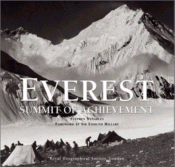 Mount Everest has captured the imagination of the West;
so many have tried and failed to climb to the summit.
Now Stephen Venables has, with the help of
the National Geographic Association, attempted to
put the subject of Mount Everest into some perspective
for the 21st century. He succeeds admirably. The book
traces the history of man's attempt to climb the mountain,
with essays by mountain climber Stephen Venables,
journalist and mountain climber Ed Douglas,
Judy and Tashi Tenzing, grandson
of Norgay Tenzing and historian John Keay. The essays
discuss everything from the difficulty
of even measuring the height of the mountain, the reaction
of the local peoples to the invasion of Westerners wanting
to climb the mountain, and details of the hardships, failures
and victories of the various expedition. More than 400 photographs
from the archives of National Geographic are displayed --
most of which have never been seen before -- and they are
absolutely stunning. The introductions by Sir Edmund Hillary
and His Holiness the Dalai Lama are a real pleasure to read.
Sir Hillary, who ascended to the summit Mount Everest in 1953 with
Tibetan guide Tenzing Norgay, remembers his historic
journey with "no thought of the impact this
ascent might have on the world in general, or indeed of the changes
it might produce in my own life. We had succeeded where so many
other great climbers had failed -- that was enough in itself."
Mount Everest has captured the imagination of the West;
so many have tried and failed to climb to the summit.
Now Stephen Venables has, with the help of
the National Geographic Association, attempted to
put the subject of Mount Everest into some perspective
for the 21st century. He succeeds admirably. The book
traces the history of man's attempt to climb the mountain,
with essays by mountain climber Stephen Venables,
journalist and mountain climber Ed Douglas,
Judy and Tashi Tenzing, grandson
of Norgay Tenzing and historian John Keay. The essays
discuss everything from the difficulty
of even measuring the height of the mountain, the reaction
of the local peoples to the invasion of Westerners wanting
to climb the mountain, and details of the hardships, failures
and victories of the various expedition. More than 400 photographs
from the archives of National Geographic are displayed --
most of which have never been seen before -- and they are
absolutely stunning. The introductions by Sir Edmund Hillary
and His Holiness the Dalai Lama are a real pleasure to read.
Sir Hillary, who ascended to the summit Mount Everest in 1953 with
Tibetan guide Tenzing Norgay, remembers his historic
journey with "no thought of the impact this
ascent might have on the world in general, or indeed of the changes
it might produce in my own life. We had succeeded where so many
other great climbers had failed -- that was enough in itself."
The Story of The West by Robert M. Utley
DK, September, 2003Hardcover, 320 pages
ISBN: 0789496607
Ordering information:
Amazon.com
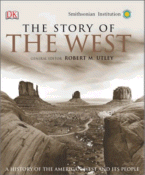 Award-winning author and historian Robert Utley
has created a fantastic resource with his new book,
The Story of the West. The West has been so romanticized
in the media that Utley wanted to present a work that was
comprehensive and would help set the record straight
about many of the myths that surround the Old West.
Written in association with the Smithsonian, the book
lays out the history of the Western United States,
from Pre-Columbian civilization to the present.
Award-winning author and historian Robert Utley
has created a fantastic resource with his new book,
The Story of the West. The West has been so romanticized
in the media that Utley wanted to present a work that was
comprehensive and would help set the record straight
about many of the myths that surround the Old West.
Written in association with the Smithsonian, the book
lays out the history of the Western United States,
from Pre-Columbian civilization to the present.
Prominent historians were assigned to write comprehensive summaries of each of six time periods. The essays are written in accessible and interesting styles, and are surrounded with photos of artifacts, sidebars with fascinating facts and beautiful paintings and drawings. The book itself is huge and is printed on heavy, demi-gloss stock which adds to the beauty of the presentation. This would make a fantastic gift for any history lover.
Click Here to Return to the Book Reviews Index
Return to the October 2003 issue of The IWJ.
More from Writers Write