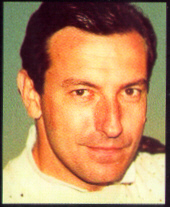
by Claire E. White
Could the terrorist attacks of 9/11 have been prevented?
Absolutely, says five-time Emmy award-winning
investigative journalist and bestselling author
Peter Lance,
in his new book,
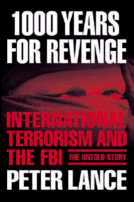
1000 Years for Revenge: International Terrorism and
the FBI, the Untold Story (ReganBooks).
In a groundbreaking work, Lance lays out the long-range
al-Qaeda plan to attack a number of American
landmarks over the last ten years, which culminated
in the attacks against the Pentagon and the Twin Towers
on September 11, 2001. Lance tells the story through
the eyes of three very different people: two American heroes,
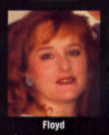
FBI Special Agent Nancy Floyd and FDNY Fire Marshal
Ronnie Bucca, and one master terrorist, Ramzi
Achmed Yousef, the man responsible for the first
World Trade Center bombing and the architect of many
other terrorist attacks.
The book features a detailed color timeline
which clearly connects the dots between the events
which led up to 9/11. The timeline also provides
photographs of all the key players in the al-Qaeda
network who were involved in this far-reaching plot.
Based upon numerous interviews and hundreds of pages
of declassified documents,
the book is meticulously researched.
One of the most disturbing aspects of the book is
the fact that a number of
talented FBI agents who were close to putting the
pieces together were thwarted at every turn by their
superiors. As Lance states, "The attacks of September
11 represented the greatest failure of intelligence
since the Trojan Horse." Lance concludes that the FBI
is the wrong intelligence agency to fight terrorism because of
the institutional culture of arrogance and the fact that
it focuses on making a legal case
after something has happened,
instead of focusing on prevention. In a recent speech, Vice-President
Dick Cheney appeared to reach the same conclusion about the FBI.
When talking about the intelligence community's failure to follow
active leads after the
arrest and conviction of World Trade Center bomber Ramzi Yousef,
Vice President Cheney stated:
"But the case was not
closed. The leads were not successfully followed.
The dots were not adequately connected. The
threat was not recognized for what it was."
1000 Years for Revenge
is an important book which puts all the pieces together
for the reader in a fast-moving, gripping narrative.
Peter spoke with us about why he felt it was so important
to write this book, how al-Qaeda managed to operate
on U.S. soil for over ten years without being caught
and why he feels the United States is now in even
more danger from al-Qaeda than ever before.
The book is really shocking. Although
sometimes nonfiction of this type, with all the
confusing names and dates, can be dry, this
reads more like a thriller.
|
Thank you. My approach to writing this book was
this: as I began peel back the layers on this story of the
events leading up to the tragedy of 9/11, I became
so shocked at the level of negligence by the FBI
that I felt I was onto a really important story that
needed to be heard by every American. So I wrote
this book in as simple a way as I could, even for
people who have never bought a nonfiction book before.
I didn't want to write one of these dry, historical pieces.
Most of the 9/11 books that have came out about the
road to 9/11 and the intelligence have been fairly dry
historical pieces. What I wanted to do was to tell the story
through three people: the master terrorist Ramzi
Achmed Yousef, Ronnie Bucca the Fire Marshal and
Nancy Floyd the FBI special agent -- the two heroes that
tried to stop them. By intercutting their stories, I was
able to present the narrative of what happened.
But in order to tell the story properly with all these
complicated names -- there are many Islamic figures
with multiple names and multiple
aliases -- I came up with the notion of doing a timeline
in the middle of the book. Each part of the timeline
chronologically would give a lost piece of
intelligence, a missed opportunity to prevent terror,
and then tie the timeline to the narrative. So as we
go through the book I recommend that people read
the timeline first to get an overview of the book.
Then, as they start reading the book, go back
and forth and look at the timeline which is in
|
color and I think its fairly easy to
follow.
I really wanted this book to be a tool
for people to see what led up to 9/11 and
the threat that we still face as Americans.
I got a free master's degree in
a way. In two years I got a master's degree in
terror and the U.S. Government's attempts to
stop it, and I wanted to be able to communicate
that to the average American.
Well let's start with Ronnie Bucca's story.
I was really saddened by his story; he was
the only Fire Marshal who actually died on
9/11. What I was most shocked about was
that he basically uncovered a terrorist right inside
the New York Fire Department - Ahmen Amin
Refai.
Ronnie believed Refai was some kind of mole. The
most extraordinary thing was that if you looked at
my story -- some of the things that I think I document
very well -- is that al Qaeda, with the exception of
Osama bin Laden himself, who
is a Saudi of Yemeni origin, is dominated
completely by radical Egyptians. Ayman al-Zawahiri,
who was recently seen on the video of bin Laden that
showed up within the last week, is an Egyptian.
Mohammed Atef who was reportedly killed after
the US invaded Afghanistan in the Fall of 2001 is an
Egyptian and a radical. And of course their spiritual
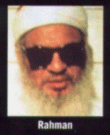
guide -- and their Pope if you will -- is the blind Sheikh
Omar Abdel Rahman. This man was indicted in the
plot to assassinate Anwar Sadat, but he escaped
punishment because they couldn't prove he was
directly involved. But he was the spiritual leader
of two anti-American anti-Western
Egyptian radical fundamentalist groups. One being
the al Gamma'a Islimaya (the "IG") and the other being the
Egyptian Islamic Jihad. He actually ran the IG,
the al Gamma'a Islimaya. Let me give you an idea
of how violent the Sheikh's connections were. The IG
that he ran (he was actually the leader of) plotted and
carried out the 1997 massacre in Luxor, Egypt
in which 58 tourists were killed. Men,
women and children were massacred, their bodies
were split open and they inserted into their bodies
leaflets that said "Free the Blind Sheikh." This is after
he had been convicted of a plot to blow up the bridges
and tunnels around New York City.
|
"They have an expression [in Baluchistan] -- 'If it
takes me ten centuries to kill my enemy, I will wait
1000 years for revenge.' This is about the Crusades.
This is a 1000 year war of vengeance that these guys
have been waiting for, to try and punish the West for
the time when the Knight Templars came down from
Europe and sacked the councils of the Islamic princes
in the 11th century. So, this is -- unfortunately -- what we
are up against."
|
This is the conspiracy. The so-called Blind Sheikh is one
of the most dangerous men
ever to be allowed into this country. He is at the heart
of this story. He met bin Laden in Afghanistan in
1989. He and these two other Egyptians, al-Zawahiri
and Atef, sided with bin Laden in what amounted to
a coup d'etat to take over a world-wide network of
brick-and-mortar centers to raise money for the
Mujahadeen rebels. It was called the MAK or
Services Office for the Mujahadeen. That was
bringing in tens of millions of dollars in
cash annually worldwide. Bin Laden had a
falling out with the original founder, Abdullah
Azzam, a Palestinian scholar. The Soviets
were dispatched in 1989 and defeated. But
money was continuing to pour into these centers
around the world. There was one in Brooklyn,
New York. There was one in Pittsburgh, one
in Atlanta, one in Detroit, and a major one in
Tuscon -- that's the Arizona connection.
So Azzam wanted the
money to be used to set up a Taliban-like
government in Afghanistan. But bin Laden had
a much broader worldwide view for the
worldwide Jihad. He wanted money to go towards
the fight against the West and the United States.
The Egyptians sided with bin Laden because they siphoned
of some of the money to kill Hosni Mubarak, the president
of Egypt. So, long story short, mysteriously Azzam
and his two sons were killed by a pipe-bomb in
Peshawar, Pakistan in November, 1989. And almost
immediately bin Laden took over that
entire brick-and-mortar network and renamed it
al Qaeda. That it is the origins of the terror network
that we know today.
So the Blind Sheikh was basically a founding member of al-Qaeda?
|
So the Blind Sheikh was involved with the terrorists from those
early days with bin Laden in 1989, all the way through
to 9/11. He was a prime motivator in a number
of the attacks that bin Laden sponsored. For example,
two weeks prior to the Cole bombing in October, 2000
bin Laden made the famous video fatwa where
you see him with a dagger. He had the Blind Sheikh's
son on camera. He said in the video, "Free the Blind Sheikh."
(Who was in U.S. custody by this time)
Remember El Sayyid Nosair? He was the guy who
murdered Rabbi Meir Kahane in 1990. And the murder
of Rabbi Kahane, as my timeline points out, was the
first true act of al Qaeda violence on American soil
directed towards an American. That was November
5th of 1990. That was the beginning and that was the
second huge dot on the chart. The first huge dot for
the FBI was in 1989 when in four successive
weekends the special operations group of the New
York Office of the Bureau, the elite Black Bag Unit
(this was the unit that nailed Gotti if you
will) followed four groups of M.E.s, (which
is bureau speak for Middle Eastern men). These Middle
Eastern men were from this notorious Alkifah center --
the very MAK center in Brooklyn that I told
mentioned before that was part of this network.
The FBI followed these guys out to Long Island -- this
is like exit 71 off the Long Island Express Way --
and they photographed them on four
separate weekends firing automatic weapons.
This was July, 1989,
during the administration of George Herbert
Walker Bush, the current president's father.
Of the men photographed on those four
weekends by the Bureau, three went on to bomb the
World Trade Center, one (Nosair) went on to kill Rabbi
Kahane, two went on to plot with the Blind Sheikh (the
plot to blow up tunnels around Manhattan -- which
included the FBI office at 2600 Federal Plaza) and
the leader of the group, Ali Mohammed, went on to
train Bin Laden's bodyguards in Khost, Afghanistan
and he later did the surveillance for the African
Embassy bombings in August of 1998. In the
pictures that Ali Mohammed took bin Laden pointed
to where he wanted to bomb places. Simultaneous
bombings killed 234 and wounded 5,000. Nine
years before this bombing, this guy was on the radar of the FBI
and they dropped the ball.
That's disturbing.
Okay, so now the Blind Sheikh, he was actually
convicted for conspiracy in the first World
Trade Center bombing?
|
"The Bush administration clearly had to invade
Afghanistan. It was a haven for al-Qaeda and the
Central Command. It was also a terrible regime,
which was extremely violative of human rights.
Because of al-Qaeda's presence there, Afghanistan
was a direct threat to the security of the United
States. So they had to go in to Afghanistan."
|
No, not for the first World Trade Center bombing. He
was convicted for the second bridge and tunnel
plot -- the land mines plot, that they call the
Day of Terror plot.
So, if you start to look at the major dots on
the chart, you've got this
surveillance which is mysteriously shut down in 1989.
The FBI photographs these terrorists practicing shooting
guns, but all of a sudden
the surveillance ends. The first big dot is
the surveillance of Calverton, the next big dot
is the murder of Rabbi Kahane on the 5th of November.
Remember how I told you that of the Calverton shooters that
three of the guys went on to bomb the Trade
Center? One of them was a big red-headed Egyptian:
you couldn't miss him. He was a six foot, two inch Egyptian
named Mahmud Abouhalima. His partner was a little
Palestinian guy named Mohammed Salameh.
Those two guys, who were in Calverton in 1989,
were the getaway drivers during the night of the
murder of Rabbi Kahane. So when Nosair burst out of
the Marriott Hotel on Lexington he thought Abouhalimah,
who was a cab driver, was going to wait for him.
But the police had moved him forward, so Nosair
jumps into the wrong cab. The cab driver freaked
out, Nosair bolted and ran down the street and
then got into a gun battle with an armed postal
inspector, was wounded and arrested. Ironically,
the victim and the shooter were in parallel stalls at the hospital.
Rabbi Kahane died, his assassin Nosair lived. That night, the
17th precinct detective squad of the NYPD, with the FBI, raided
Nosair's rented house in Cliffside Park, New Jersey.
Astonishingly, in the search they found 47 boxes of
evidence. In the 47 boxes of evidence were included:
1400 rounds of ammunition, top secret manuals from
the U.S. Special Forces Warfare school in Fort Bragg,
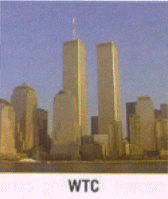
North Carolina, maps of the World Trade Center,
pictures of the World Trade Center, bomb recipes and
the untranslated sermons and writings describing the Blind
Sheikh's sermons which said that they wanted to hit
the edifices of capitalism -- "the high world buildings."
If they had had a blinking red light in the sky pointing at the
World Trade Center on that night in November of 1990, it
couldn't have been more obvious. But what
happened was the Chief of Detectives for the NYPD,
Joseph Borelli, who was credited as the man that
got the Son of Sam, decided to treat it as a "lone
gunman" shooting. In the face of vast evidence of
an international conspiracy, he didn't want to have a
political show trial in New York City. And in fact
they tried him as the lone shooter. But guess who
was present at the house that night when the police
came in and they were taken into custody?
Mahmud Abouhalima and Mohammed Salameh - the
getaway guys. And the NYPD let them go the next
day, because this was "just a lone gunman shooting."
The second major dot on the chart. Astonishing.
That is very disturbing. Where is the Blind Sheikh right now?
I'm not sure what Federal Prison he is because he was
|
in prison in Minnesota. But a recent indictment
that come down in April, 2002, alleged by the feds that
while in Minnesota
his lawyer, Lynn Stuart, and a translator, actually distracted the guards at the
prison so that the Blind Sheikh could communicate direction
to the IG, this terrorist group. What happened was
there was a U.S. Postal worker named Abdel Sattar.
Sattar basically was running the IG from his house
on Staten Island. He was giving the information from
the Blind Sheikh that was being trafficked through the
translator. These are current, pending allegations. There
is a federal indictment against his lawyer, Lynn Stuart and this
translator and Sattar. It is alleged that they were
getting the directions from the Sheikh in a prison in
Rochester, Minnesota. Then Sattar from Staten
Island was acting as the U.S. communication director
for this terrorist group. This is a U.S. postal worker:
another naturalized Egyptian. And that's one of
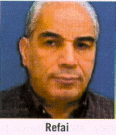
the reasons that the Ahmed Amin Refai story (the mole
in the New York Fire Department)
resonates so much, because there is a very similar
fact pattern.
Refai was a naturalized Egyptian
who was working as an accountant in the FDNY
for twenty-five years and was later discovered by
Fire Marshal Ronnie Bucca a) to have obtained the plans to
the World Trade Center prior to the bombing and
b) in 1999 to have lied to obtain a second ID to
Metrotech, which is the city's most secure
building, the FDNY's new headquarters where
the plans of most of the city's buildings are kept.
So, how did Ronnie Bucca become suspicious
of Refai?
|
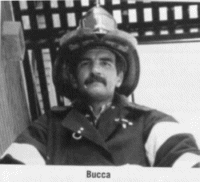
So Ronnie Bucca was a Fire Marshal. He was
a decorated heroic firefighter. He was in Rescue One;
Rescue One is like the
Green Berets of the Fire Department. They are the
guys that go in and do all the heavy rescue work
in Manhattan. Ronnie had been injured seriously in 1986
in a fall in which he broke his back and was not
expected to live. He could have retired on a three-quarters tax-free
pension. Not only did he go back to the Fire
Department, but he went back to Rescue One in one year
which is unheard of. He was known henceforth
as the Flying Firefighter. He was kind of a legend to
begin with in the Fire Department. He had always
had an active duty army reserve
presence. He was a paratrooper in the 101st Airborne
and because he hurt his back, he put in for Military
Intelligence. He was ultimately in a unit that was
one of only four army reserve units in the entire
country that was tasked to the Defense Intelligence
Analysis Center at Boling Air Force Base in
Washington. So, Ronnie had top-secret clearance from
the U.S. government. After the first World Trade Center
bombing, he had a
personal interest in investigating because of Kevin Shea,
the firefighter who fell into the four story hole that
the bomber Ramzi Yousef had created, right after Rescue
One responded. This firefighter, Kevin Shea, literally dropped four
stories and almost died. He was in the hospital
that night and Ronnie went to see him. So Ronnie
was not only interested in the World Trade Center bombing
because he was a Fire
Marshal, this was arguably the greatest arson
fire in New York City history and the Fire Marshal should
have had jurisdiction. But he also had a personal stake
because his friend was hurt. He assumed that the FBI
would allow the Fire Marshals into the investigation.
But, except for two token Marshals, they
excluded the Fire Department completely. This is one of the
many problems that the Joint Congressional Inquiry
found on the road to 9/11: this
arrogance, this exclusion of various agencies from
crucial investigations. The report states that the CIA
kept information from the FBI. Here is an example
where the FBI kept out capable local fire department
investigators who could have contributed.
|
Having been thwarted the first time from being
involved in the FBI investigation, Ronnie then
educated himself about Islamic terrorism and began
his own, personal probe. He came across an astonishing
piece of evidence early on (not long after
the bombing) that convinced him that these guys
were going to come back to New York and try again to
topple the World Trade Center. Ronnie learned a lot
because of his contacts at Army
Reserve Military Intelligence.
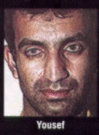
The evidence he had was this. A computer was found
in New Jersey, on which bomber Ramzi Yousef had
written threat letters to five New York newspapers,
after the bombing. Yousef's letter was eventually published
in
The New York Times. In the letter, Yousef called his
terrorist group The 5th Battalion of the Liberation Army.
The letter was typed on the computer of one Nidel
Ayyad, who is a Rutgers graduate, a Kuwaiti, who was one of the
four original bombers convicted. When the Feds
found the computer, at the bottom of the
computer, was a coda that had been added to by Nidel Ayyad
on behalf of Ramzi Yousef which said in so many words,
"We know what we did wrong, we placed the bomb in the wrong spot."
It was clear that the terrorists had wanted to knock
Tower 1 into Tower 2, but didn't place the bomb in the correct
position. Essentially the translation was "We know
what we did wrong, we'll come back and next time the twin
towers will not stand." (I'm paraphrasing here.)
Ronnie had access to this information, the public did not.
So Ronnie himself was concerned about the Twin Towers.
From 1993 up until 9/11, he was obsessed (in the best possible way) with
learning as much as he could about the threat from
Islamic fundamentalists and protecting the Twin Towers.
He told dozens of people over the years that he
was convinced that there was going to be another
attack on the World Trade Center.
He even gave up his vacations to get extra training,
didn't he?
|
"Of course,
we do have more modern mechanisms like,
ELINT, electronic surveillance, and PHOINT,
which is from satellites, but as has been pointed
out by a few conservatives after 9/11,
the decimation of the human spy element in the CIA
is what blinded us to 9/11. To this day, as far as I know,
there has been no significant inroads made in the
ability to penetrate the al-Qaeda organization."
|
He did. In fact, just before 9/11, he had used up all his
leave time for 2001 to get extra training.
So he was planning to take sixteen days of his next year's leave
time to go take another military intelligence course in
the army reserve. One month before 9/11, Ronnie Bucca
visited one of the security guards at WTC
and inquired whether there were any new means of
ingress or egress that could allow anyone
access to the Twin Towers from below. That's how specific
he sensed the threat was. In September, 1999, he
was working at Metrotech,
which was the new fire department headquarters in Brooklyn.
Metrotech is one of the most secure buildings in the city.
It contains the plans for virtually all the major structures
in New York City. Ronnie learned of an Egyptian-American
named Ahmed Refai, who was an accountant for
twenty-five years with the FDNY, a naturalized
Egyptian citizen. Refai had lied about losing his ID.
He had claimed that he'd lost his ID, so that he
could obtain a second ID. Ronnie, given his knowledge
of the Egyptians and the role that they played
earlier with the Blind Sheikh and the Day of Terror
plot and the first World Trade Center bombing found
that very suspicious. So, just on a hunch,
he started taking a closer look at Refai. He went
down and observed the videotape taken of Refai
which clearly showed that his ID was right there in
his back pocket, when he was requesting a new one.
Although he was supposed to have lost his ID,
later video showed him swiping his ID card through the reader
and getting in to Metrotech. Ronnie wondered
why would a guy lie like
that? Then they found out Refai had filed a false report
to report the card missing and forged the signature
of a Fire Marshal. Ronnie wondered, "Why would a
guy go to that kind of trouble?" Refai was
interviewed, but gave conflicting information.
First he said was nostalgic for his old unit, the capital
budget unit, that he did not like his new unit and he
wanted to keep his old ID and get a new ID for
nostalgia reasons. Which is absurd. So Ronnie talked to his boss, one
Kay Woods, who is now Deputy Assistant Commissioner,
and asked her what kind of employee Refai had been.
Woods kind of rolled her eyes and said this guy was
like a ghost employee. He would come in late, took
every vacation, would fall asleep at his desk, and made calls
to Egypt. He was like a non-entity in the department,
so saying he was "nostalgic" for his old department just
didn't make sense. Ronnie asked her if he had
done anything else unusual that
she had observed. Wood replied that there was that time
that Refai got the blueprints -- and Ronnie asked,
"What blueprints?" She replied,
"The blueprints to the World Trade Center."
Ronnie was shocked, to say the least.
Woods then said that in the early 90s (prior to the bombing)
the capital budget unit where she and Refai were located was being
renovated. They had some old green filing cabinets
where the blueprints of a number of buildings were
kept from when the inspection department was in that
area. They were throwing them out. She had two
dumpsters and they were just tossing these old blueprints. She
went to lunch one day and came back to find
Refai digging through the dumpsters. She said he
had found the blueprints to the Trade Center. (Another
Marshal also told me Refai also had the blueprints to the
bridges and tunnels.) But in any event Kay Woods
specifically remembered the World Trade Center blueprints
and Refai asking, "Can I
have these?" At the time she thought nothing
of it. The day of the first World Trade Center bombing
(February 26, 1993), Refai called in sick. He then became
extremely paranoid. Woods described a pattern where
he told her he thought the FBI was bugging his
garage.
|
Ronnie Bucca then discovered that the FBI
had interviewed him twice in 1994.
But more specifically Ronnie found out from people
in the fire department that this man, Refai, had been
seen in new footage
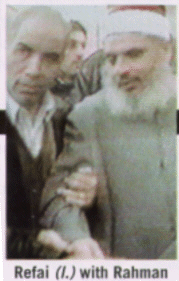
walking near the Blind Sheikh,
holding his arm.
So Ronnie went up to Channel 7 Eyewitness News
where Ronnie knew a film editor who did him a favor.
Ronnie had no expectations, but by the fourth or fifth cassette
he was looking at, he found the tape showing Refai on the arm of the
Blind Sheikh, acting like his bodyguard , moving him through
the crowd, while whispering in his ear -- like an intimate
of one of the most dangerous terrorists America
has ever known.
Don't you have to be one of the inner circle to
be allowed to get that close to a leader like the Sheikh?
Absolutely. An FBI agent named Joe O'Brien, a
veteran agent who wrote the book
Boss of
Bosses with his partner Andy Kurins, and who
spent 19 years in the FBI as an organized crime expert, went
down with me to interview Refai for the book.
When I finally got the story I had to give him an
opportunity to respond. Joe told me that
the Sheikh would have had to trust Refai with
life to let him get that close to him. But, more importantly,
when I interviewed Refai he admitted that he had
acted as the Sheikh's translator at his INS hearing.
Now this is a hearing where his status in the
country is going to be affected. He wouldn't
just let any random guy represent him - he would
have to have an intimate man he could trust. Even
more significantly, Refai later admitted that he was
a member of the al-Salaam mosque in Jersey City.
Now he frequented the two others mosques in
Brooklyn where the Sheikh would preach -
the Al Farooq Mosque - where those Middle-Eastern
men where going in 1989 - that was the al Qaeda
base. The Sheikh preached there and he also preached
at another mosque called the Abu Bakr. But the main
mosque was a dingy little third-floor room over a
toy store in Jersey City called the al-Salaam,
the Mosque of Peace, ironically. That room
would only hold like twenty-five people, tops, that's how small
it was. Of the twenty-five men in that room, seven
of them have been convicted of terrorism. One third
of the members in that room on any given night during that
time period are now in
federal prison. Ironically enough, this guy Refai lives in
Middletown, New Jersey, which is the town in
New Jersey that has the highest concentration of 9/11
widows, because that's where a lot of Cantor
Fitzgerald people lived. Refai lives in a nice, beautiful
upper middle class neighborhood in a split-level
house an hour and a half south of Jersey City. For
him to go that dingy little mosque means only one
thing -- he was there for the Sheikh, to serve the
Sheikh and to act on behalf on the Sheikh.
So Ronnie
Bucca finds this information that Refai had plans
to the World Trade Center and he brings it to
the FBI in September of 1999. And what do they do?
They say, "Well, we don't see any crime here.
There is
nothing we can do." He was absolutely stunned.
He was shocked.
What was his
reaction when you told Refai about your
book?
I did this interview
|
for like 45 minutes which I recorded and I asked him
four times if he would renounce the Blind Sheikh,
a convicted terrorist -- and
he refused to renounce him. I gave him four
opportunities during the course of the interview. I
showed him a video picture. I found the same video
last Christmas. I called in a favor with one of my
old producers at ABC News. I went up to
ABC World News Tonight and went into a room with
about a dozen cassettes. I had no idea what I would
find, but I found this thing on the sixth or seventh
cassette I looked at. I couldn't believe it. This
is a picture worth a million words because Refai's
body language -- the way he is moving the Sheikh
through the crowd and whispering in his ear -- it
clearly looks like the guy's bodyguard. So I took a
video still of that and showed it to him and he
admitted that that was him. He denied that he had
obtained the plans to the World Trade Center. He denied
that he had called in sick for work that day. But he
basically said that he was just a member of the
mosque that was walking the Sheikh to an
immigration hearing as his translator. So, then I
pressed him and I asked, "Well did you know
Mahmud Abouhalima?" And he said, "Yes, I know him."
"Did you know Mohammed Salameh?" "Yes, I know
him." "Did you know Nidal Ayyad?" "Yes, I knew him."
"Did you know El Sayyid Nosair?" "Yes I knew him.
But I do not really know these men. In other words
I was acquainted with them." Now, how he can be
in a room with these twenty men (which was
essentially a nest of vipers in Jersey City) and not
know what they were up to is beyond any reasonable belief.
So, at the very end of the interview I asked him at
one point "How did you feel about 9/11?" And he
tried to fake a weepy eyed kind of expression, saying
"I went to the park in the town and I hold a candle
for these people." He started to get like he was
getting sad, but not for long, because I really pressed this guy
hard. I kept pushing on him about the Sheikh and his
relationship with him and (just a few minutes later)
he finally lost it. He said, "Do you know why the FBI did
not discover 9/11?" I didn't understand what
he was saying. I said, "Well that's what my book
seeks to answer." And he said, "No do you understand
what my people believe? This is not bin Laden.
This is not the Sheikh. This is the U.S. Government
doing this for Israel." I'm said, "What??" I looked at
FBI agent Joe O'Brien and he looked
over at me. We were stunned. I said, "Let me get this
straight: you are saying that your people believe that the
3,000 people were murdered by the U.S. Government
on behalf of the State of Israel?" He said, "This
is what my people believe." Which is just absurd.
That was the way
the interview ended, except as I was walking out of
his house I was asked, "What is the name of your book?"
I said it was
1000 Years for Revenge.
He began to laugh: "Ah ha ha ha." Kind of this chilling laugh.
He thought that was very funny.
The phrase "1000 Years for Revenge" comes from an expression
in Baluchistan, a no-man's land between Pakistan,
Afghanistan and Iran. It's about the
size of France and is a hotbed of Islamic radicalism. Ramzi
Yousef comes from there, his uncle Khalid Shaikh Mohammed
has his roots there and so did Mir Aimal Kasi, the CIA
shooter -- the man who killed two people outside
the CIA. They have an expression there -- "If it
takes me ten centuries to kill my enemy, I will wait
1000 years for revenge." This is about the Crusades.
This is a 1000 year war of vengeance that these guys
have been waiting for, to try and punish the West for
the time when the Knight Templar came down from
Europe and sacked the castles of the Islamic princes
in the 11th century. So, this is unfortunately what we
are up against.
You told Paula Zahn on CNN that you thought America was still
in grave danger. What did you mean by that?
|
"I'm very praiseworthy of the U.S. military. Since
Vietnam, they have had so much improvement with
the efficiency with which they fight a war,
the collateral damage is down, the number of
POWs and casualties are down. They really
have learned the lessons of Vietnam. Unfortunately,
our intelligence agencies have not. They still have
this old mentality."
|
Well, I think the danger increased exponentially
after the invasion of Iraq. This isn't just my
opinion. Remember Colleen Rowley? She was
the courageous FBI lawyer from Minneapolis who blew the whistle
on the charade over the failure to get a warrant
on Zacarias Moussaoui. If it wasn't for Colleen
Rowley, by the way, I firmly believe that
director Robert Mueller would have made no
significant changes in the Bureau after 9/11.
Because for months after 9/11 he circled the wagons and
he claimed that there was no culpability.
I actually found a speech he gave on the 19th of 2002
to a businessmen's group in San Francisco
in which he actually said that there was not a single
piece of paper in our files that would have
given us warning of 9/11. Well, my book has 500 pages
which documents what went wrong. In the back of the book,
are a series of pages which document the amount of
paper they had in their file, including at the end of the
book, we have a seventeen page FBI "302 Memo," which has
never been published before.
The Memo memorializes the interrogation
by two Bureau
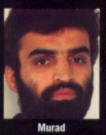
agents who are questioning Ramzi Yousef's
partner, Abdul Hakim Murad, as he was being
extradited back to the U.S. on a plane. The interrogation
was memorialized in this seventeen page memo that they
call a "302 Form." In the memo it states
"Murad advises that Ramzi Yousef wants to
return to New York to bomb the World Trade Center
a second time." It's right there in black and white,
in April, 1995. So when Director Mueller made that
statement, Colleen Rowley and her co-workers
in Minneapolis were so shocked that she dashed off
a twelve page letter to him, criticizing his statements.
Only after this letter was made public, did Mueller
announce these reforms. On February 26, 2003,
prior to the invasion of Iraq, she wrote him another letter
saying (and I'm paraphrasing) she had grave concerns
that the agency would not be able to meet the increased
level of danger that would come at the country after
we invaded Iraq. She said she was not sure if
he, as Director of the FBI, had communicated this
to the President. This is coming from the inside.
I can give you a quick recap of a dozen reasons why
I believe we are at greater risk. Saddam Hussein was a
despot, but he was a self-contained despot who directed
his villainy towards his own people. We know now, that
despite the allegations of the Bush administration prior
to the invasion, there was next to no evidence of any
weapons of mass destruction, no evidence that America
was in imminent danger from Iraq and literally no evidence
of any al-Qaeda connection. Iraq certainly had no connections
to 9/11 (which the White House has stated recently).
There was a training camp in Northern Iraq that was in
Kurdish-held territory (not even Saddam's territory),
there was one al-Qaeda member who had medical
treatment in Baghdad, but in terms of any significant
proof that Saddam Hussein had been in league with
bin Laden or had any direct connection to 9/11 has
never been found. We've been on the ground for five
months and, believe me, if there was a single piece of
paper proving that found in Iraq, it would be on the
front page of the
Washington Times.
We now know that the very reason that
Americans supported the invasion was based on faulty
intelligence. There are also the lies that have been documented
about the alleged importing of uranium (which turned
out to be a forgery.). So here's the situation now.
We have a protracted guerrilla war. Our brave men and
women are now in harm's way. Our service people are
subjected to daily life-threatening
situations where the front is all around them now, as
it was in Vietnam. There is no clearly defined
enemy. You have a virulent anti-American Shiite
majority. And you have the prospect that if in fact
democracy is restored to that country, they will vote
in an Iran-like or Taliban-like anti-American radical
Islamic regime that will be much more likely to
ally itself with al-Qaeda than ever before. You now
have evidence of al-Qaeda operatives entering Iraq
to ally with the Baath party members, where
before, Osama bin Laden, the Blind Sheikh and
Ramzi Yousef
hated Saddam Hussein.
The last moment of Ramzi Yousef's public career
was at the end of his trial. He went out of his
way to condemn Saddam Hussein as a secular
Islamic leader. The Sheikh was booed off a
pulpit in a mosque in Brooklyn in 1991 for
condemning Saddam Hussein for the invasion
of Kuwait. So these guys, after Israel and the U.S.,
they put Saddam Hussein as #3 on their enemies
list, prior to the invasion. But now the Arab street
has united against the United States as a result of
the invasion. Therefore to me, the danger is
exponentially greater.
After 9/11, the White House never came out and
blamed the FBI. In fact, it went out of its way to
praise them and the CIA publicly. But, President
Bush then immediately turned around and created
the Office of Homeland Security, which was clearly
a slap in the face of both the CIA and the FBI, saying
"you can't get it done, obviously, we need a new
agency." How do the agencies all work together now? Is it
working or has it just created a giant bureaucracy?
|
"The FBI never should have been given this job of
defending America, protecting America against
domestic terrorism. The FBI is in the business
of solving crimes, after the chalk mark is on the ground.
Even with that job, they've had a lot of foibles
over the years. But at least they know how to
do that. The way it works is this. You get ahead
in the Justice Department and the FBI by making
cases, by getting convictions, not stopping crimes
before they happen. One of the biggest problems
they've had over the years is treating these incidents --
the first Trade Center bombing, the murder of Kahane,
the Day of Terror plot, Project Bojinka -- they
treated them as a series of legal cases that could
be taken one at a time, they get a conviction, they
get a long sentence for these guys, and they figure
that the threat is over. They weren't stepping back
and looking at this as the political threat that it was.
It was a war and they were treating it as a series of
legal cases. But that's the nature of the FBI and
the Justice Department, that's what they do."
|
The new setup helps with communication between the
various agencies. I think one positive step for homeland
security is that we would hope that now if someone's
name shows up on a watch list, the FAA, the INS, Customs,
the FBI, CIA, NSA -- everybody in the big 5 --
finds out about it instantly. If they don't have that by now,
then Americans should be terrified. One would hope that
step has already been taken. However, with respect to intelligence,
the forward-thinking foresight as to what the threat is,
e.g., perceiving the threat
before something happens,
and interdicting it, the Homeland Security Office has
no independent intelligence-gathering capabilities.
They rely on the Bureau and the CIA. If you want an
example of how good the CIA has gotten since 9/11,
just look at the road to Iraq. All of the faulty
intelligence on Iraq has been blamed on the CIA.
I've already spoken as to where the Bureau stands.
There haven't been any significant reforms and Director Mueller
has directed about 20% of the personnel in the FBI,
instead of working on drug cases (which they shouldn't
be working on anyway, since that is the DEA's job)
he directed them towards terrorism. But you don't
change the fundamental culture of an agency overnight.
The FBI never should have been given this job of
defending America, protecting America against
domestic terrorism. The FBI is in the business
of solving crimes,
after the chalk mark
is on the ground. Even with that job, they've had a lot of foibles
over the years. But at least they know how to
do that. The way it works is this. You get ahead
in the Justice Department and the FBI by making
cases, by getting convictions -- not stopping crimes
before they happen. One of the biggest problems
they've had over the years is treating these incidents --
the first Trade Center bombing, the murder of Kahane,
the Day of Terror plot, Project Bojinka -- they
treated them as a series of legal cases that could
be taken one at a time. They get a conviction, they
get a long sentence for these guys, and they figure
that the threat is over. They weren't stepping back
and looking at this as the political threat that it was.
It was a war and they were treating it as a series of
legal cases. But that's the nature of the FBI and
the Justice Department, that's what they do.
The Secret Service is totally different. There are
men and women in the Secret Service that you
will never hear about, because they have interdicted
threats before they happen. They have a completely
different way of measuring success than the Bureau.
The Bureau is just the wrong agency to be fighting
terrorism. I am telling you, Joe O'Brien, a very sharp
guy who is very conservative, he wears a "No Spin Zone"
hat from Bill O'Reilly, he's not even remotely
moderate, let alone liberal, and he has embraced my
book and what I've tried to do. He's a veteran FBI agent
who has said to me, "Peter, I've talked to people inside
and outside the agency and I'm telling you they still don't
get it." That's a terrifying thing to hear from a veteran
FBI agent from the New York. office. The New York office,
on which I lay most of the culpability on in my book,
is the office of origin for all the bin Laden cases. The Joint
Terrorism Task Force was from the New York flagship
office. In September, 2000, they had a 20th anniversary party to
pat themselves on the back for how great they were
and how many convictions they had gotten over the
years. Guess where the party was? Windows on the
World, the restaurant at the top of the north tower of
the World Trade Center. While these feds were sitting
around drinking martinis and celebrating their great
victories, the cohorts of Ramzi Yousef and Kalid Sheikh
Mohammed were sleeping on mattresses on 54 Marionstrasse
in Hamburg, Germany, plotting to take down those
very buildings where those people were celebrating.
That's unbelievable. In light of recent tapes which appear
to show bin Laden tripping along on an afternoon ramble
in the mountains, looking pretty spry for a guy with kidney
problems, as a practical matter, how do these terror
cells work? How does the money flow? It seems
like Kalid Sheikh Mohammed had a lot of
freedom in what he did.
|
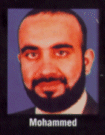
Well, they called Kalid Sheikh Mohammed
"The man with the ignition key." He
was considered the Chief Operating Officer
of al-Qaeda; he was a brilliant strategic planner.
Ramzi Yousef, his nephew, was the chief
point man for four years, the chief
detonator, if you will, of bin Laden's
strike force worldwide. He is an absolute
engineering genius. Al-Qaeda operates
with many terror groups, as a series of cells.
The cells operate on a "need to know" basis,
and that's why they are so difficult to fight.
The problem with the Bush administration is
that they've treated the war on terrorism the way
local TV stations treat crime: they shoot the chalk mark.
That's easy to do. You go in, you shoot the body,
you do a couple of talking head interviews: covering
crime and the origins of crime is much more difficult.
The Bush administration clearly had to invade
Afghanistan. It was a haven for al-Qaeda and the
Central Command. It was also a terrible regime,
which was extremely violative of human rights.
Because of al-Qaeda's presence there, Afghanistan
was a direct threat to the security of the United
States. So they had to go in to Afghanistan. But with
respect to Iraq, taking out leaders is easier because
you have a military objective that you cam accomplish.
I'm very praiseworthy of the U.S. military. Since
Vietnam, they have had so much improvement with
the efficiency with which they fight a war,
the collateral damage is down, the number of
POWs and casualties are down. They really
have learned the lessons of Vietnam. Unfortunately,
our intelligence agencies have not. They still have
this old mentality. People don't realize how the CIA
really works. When
someone talks about a CIA operative or a case officer,
do you know what CIA case officers actually
do
overseas? They basically recruit assets. The notion of a spy
going undercover is just wrong. Even the kind
of undercover operation that the FBI ran to get the
Mafia doesn't exist in the CIA. What the case officer
does is to go into another country, hopefully he's
fluent in the language, but that's not always the
case, and he then tries to recruit foreign nationals
to betray their country. He asks them to go in as
double agents. A huge number of these guys
are really triple agents. They don't betray their
country at all. So our CIA is really getting second
hand information. It's not like the operative is
actually undercover. The absolute methodology
of the HUMINT (Human Intelligence) by the
on the ground spies is
archaic as it was the day it was founded as a legacy
of the OSS, which is really ancient. Of course,
we do have more modern mechanisms like,
ELINT, electronic surveillance, and PHOINT,
which is from satellites, but as has been pointed
out by a few conservatives after 9/11,
the decimation of the human spy element in the CIA
is what blinded us to 9/11. To this day, as far as I know,
there have been no significant inroads made in the
ability to penetrate the al-Qaeda organization.
So you would not agree that we have "broken the back" of
al-Qaeda?
No, we have not broken the back of al-Qaeda.
In fact, the FBI has declared victory over al-Qaeda a number
of times. Remember Dale Watson, the #3 guy in the FBI
who in 1998 minimized the threat from al-Qaeda? He's the
guy that twice in 2002 made statements that
bin Laden was dead. When Kalid Sheikh Mohammed
was arrested in March, they said they had broken the back
of al-Qaeda, then after the Gulf War II, there were these
spectacular attacks by al-Qaeda in Saudi Arabia and
Morocco. Every time they arrest one of these guys,
they say al-Qaeda is finished. We keep picking up
important people, such as the Indonesian cleric they arrested two
weeks ago who was tied to the Bali bombing. He was
at the January, 2000, surveillance
meeting about 9/11. We keep picking these guys
up, but somehow their bench strength seems to
be quite significant.
So we have Osama bin Laden and Ayman al-Zawahiri,
on the run. As a practical matter, do you and your
sources think they are still plotting against us?
How do they communicate, as a practical matter?
Or is Osama just a figurehead to inspire terror?
|
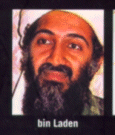
No, absolutely not -- he's not just a figurehead.
I believe that when we get
bin Laden, that we will make a geometric leap
forward in the war on terrorism. Because, not only
is he a billionaire, he is internationally capable.
Before he turned to radical Islam, bin Laden
was an international businessman. He was actually
involved with the BCCI -- the Bank of Credit
and Commerce. He traveled the world as an
international entrepreneur. He had connections
all over the world, he learned how to move money,
munitions, arms and large scale construction
equipment. So he was so capable. They believe that
he's holed up in some area of Afghanistan, I believe
that he's maybe in Baluchistan, some people have
actually said that he may have crossed the border
into China. In any event, these guys communicate
with a low tech system. That's why they are such
a big threat. They stay under the radar. They have
years and years to plan. We now know that they
began planning the attacks of 9/11 in the Fall of 1994.
That's how long 9/11 was in the works.
"There was a tendency to treat incidents
like these as individual criminal acts to
be handled primarily through law enforcement.
Ramzi Yousef, who perpetrated the first attack
on the World Trade Center, is the best case in
point.
The U.S. government tracking him down, arrested
him and got a conviction. After he was sent off
to serve a 240-year sentence, some might have
thought, 'Case closed.' But the case was not
closed. The leads were not successfully followed.
The dots were not adequately connected. The
threat was not recognized for what it was."
--Vice President Dick Cheney, Transcript of Speech at
the Heritage Foundation, October, 2003.
|
The African Embassy bombing had been planned
for three or four years. So they have the time to wait
us out. That is what is so terrifying about it.
What I wish is that the FBI and the CIA would
do a wholesale national recruiting campaign
for middle eastern immigrants of Islamic origin
who speak Arabic and speak Uzbeki and Urdu
and the languages that the terrorists speak. That
they would say to these people "We want you --
the patriotic, loyal citizens." There are
people of multi-generations all living in America
loyal to the flag, loyal to our country -- not loyal to
the higher power of radical Islam. They could
be trusted, they could be vetted, they could be polygraphed
and we could embrace those people and send them back
to have them infiltrate al Qaeda, but for some reason to
these day it hasn't happened. There was a story a month
ago in the
New
York Times about one of the top FBI agents who speaks
fluent Arabic (he is one of the few people who can
actually conduct a polygraph in Arabic) was frozen out
by Dale Watson, the very guy I just described,
who is now retired. That agent did such a good
job on the Khobar Towers investigation while Watson had
told FBI Director Louis Freeh that we were getting nowhere
in the investigation. This agent
went to Saudi Arabia and had incredible success.
Watson apparently felt threatened and basically put a
cloud over this man's career. That is what has been alleged, in
any event. So this guy has been frozen out. This is one
of the most important guys that we need right now in the
Bureau and this guy has a cloud over his career.
Was there any evidence that turned up during your
investigation that some of the slip up may not have
been incompetence -- that they may have been something
a little bit more sinister?
Yes, that's a very good question. When I interviewed
Col. Rodolfo Mendoza, the interrogator of Yousef's
partner Murad, some interesting things came out.
I think I did the most extensive
interview on audio and video that any journalist has
done with him. He's the guy that said that as early as
1994 Murad told him that al-Qaeda had six targets including the
Trade Center, Pentagon, Sears and Transamerica towers,
CIA headquarters and a nuclear facility. They had ten
men training in U.S. flight schools at that moment in
1994. He gave all this information to the U.S.
Embassy in Manila. He wouldn't tell me who -- he
didn't want to embarrass whoever it was. But clearly we
know the FBI got it because they mention it in a
Memo which I have a copy of part of in the book.
And
we know that they investigated two of the flight schools.
Murad, Yousef's lifelong friend had been to four US
flight schools in 1991 and 1992. So we know they had
it. I think what happened at that point when they
dropped the ball on 9/11 -- they figured we'll we have
Ramzi for the Trade Center, were going to try him again
for the Bojinka plot. He is going to go away -- it's all
going to be over. But when they started connecting the
dots and they realized that this organization related to
him went all the way back to the original Trade Center
bombing and we haven't even gotten to the story of
Nancy Floyd -- this courageous FBI agent who came
within a hair's breath of stopping the first bombing
by Yousef only to be thwarted by management in
New York. She almost succeeded in capturing and
interdicting the plot, but the Bureau blew it.
Yes, the Nancy Floyd story was very interesting. Her
story and many other interesting stories are covered in
the book. It's an
important book for Americans to read to understand the
threat that faces us today.
Return to the
October 2003 issue of The IWJ.
Penguin Random House Acquires Personalized Gift Book Publisher Wonderbly
2024 Nebula Award Winners Announced
Merriam-Webster Names Polarization 2024 Word of the Year
Winners of the 2024 Kirkus Prizes Announced
Han Kang Wins The Nobel Prize in Literature for 2024