
Children's Book Reviews
Page Three of ThreeMy First Jumbo Book of Things That Go by James Diaz, Melanie Gerth and Francesca Diaz
Scholastic, June, 2003Hardcover, 10 pages
ISBN: 0375810536
Ages 4-6
Ordering information:
Amazon.com
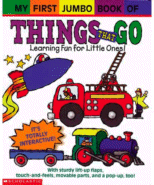 Kids love things that move, especially cars, trains,
trucks, tractors and boats. This book, with its
cute pictures of vehicles, and interactive features
like lift-up flaps, touch-and-feels and pop-ups will
definitely appeal to all the world's young engineering
minds. The large, colorful drawings show each
vehicle in action: the cement truck is pouring
cement, the tow truck is giving a car a tow and
a train is on the tracks. From engine to caboose,
all of the parts of the train are shown. This colorful
interactive book also
provides educational value by asking the young
reader questions like "What loads dirt in trucks?"
The answer, "Dump Truck," is provided
underneath a flap which kids can lift after
trying to first guess the answer from looking at the pictures.
The last two pages feature a huge pop-up
of an adorable dog dressed as a train engineer.
This section of the book lets children sort cards
with the pictures of vehicles on them into the appropriate
slot, for more educational fun. The movable parts of the book are made
of high quality paper, so parents won't have
to worry about their kids breaking or tearing
them after the first or second reading. Kids will
be able to read and play with Things That Go
time and time again.
Kids love things that move, especially cars, trains,
trucks, tractors and boats. This book, with its
cute pictures of vehicles, and interactive features
like lift-up flaps, touch-and-feels and pop-ups will
definitely appeal to all the world's young engineering
minds. The large, colorful drawings show each
vehicle in action: the cement truck is pouring
cement, the tow truck is giving a car a tow and
a train is on the tracks. From engine to caboose,
all of the parts of the train are shown. This colorful
interactive book also
provides educational value by asking the young
reader questions like "What loads dirt in trucks?"
The answer, "Dump Truck," is provided
underneath a flap which kids can lift after
trying to first guess the answer from looking at the pictures.
The last two pages feature a huge pop-up
of an adorable dog dressed as a train engineer.
This section of the book lets children sort cards
with the pictures of vehicles on them into the appropriate
slot, for more educational fun. The movable parts of the book are made
of high quality paper, so parents won't have
to worry about their kids breaking or tearing
them after the first or second reading. Kids will
be able to read and play with Things That Go
time and time again.
The Second Summer of the Sisterhood by Ann Brashares
Delacorte Press, April, 2003Hardcover, 373 pages
ISBN: 0385729340
Ages: Young Adult
Ordering information:
Amazon.com
 The Second Summer of the Sisterhood is a sequel
to the bestselling The Sisterhood of the Traveling Pants.
However, there is
no need to have read the first book in order to enjoy
the second one. All the rules for wearing the pants
are printed on a page before the title page, and the
reader is immediately engaged in this fascinating tale
that works out the problems that all teenage girls
experience with wisdom and just a touch of magic.
(Rule one: you must never wash the pants.)
The author's prologue introduces the reader to the
world of a group of girls whose mothers had all
met in the same pregnancy aerobics class and all
were due to deliver in September. Thus the girls
grew up together with a special bond. As young
people still in school tend to do, they all measured
time by summers.
The Second Summer of the Sisterhood is a sequel
to the bestselling The Sisterhood of the Traveling Pants.
However, there is
no need to have read the first book in order to enjoy
the second one. All the rules for wearing the pants
are printed on a page before the title page, and the
reader is immediately engaged in this fascinating tale
that works out the problems that all teenage girls
experience with wisdom and just a touch of magic.
(Rule one: you must never wash the pants.)
The author's prologue introduces the reader to the
world of a group of girls whose mothers had all
met in the same pregnancy aerobics class and all
were due to deliver in September. Thus the girls
grew up together with a special bond. As young
people still in school tend to do, they all measured
time by summers.
There is no item of clothing that has provoked more attention among the young than blue jeans, so it is not asking too much of the reader to believe that a special pair of blue jeans can have a powerful yet individual effect on a group of teen aged girls growing up in the suburbs of Washington , D. C. Blue jeans have united young people around the world, and selecting a pair is definitely a sartorial event fraught with powerful emotions.
The Sisterhood is diverse. Carmen is Hispanic. She lives with her mother in an apartment. Her mother has never married after her marriage fell apart, but Carmen's father married a woman who has a daughter close to Carmen's age. Lena is Greek, and remembers the sad ending to her romance last summer in Greece. Bridget wonders why her father never speaks to her grandmother, who lives in a small town in Alabama. Bridget has lost her interest in her talent for soccer, has stopped exercising and has dyed her blonde hair dark. Tibby is interested in enrolling in a film class at a local college so that she can make a movie about some things very important to her.
Each girl uses the summer to work out various problems. Carmen's mother begins a romance with a lawyer who works in the same firm she does, and Carmen feels uneasy. Lena is overwhelmed when her big romance, Kostos suddenly shows up and is staying with family friends who live close by. Bridget discovers letters and uncashed checks from her grandmother, and Greta and storms at her father for keeping them from her. In disguise, Bridget leaves for a small town in Alabama to get to know her mother's mother from a distance. Bridget assumes another identity so that she can assess what really happened to her mother. Tibby enrolls in the college course and begins to work on her documentary and finds out too late that the detached and unemotional eye of the photojournalist can truly wound loved ones. Throughout the summer the pants are traded back and forth, but they refuse to work exactly as each wearer would like. Nevertheless, as the summer unfolds, each girl in the sisterhood makes a life change.
Reading a book about a group of girls who share their growing up years will delight younger readers and will bring back poignant memories to older readers.
--Sarah Reaves White
The Wolves in the Walls by Neil Gaiman, Illustrated by Dave McKean
HarperCollins, August, 2003Picture Book, 56 pages
ISBN: 038097827X
Ages 5 and up
Ordering information:
Amazon.com
 Lucy is a sensible girl and when she hears noises
coming from inside the walls - "sneaking, creeping
crumpling noises" - she knows it's the wolves. But her
mother and father dismiss her fears. For as everyone
knows, "If the wolves come out of
the walls, It's all over." Although no one ever explains
what "it" is, certainly "it's all over" sounds dire.
Her mom continues to make fresh strawberry jam and
her father continues to play his tuba, unaware of the
frightening events that are about to overtake their family.
For one night, the wolves do come out of the walls
(just as Lucy predicted) and the family ends up huddled
at the bottom of the garden, homeless. For the wolves are
eating all the strawberry jam, playing her dad's second-best
tuba and having a riotous party and generally making quite a nuisance
of themselves. It is up to Lucy to be the brave one and sneak
into the house to rescue her beloved pig puppet, who was left
behind in the rush to escape. After Lucy does some initial
reconnaissance, she convinces
her family to sneak into the walls of the house. Soon after,
they come out of the walls, and the wolves run
for their lives shouting, "Flee! For once the people come out
of the walls, it's all over."
Lucy is a sensible girl and when she hears noises
coming from inside the walls - "sneaking, creeping
crumpling noises" - she knows it's the wolves. But her
mother and father dismiss her fears. For as everyone
knows, "If the wolves come out of
the walls, It's all over." Although no one ever explains
what "it" is, certainly "it's all over" sounds dire.
Her mom continues to make fresh strawberry jam and
her father continues to play his tuba, unaware of the
frightening events that are about to overtake their family.
For one night, the wolves do come out of the walls
(just as Lucy predicted) and the family ends up huddled
at the bottom of the garden, homeless. For the wolves are
eating all the strawberry jam, playing her dad's second-best
tuba and having a riotous party and generally making quite a nuisance
of themselves. It is up to Lucy to be the brave one and sneak
into the house to rescue her beloved pig puppet, who was left
behind in the rush to escape. After Lucy does some initial
reconnaissance, she convinces
her family to sneak into the walls of the house. Soon after,
they come out of the walls, and the wolves run
for their lives shouting, "Flee! For once the people come out
of the walls, it's all over."
Neil Gaiman, bestselling author of American Gods, Coraline and The Day I Swapped My Dad for 2 Goldfish, has two little girls of his own and he knows how they think. His heroines, such as Coraline and Lucy, are intelligent children who work things out in their own way, in their own time. They tend not to scare easily and think that grownups do some very odd things indeed. Gaiman's children's books are meant to be read aloud: it is then that his true mastery of words, phrasing, sounds and rhythms becomes so apparent. Award-winning artist Dave McKean (probably best known for his work on Gaiman's Sandman series) does a marvelous job with the artwork, using mixed media: collages, photographs and scratchy pen and ink drawings for the scenes where the wolves run amok. He occasionally uses a four-panel style layout, borrowed from graphic novels which adds to the richness and depth of the story. In fact, the illustrations are quite scary, which make a nice contrast for the matter of fact tone that Gaiman uses to relate the inventive and creepy narrative.
Some themes are beginning to emerge from Gaiman's growing body of children's books: the intelligence of the child which is often ignored or overlooked by adults, the fact that many adults don't really listen to what children are saying, children's routine acceptance of things that adults would find frightening or bizarre, the fact that the world really is a pretty scary place and that bravery is something that will keep one in good stead throughout life. Neil Gaiman continues to surprise readers, not only with his prolificacy, but with his depth of talent.
--Claire E. White
Children's Book Reviews
Page One | Page Two | Page Three
Return to Book Reviews Index
Return to the October 2003 issue of The IWJ.
More from Writers Write