
The Problems of eBook Publishing
by Paul Papanek Stork
Click here for Part I of this series, The Promise of eBook Publishing.
|
There are also obstacles that must be overcome if eBooks are to become widely accepted. Many of the advances in technology discussed above are not yet mature and some of the advantages bring their own inherent problems. There is also the traditional problem summed up in the seven words “We never did it that way before.” Just like the promise of eBook publishing, the problems of eBook publishing do not apply uniformly to all platforms, formats or groups. The obstacles to eBook publishing can be broken down into resistance to change, font issues, lack of a standard format, digital rights management, reproduction of graphics, and reader hardware.
Resistance to Change
I am an unrepentant technical gadget “junkie”. I'm always looking for the newest technological gadget to try out, just because it's new. Not everyone is like that. Many, if not most, people avoid making changes in their core habits. They may try something new for a period of time, but rarely look forward to adopting radical changes in the way they do things. Reading eBooks is one of those kinds of changes. Instead of a traditional paper based book that readers can see and feel, eBooks are an electronic medium. They have no physical representation unless you are storing them on a disk or CD-ROM. Even the act of reading has changed. Try “curling up with a good book” when you are reading books online or with a laptop or desktop computer. As mentioned in portability above, many of the readers are not as portable as a regular book. Their advantage comes from being capable of storing a whole library of books in a fraction of the space. Even when a reader is small enough and light enough to be portable, the act of reading is altered. No more turning pages, now it's scrolling. Some readers have tried to approximate the current experience by adding the sound of a paper page turning when you move from one page to the next, simply to minimize the jarring difference of the new experience. The very enhancements that make eBooks a potentially superior reading experience will keep may people from switching.
Font Issues
Fonts are both an advantage and a disadvantage for eBooks. The ability to resize fonts to fit the needs of the vision-impaired reader is an advantage. However, fonts on a computer screen at sizes equal to those used in printed materials are not as easy on the eyes.
Characters on paper are analog, but characters on an LCD screen or monitor are digital. The outline of characters printed on a page are smooth, but characters on a monitor are made up of little dots spaced into a pattern which our eyes have come to recognize as a printed character. It's like comparing output from an old dot matrix printer to a laser printer. Laser printers print at 300, 600, or even 1200 dpi (dots per inch). Compare that to a monitor or LCD screen that operates at about 72 dpi. Characters on a computer screen are not as easy to read as characters on a printed page. The difference in the quality of fonts can lead to eyestrain when reading eBooks.
Some eBook vendors are actively looking for ways to enhance the resolution of fonts on eBook software and hardware. Figure 1.b below shows a magnification of two views of text on a computer screen. The top half of the figure shows text displayed with a normal computer font. The bottom half shows the same text on Glassbook Reader with sub pixel rendering of the font turned on. Sub pixel rendering creates an optical illusion of a better font quality than is currently possible with an LCD screen or monitor. Microsoft Reader also uses this type of technology.
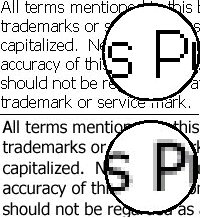
Figure 1.b:
Sub Pixel Rendering
Typography is another font problem faced by eBooks. Some eBook formats allow text to be reformatted to fit the physical dimensions of the eBook reader. For many types of content, this is an advantage. But in some books, the way text is arranged on the page is part of the message of the book. Imagine reading the poetry of e.e. Cummings or the mouse's tail passage from “Alice in Wonderland” with the words words just jumbled together on the page. In many books controlling the formatting of the type on the page is a necessity. This is very difficult, if not impossible, in some eBook formats.
Lack of a Standard format
Imagine trying to read a book if there was no agreement on how to put the words on a printed page. Should they be printed as black on white or white on black. Should they run left to right or right to left. Maybe they should be printed from top to bottom. Should a printed book be bound together or just loose pages. Should it open from the top, the left or the right? Without agreement on these simple standards, reading would be a definite adventure. The problem is many times worse in the eBook publishing industry. Lack of a single overriding standard means that authors, publishers, and even readers must choose what format they will support.
We've seen that different combinations of hardware and software are better or worse for different types of content. That guarantees that there will be multiple formats supported by different vendors trying to take advantage of specific markets. For example, the Rocket eBook from NuvoMedia uses a relatively small black and white screen to enhance portability and minimize price. These are advantages if you are marketing primarily to recreational readers. Softbook Publishing's reader has a single 8” X 11” color screen, which is more expensive but better suited to reproduction of more demanding reading material like textbooks. Each reader has their own format. Rocket eBook is a binary format based on HTML and Softbook Publishing uses a format based on Adobe .pdf. An attempt has been made to create a single universal standard called the Open eBook specification, but many vendors still prefer .pdf.
Digital Rights
Management (DRM)
Protecting an author's copyright is one of the prime concerns when distributing books via electronic format. Similar concerns were raised about traditional books when copiers became commonly available. Although copying an entire book is now possible, the cost and inconvenience of doing it manually has kept this type of piracy to a minimum. But when copying is as easy as duplicating a file, piracy becomes a major problem. Current struggles by performers and the music industry over the MP3 format is a preview of what could happen in eBook publishing. The music industry has been trying to combat the problem by lobbying for inclusion of encryption protection in the MP3 standard. However, even encryption is not a guarantee. As mentioned in the introduction to this chapter, it took less than 48 hours before the encryption on Stephen King's eBook Riding the Bullet to be broken. Some method of securely distributing eBooks and preserving the copyrights and royalties of authors is essential if eBooks are to flourish. Adobe, Xerox, and Microsoft are just a few of the companies currently working on this problem.
Encryption and secure distribution are important parts of the solution to Digital Rights Management, but they also cause other problems. Documents encrypted to be read on one device can't be copied to another device. What happens if you wish to lend an eBook to a friend after you've finished reading it? How will lending libraries be created and operated? What happens if you upgrade your reader hardware or software? Flexible mechanisms must be created that protect the rights of authors and publishers without burdening the consumer. Some vendors are already working on ways to securely “lend” a copy of an eBook by transferring it to another reader.
Reproduction of Graphics
Full color graphics, complex tables, and figures are not easily reproducible on small screens. Some eBook formats don't even support the inclusion of images. In order to lower the price and increase battery life some eBook hardware uses only a black and white screen. All of these factors make reproduction of graphic elements on many eBooks a challenge. For many types of content, such as fiction, this is a minor inconvenience. But for technical publications and textbooks, inclusion of graphics is a necessity.
Some potential solutions include using a thumbnail graphic with a hyperlink in place of a full graphic. This allows the reader to view the graphic full size on a small screen without intruding on the text. A zoomed in view with scrolling is another way to allow the use of a graphic, table or figure that is larger than the screen of the eBook device. Most of the eBook formats that don't currently support graphics are also looking at ways to enhance their standards to allow the inclusion of graphic elements. The one limitation that seems here to stay is the one imposed by Black and White screens. But just as the declining price of color televisions marked the obsolescence of Black and White TVs, the declining price of color LCDs should allow the next generation of eBook devices to offer color at a reasonable price. The recent release of the new Palm IIIc and color Pocket PCs are a perfect example.
Reader Hardware
The final problem associated with eBooks is Reader hardware and software itself. eBook readers range in size from a small handheld PDA to a desktop computer and dedicated readers are relatively expensive when compared to the price of a book. Readers range from PDAs and dedicated readers costing $150-$200 to full Personal computers, laptops, and some dedicated readers costing thousands. The price of readers continues to be a major roadblock to the expansion of eBook publishing. Of course, many people already own personal computers and laptops, but the change in habits required by these devices has already been mentioned as a problem (see Resistance to Change above).
Finally, the variety of incompatible hardware, software, and formats also leads to a problem. Since many eBook formats are not interchangeable, a consumer must choose carefully when purchasing a platform or they might not be able to read the books that they want. Publishers must also go to the added expense of creating books in multiple formats or forgo whole sections of the eBook marketplace. For example, this book will be published in three or four different eBook formats in an effort to maximize coverage of the eBook market.
Summary
eBooks are not for everyone and they won't replace traditional publications tomorrow. But more people take notice of their potential everyday. Many traditional publishers and vendors are looking for ways to expand into the eBook marketplace.
- Time Warner Trade Publishing recently announced iPublish, where they will actively solicit and support authors who would like their work published in eBook format.
- Barnes and Noble recently opened a section of http://www.barnesandnoble.com that deals exclusively with eBooks.
- Microsoft made their Reader software one of the key applications on their new Pocket PCs.
Other vendors, publishers, and authors will surely follow suit. EBooks promise a new age of reading pleasure, but there will be bumps in the road, especially for early adopters. The rest of this book will attempt to look at the technological foundations on which the eBook publishing business stands. We will examine the following:
- What is the history of the industry that led us to this point.
- What are the strengths and the weaknesses of eBook formats currently being used and refined.
- What are the key technologies currently being developed which will affect the future of the industry.
 **Paul Papanek Stork is a Senior Lecturer and Director of the E-Ideas Lab for
Weatherhead School of Management at Case Western Reserve University. Paul has an MBA from
Weatherhead and is a Microsoft Certified Trainer, a Microsoft Certified Systems Engineer
plus Internet, and a Certified Novell Engineer with more than 14 years experience
designing, implementing and supporting Microsoft and Novell Networks. Prior to his
appointment as a lecturer at Weatherhead in January of 2000, Paul was an active member of
Microsoft's Windows 2000 Rapid Deployment Program for DeCarlo, Paternite, and Associates,
Inc. As a staff instructor at DPAI he was one of the first MCTs in the Midwest to teach
Beta classes on Windows 2000 to other trainers and network engineers.
**Paul Papanek Stork is a Senior Lecturer and Director of the E-Ideas Lab for
Weatherhead School of Management at Case Western Reserve University. Paul has an MBA from
Weatherhead and is a Microsoft Certified Trainer, a Microsoft Certified Systems Engineer
plus Internet, and a Certified Novell Engineer with more than 14 years experience
designing, implementing and supporting Microsoft and Novell Networks. Prior to his
appointment as a lecturer at Weatherhead in January of 2000, Paul was an active member of
Microsoft's Windows 2000 Rapid Deployment Program for DeCarlo, Paternite, and Associates,
Inc. As a staff instructor at DPAI he was one of the first MCTs in the Midwest to teach
Beta classes on Windows 2000 to other trainers and network engineers.
Excerpted from eBook Publishing: Standards and Technologies, by Paul Papanek Stork. Reprinted by permission. © 2000 New Riders, Inc. All Rights Reserved. No part of this excerpt may be reproduced or reprinted without permission in writing from the publisher.
Return to the December-January 2001 issue of The IWJ.