
Reviews of Writing Books
Do The Write Thing by Kwame Alexander with Nina Foxx
Manisy Willows Books, January, 2002Hardcover, 123 pages
ISBN: 0967895960
Ordering information:
Amazon.com
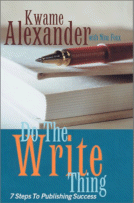 This concise book spells out what beginners looking
to self-publish need to do. In an easy-to-follow manner
the book lays out common sense approaches to essential tasks,
such as getting the book written, fine-tuning what you
have written, creating a publishing company, designing
your book's cover, printing your book and
marketing and selling your book. The book includes
anecdotes, examples and tips to help writers understand
the important steps of hiring an editor, obtaining ISBN numbers,
preparing your book for the printer and
creating a press kit. The book also includes
sample worksheets to help writers complete their book
and get it published. Recommended reading resources
are also provided for writers that need additional information.
The friendly, informative
writing style in this book will be most appreciated
by writers who are new to self-publishing. Highly
recommended for the self-publishing novice.
This concise book spells out what beginners looking
to self-publish need to do. In an easy-to-follow manner
the book lays out common sense approaches to essential tasks,
such as getting the book written, fine-tuning what you
have written, creating a publishing company, designing
your book's cover, printing your book and
marketing and selling your book. The book includes
anecdotes, examples and tips to help writers understand
the important steps of hiring an editor, obtaining ISBN numbers,
preparing your book for the printer and
creating a press kit. The book also includes
sample worksheets to help writers complete their book
and get it published. Recommended reading resources
are also provided for writers that need additional information.
The friendly, informative
writing style in this book will be most appreciated
by writers who are new to self-publishing. Highly
recommended for the self-publishing novice.
The Writer's Handbook 2003 edited by Elfrieda Abbe
The Writer Books, September, 2002Paperback, 1054 pages
ISBN: 0871161966
Ordering information:
Amazon.com
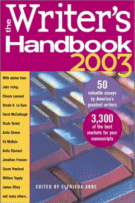 The Writer's Handbook is an annual guide for writers which is
packed with practical advice and places to submit your
writing, whether it is an article, poem, short story,
or novel. Each year the guide includes
updated market listings, new articles and lists of current
conferences, contests and writing workshops.
This first part of this year's edition includes interviews
with Jonathan Franzen, John Irving, Sue Miller,
Anita Shreve and other bestsellers. Valuable advice
that both inspires and informs is contained in essays
from Terry McMillan, Elmore Leonard, Ursula Le Guin,
Vanessa Grant and others. The second part of the
book contains the market listings, which also include
listings for conferences, colonies, prizes and awards.
In addition to a large number of
fiction and nonfiction markets, the
book also includes markets for other types of manuscripts,
including greeting card publishers, play publishers,
syndicates and television and film products.
The markets listings themselves are brief, but contain
all the necessary details such as contact information,
needs of the publisher, payment information and
tips for writers.
The Writer's Handbook is an annual guide for writers which is
packed with practical advice and places to submit your
writing, whether it is an article, poem, short story,
or novel. Each year the guide includes
updated market listings, new articles and lists of current
conferences, contests and writing workshops.
This first part of this year's edition includes interviews
with Jonathan Franzen, John Irving, Sue Miller,
Anita Shreve and other bestsellers. Valuable advice
that both inspires and informs is contained in essays
from Terry McMillan, Elmore Leonard, Ursula Le Guin,
Vanessa Grant and others. The second part of the
book contains the market listings, which also include
listings for conferences, colonies, prizes and awards.
In addition to a large number of
fiction and nonfiction markets, the
book also includes markets for other types of manuscripts,
including greeting card publishers, play publishers,
syndicates and television and film products.
The markets listings themselves are brief, but contain
all the necessary details such as contact information,
needs of the publisher, payment information and
tips for writers.
This year's edition of the Handbook contains over 3,300 potential markets for writers. It also contains some excellent advice from bestselling authors, covering subjects writers often have questions about: rights, queries, clips, point of view, writer's block, marketing and research. Writers looking for a large collection of both professional advice and good paying markets in one source can't go wrong with the always-reliable Writer's Handbook.
Writing for the Information Age by Bruce Ross-Larson
W.W. Norton & Company, September, 2002Hardcover, 192 pages
ISBN: 0393047865
Ordering information:
Amazon.com
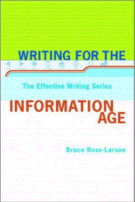 Technology has created so many new ways to present information
that writers have had to take advantage of these
new options in order to entice readers.
Bruce Ross-Larson, founder of the American
Writing Institute and president of Communications
Development Incorporate, provides techniques for
grabbing an audience in the computer world
in Writing for the Information Age.
As Ross-Larson suggests, "Today's
impatient readers pay attention mainly to writing that
engages them -- to writing that allows them to find
quickly and easily what might be of interest."
The focus of the book
is teaching you how to best organize and present information
and link ideas across different media. The book has a
unique and easy-to-use
organizational structure. Each technique in the book is
covered in a two-page spread, which both explains the technique
and gives several examples of the technique in use. The
technique listings are cross-referenced to other
techniques. Writers will learn how to
use tools such as word
counts, content generators, document models and
grammar checkers; use attention-sustaining
devices such as short paragraphs,
bulleted lists, tables, graphs and boxes; understand
and utilize structure, including hierarchy, chronicle events,
and sequences; and learn to write effective sentences, paragraphs
and select better words. This is a great tool for
professional writers,
especially those involved with business communications
and information technology.
Technology has created so many new ways to present information
that writers have had to take advantage of these
new options in order to entice readers.
Bruce Ross-Larson, founder of the American
Writing Institute and president of Communications
Development Incorporate, provides techniques for
grabbing an audience in the computer world
in Writing for the Information Age.
As Ross-Larson suggests, "Today's
impatient readers pay attention mainly to writing that
engages them -- to writing that allows them to find
quickly and easily what might be of interest."
The focus of the book
is teaching you how to best organize and present information
and link ideas across different media. The book has a
unique and easy-to-use
organizational structure. Each technique in the book is
covered in a two-page spread, which both explains the technique
and gives several examples of the technique in use. The
technique listings are cross-referenced to other
techniques. Writers will learn how to
use tools such as word
counts, content generators, document models and
grammar checkers; use attention-sustaining
devices such as short paragraphs,
bulleted lists, tables, graphs and boxes; understand
and utilize structure, including hierarchy, chronicle events,
and sequences; and learn to write effective sentences, paragraphs
and select better words. This is a great tool for
professional writers,
especially those involved with business communications
and information technology.
Return to Book Reviews Index
Return to the September 2002 issue of The IWJ.
More from Writers Write