
Reviews of Writing Books
Championship Writing by Paula LaRocque
Marion Street Press, November 2000.Paperback, 206 pages.
ISBN: 0966517636
Ordering information:
Amazon.com.
 Championship Writing provides instruction
and tips for improving your writing. This reference
is a collection of fifty columns which originally
appeared in Quill, the Society of Professional
Journalists' magazine. The articles provide
advice for print and broadcast journalists,
copywriters and business and marketing
professionals. Topics cover some of the most
common areas where problems and errors occur,
including usage,
grammar, quotations, headlines, tense, pronouns,
commas, clichés, analogies, poetic devices
and editing.
Championship Writing provides instruction
and tips for improving your writing. This reference
is a collection of fifty columns which originally
appeared in Quill, the Society of Professional
Journalists' magazine. The articles provide
advice for print and broadcast journalists,
copywriters and business and marketing
professionals. Topics cover some of the most
common areas where problems and errors occur,
including usage,
grammar, quotations, headlines, tense, pronouns,
commas, clichés, analogies, poetic devices
and editing.
Paula LaRocque, assistant managing editor and the writing coach for the Dallas Morning News and a frequent speaker on effective communications, has created an excellent collection of concise writing tips. Her practical articles get right to the point, explain the problem, offer solutions and also include helpful examples. LaRocque's writing aide is a much-needed companion for anyone involved in writing, especially freelancers, journalists and communications' professionals.
The Complete Idiot's Guide to Publishing Science Fiction by Cory Doctorow and Karl Schroeder
Alpha Books, 2000.Trade Paperback, 257 pages.
ISBN: 0028639189
Ordering information:
Amazon.com.
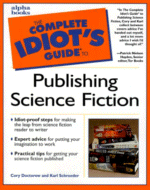 This reference for science fiction
writers provides advice about the
basics of getting started in science
fiction writing, including information
about how to create a manuscript,
how and where
to submit a completed manuscript
and information about networking
and promotional opportunities.
Some of the topics covered include:
writer's groups, characters, short
stories, novels, short story markets,
contracts, writer's organizations,
self-promotion, agents and electronic
publishing.
This reference also provides some
great insight into science fiction
conventions, science fiction awards
and the publishing industry.
The book provides numerous
tips, sidebars and warnings (from
alien and robot icons)
which provide suggestions and
factoids such as,
"Get the word out to local bookstores
and libraries by producing and distributing
a flier with the times, dates and locations of
your book signings, along with your Web
address." and "Hard sf is the subgenre of
sf in which scientific rigor is an absolute
requirement in story-telling."
This is a terrific reference for the beginner
looking to learn more about the process of
publishing a science fiction novel or
short story.
This reference for science fiction
writers provides advice about the
basics of getting started in science
fiction writing, including information
about how to create a manuscript,
how and where
to submit a completed manuscript
and information about networking
and promotional opportunities.
Some of the topics covered include:
writer's groups, characters, short
stories, novels, short story markets,
contracts, writer's organizations,
self-promotion, agents and electronic
publishing.
This reference also provides some
great insight into science fiction
conventions, science fiction awards
and the publishing industry.
The book provides numerous
tips, sidebars and warnings (from
alien and robot icons)
which provide suggestions and
factoids such as,
"Get the word out to local bookstores
and libraries by producing and distributing
a flier with the times, dates and locations of
your book signings, along with your Web
address." and "Hard sf is the subgenre of
sf in which scientific rigor is an absolute
requirement in story-telling."
This is a terrific reference for the beginner
looking to learn more about the process of
publishing a science fiction novel or
short story.
The Science of Science-fiction Writing by James Gunn
Scarecrow Press, November 2000.Trade Paperback, 232 pages.
ISBN: 1578860113
Ordering information:
Amazon.com.
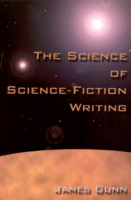 This thorough reference helps writers
get to the heart and soul of science
fiction writing and learn more about
the history of science fiction, its appeal to readers and
how to improve their own science fiction
short stories and novels.
The reference begins with an interesting
chapter on why people read science fiction.
The next section includes chapters on
the art and craft of writing, which covers
finding ideas, heroes, heroines and villains,
creating suspense, characterization, scenes
and dialogue.
The book also
includes profiles of well-known authors
such as H.G. Wells, Heinlein and Asimov. The profiles
explore each of these author's writing styles, how they came
to write science fiction
and what influenced their writing.
The appendix in the book provides a valuable collection
of a student's notes from a science fiction
writer's workshop. The syllabus for the workshop,
including readings and
assignments, is also provided.
This thorough reference helps writers
get to the heart and soul of science
fiction writing and learn more about
the history of science fiction, its appeal to readers and
how to improve their own science fiction
short stories and novels.
The reference begins with an interesting
chapter on why people read science fiction.
The next section includes chapters on
the art and craft of writing, which covers
finding ideas, heroes, heroines and villains,
creating suspense, characterization, scenes
and dialogue.
The book also
includes profiles of well-known authors
such as H.G. Wells, Heinlein and Asimov. The profiles
explore each of these author's writing styles, how they came
to write science fiction
and what influenced their writing.
The appendix in the book provides a valuable collection
of a student's notes from a science fiction
writer's workshop. The syllabus for the workshop,
including readings and
assignments, is also provided.
James Gunn, a science fiction novelist, editor and emeritus professor of English at the University of Kansas, has been involved with the science fiction genre for forty years. He conveys a great deal of his knowledge to the reader in concise form in this book. Gunn's instruction is provided in a helpful tone that both inspires and teaches. He also refers to well-known writers throughout the text, including authors such as Charles Dickens, Ernest Hemmingway, Marion Zimmer Bradley and Larry Niven, to help explain the process of writing. The Science of Science-Fiction Writing is an impressive writer's aide that serious science fiction writers should have on their bookshelves.
Return to the March 2001 issue of The IWJ.
More from Writers Write